"Judicial Reform Should Be Centered on the People, Not Public Officials" – Interview with Kim Gi-won, Vice President of the Seoul Bar Association
- Input
- 2026-01-06 10:44:48
- Updated
- 2026-01-06 10:44:48
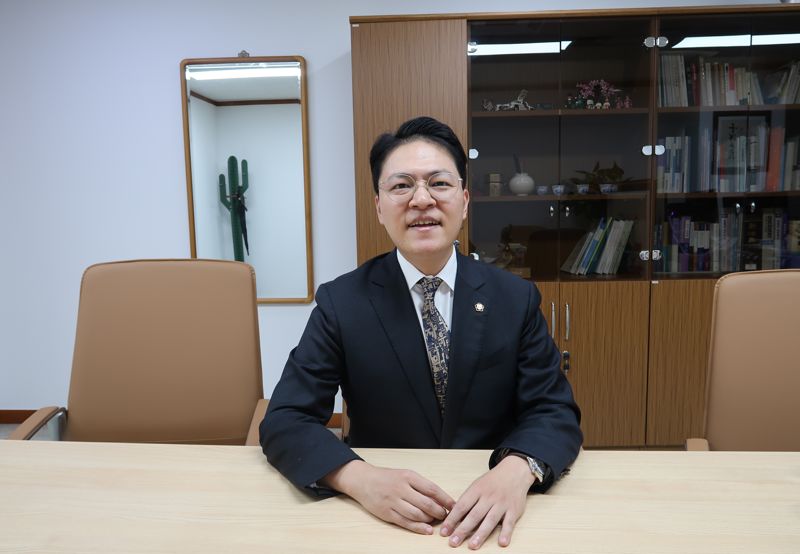
[Financial News] "It is time to shift the paradigm of our judicial system from being magistrate-centered to being focused on citizens and lawyers."
As judicial reform emerges as a key issue for the new year, some argue that discussions must go beyond simply increasing the number of Supreme Court justices and move away from a public official-centered approach altogether. In a recent interview, Kim Gi-won, Senior Vice President of the Seoul Bar Association (5th Bar Exam), stated that the current judicial structure, designed around magistrates such as judges, prosecutors, and police, "fails to truly represent the people and their interests." He emphasized the need to restructure the system to be centered on citizens and the lawyers who represent them.
Kim noted, "A judicial system suited to a pluralistic society is one in which citizens and lawyers are guaranteed real authority and opportunities." He added, "Reform must begin by reasonably distributing the powers currently monopolized by the courts and magistrates."
He specifically pointed out the issue of the courts' near-exclusive authority to investigate past events in civil litigation. Under the current system, most powers—such as witness examination, securing evidence, and on-site inspections—are concentrated in the courts. Unless the court decides to investigate evidence ex officio, it is difficult for ordinary citizens or lawyers to effectively collect evidence from companies or opposing parties.
As a solution, Kim proposed the introduction of a discovery system. "It is extremely difficult for citizens and lawyers to secure evidence in civil cases under the current system," he explained. "We need a discovery system, similar to that in the United States, which grants lawyers investigative authority in civil matters."
Discovery is a procedure that allows parties to obtain relevant materials from the opposing party or third parties before a lawsuit begins, and requires mutual disclosure of evidence. Before a formal trial, parties can directly secure documents and information related to the case, and lawyers can request document production, submit written questions, and record depositions. If a party refuses without just cause, the court may impose sanctions. This system is designed to level the playing field between individuals and corporations when there is an imbalance of information and power.
Kim also stressed the importance of making civil damages more substantial by introducing punitive damages. "The main reason civil litigation is ineffective is that the amount of damages awarded is excessively low," he pointed out. "For companies, even if they lose a lawsuit, it is often easier to simply pay the damages and continue with prolonged litigation." He argued that to shift the focus away from criminal complaints as the primary means of dispute resolution, the level of civil compensation itself must be raised.
Kim cited the so-called 'McDonald's coffee case'—the 1992 U.S. case of Liebeck v. McDonald's Restaurants—as a representative example of both discovery and punitive damages. In that case, 79-year-old Stella Liebeck suffered third-degree burns after spilling McDonald's coffee. Through discovery, internal documents revealed that McDonald's had long been aware of the risks associated with its coffee. As a result, the court awarded $2.7 million (approximately 4 billion KRW) in punitive damages, equivalent to two days' worth of coffee sales.
Meanwhile, the Legislation and Judiciary Committee of the National Assembly recently passed a bill introducing Attorney-Client Privilege (ACP), which prevents investigative agencies from arbitrarily seizing communications between lawyers and their clients. However, Kim emphasized that any expansion of lawyers' authority must be accompanied by strengthened ethical responsibilities. "As lawyers are granted more authority, their ethical obligations must also increase," he stated. "There must be a robust system in place to ensure that those who abuse their authority can lose their qualifications."
[email protected] Choi Eun-sol Reporter