Coupang Also Disregarded '2017 Korea'... We Protected, They Relinquished [Seo's 'Latte' Column]
- Input
- 2026-01-05 16:17:43
- Updated
- 2026-01-05 16:17:43
[Financial News] Practically the entire nation’s personal information has been leaked. Delivery workers have suffered from overwork and industrial accidents. Controversies are ongoing, yet there is neither remorse nor meaningful change.
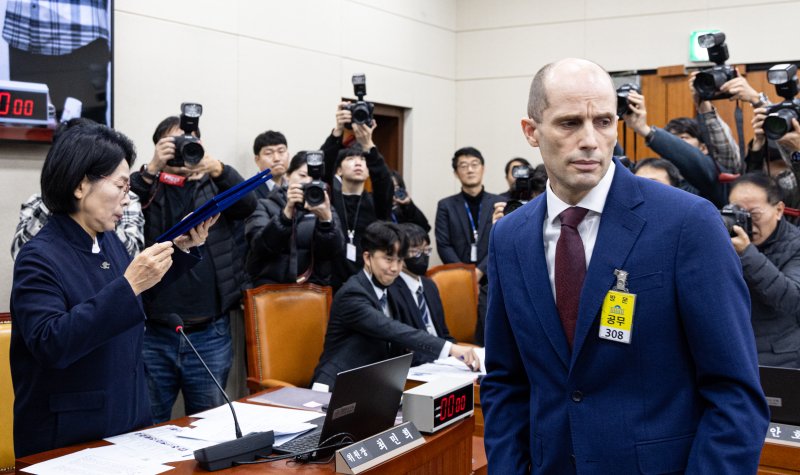
Coupang consistently downplayed the scale of the damage and responded inadequately. During the joint hearing at the National Assembly of the Republic of Korea on December 30–31 last year, the company even displayed a dismissive attitude toward the Assembly and the Korean people.
The bitterness left by Coupang’s attitude was compounded by memories of 2017. At that time, the world witnessed the rise of an unprecedented type of leader in the United States, the global superpower.
The Last Line of Defense: Agricultural & Livestock Products... A Tool for U.S. Lobbying by Coupang
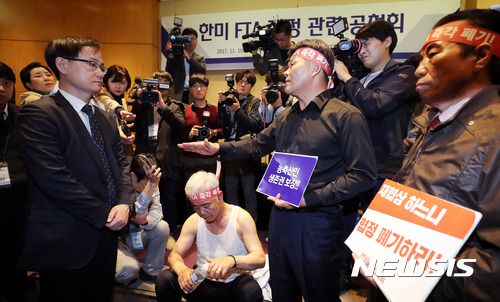
In November 2017, a public hearing organized by the Ministry of Trade, Industry and Energy (MOTIE) at COEX in Gangnam, Seoul, was abruptly halted. The disruption was caused by protestors wearing headbands and holding placards, raising their voices. Media cameras captured the scene.
This was a public hearing for the United States–Korea Free Trade Agreement (KORUS FTA) amendment, and those present were stakeholders from the agricultural and livestock sectors. Their demands were clear: opposition to the renegotiation or abolition of the KORUS FTA and protection of agricultural and livestock products.
Their concerns stemmed from the fact that their counterpart was President Donald Trump. Upon taking office, President Trump declared a tariff war to resolve the chronic U.S. trade deficit. The agricultural and livestock markets, protected during the 2011 KORUS FTA, now seemed at risk in the renegotiations.
President Trump issued an executive order to analyze the causes of the U.S. trade deficit with 16 countries, including China, Germany, Japan, and Korea. He also signed an order imposing punitive tariffs for unfair trade practices.
Additionally, he imposed safeguard measures with high tariffs on solar panels and washing machines produced in China, Korea, Vietnam, Malaysia, and Thailand. Citing national security threats, he invoked Section 232 of the Trade Expansion Act to impose a flat 25% tariff on imported steel.
The KORUS FTA, designed to break down trade barriers and promote economic integration, proved ineffective. After unilaterally withdrawing from the North American Free Trade Agreement (NAFTA) with Canada and Mexico, the U.S. demanded amendments to the KORUS FTA.
As a result, during Trump’s first term, Korea’s steel exports were limited to a tariff-free quota of 2.63 million tons, about 70% of the 2015–2017 annual average (3.83 million tons). This quota remains in place. In the KORUS FTA amendment concluded in March 2018, the removal of the 25% safeguard tariff on Korean pickup trucks, originally scheduled for 2019, was postponed until 2038.
Fortunately, there was no further opening of the agricultural and livestock markets.
This year, the agricultural and livestock sectors are once again on edge. The second Trump administration, which began in January, has signaled an even fiercer tariff war and has disregarded the KORUS FTA.
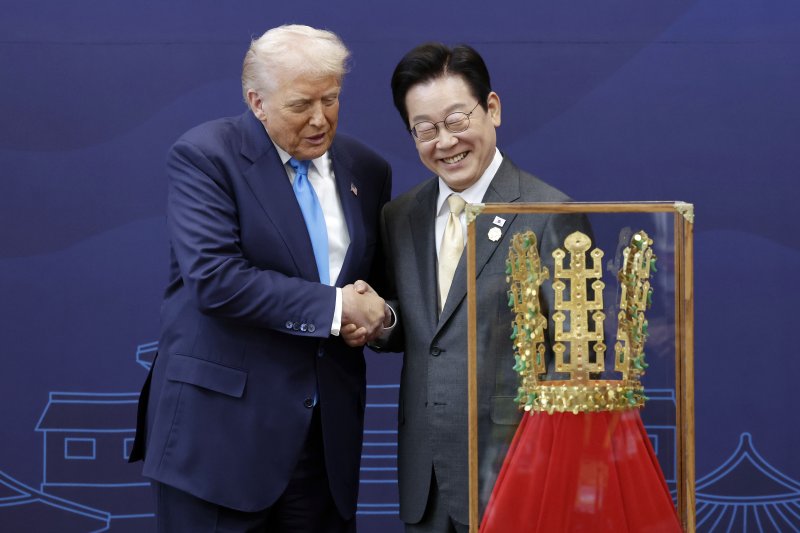
The two countries’ tariff negotiations, which had been at an impasse, were dramatically resolved last October when President Lee Jae-myung met with President Trump during the Asia-Pacific Economic Cooperation (APEC) summit in Gyeongju. It was announced that additional opening of the agricultural and fisheries markets had been prevented.
Time and again, Korea has faced the threat of opening its agricultural and livestock markets, and each time, the government has defended them. Ironically, while Korea has fought to protect these markets, the U.S. has long sought their opening.
In this context, Coupang acted very much like an American company. According to lobbying reports obtained by Munhwa Broadcasting Corporation (MBC) and Joongang Tongyang Broadcasting Company (JTBC), during the third quarter of last year, when tariff negotiations were in full swing, Coupang emphasized to the U.S. Congress that "American agricultural and livestock producers would make greater use of Coupang’s infrastructure." In effect, this meant facilitating the entry of U.S. agricultural and livestock products into Korea via Coupang’s domestic distribution network—essentially opening Korea’s market.
Coupang’s Use of 'English'
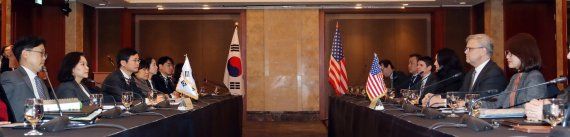
During the first Trump administration, there was another reason for the Korean government’s anxiety at the negotiating table: the language of negotiation—English.
A MOTIE official who participated in the negotiations recalled, "Since we had to negotiate with the U.S., whose native language is English, we constantly communicated and double-checked among ourselves to avoid any linguistic mistakes."
The harsh experience of 2011 proved helpful. When the European Union (EU) FTA text was released, the Korean government faced difficulties over certain English expressions.
For example, the phrase "any product shall be subject to" means that all products are subject to the provision without exception, but the omission of 'any' in the Korean version led to concerns that the scope of application could be narrowed.
At the time, Kim Jong-hoon, then Chief Negotiator for Trade, stated, "We established the principle that the adjective 'any' should not be translated unless absolutely necessary in context. There is no significant issue in the overall interpretation." However, the National Assembly of the Republic of Korea and civic groups disagreed.
A similar issue arose with the KORUS FTA text. In June 2011, the Ministry of Foreign Affairs announced that it had found and corrected a total of 296 errors, including 166 mistranslations, in the Korean version of the agreement. Civic groups, after reviewing the ministry’s findings through a disclosure lawsuit, claimed there were even more errors.
This is why negotiators for the 2017 KORUS FTA amendment were so tense. They needed to prevent repeated controversies over mistranslations or ambiguous expressions. As a result, after the renegotiation was concluded, there were no translation disputes.
Coupang, in contrast to the Korean government’s careful use of English, wielded the language as a weapon or shield.
Regarding the Personal Information Leakage, the Korean statement Coupang posted on its website on December 26 showed subtle differences from the English version. For instance, 'unnecessary anxiety' was rendered as 'false insecurity' in English, and the phrase 'unjust criticism that Coupang did not take the information leakage seriously' was translated as 'false accused.'
They even changed the subject of the sentence. The Korean version stated, 'On December 1, Coupang met with the government and promised full cooperation,' while the English version read, 'On December 1, the government contacted Coupang and requested full cooperation.'
Critics argued that the English statement was intended to give the U.S. the impression that Korea was overreacting to the Personal Information Leakage. In fact, after the apology was released on the 25th, Coupang’s stock price surged 6.45% on the New York Stock Exchange (NYSE).
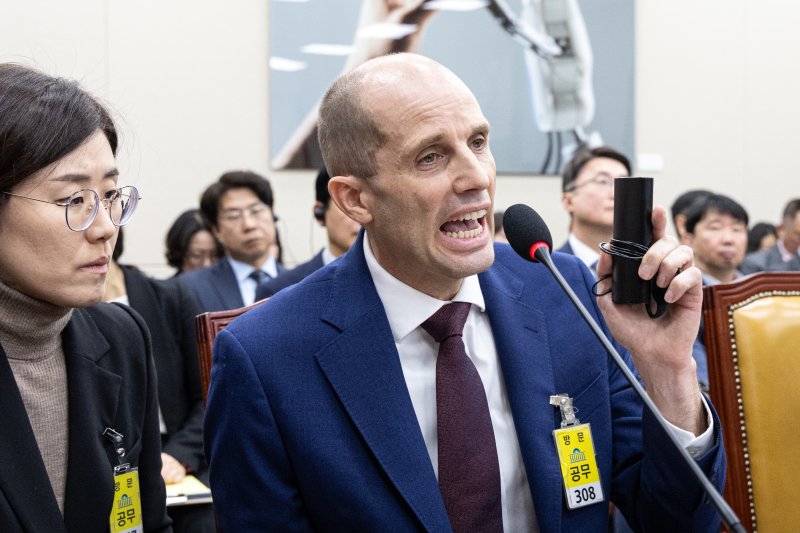
At the joint hearing, English was used not as a language but as a weapon. On December 30, Harold Rogers, interim CEO of Coupang, ignored the National Assembly’s simultaneous interpretation and communicated only with his own interpreter. Regardless of the questions, Rogers stuck to his own statements and even banged on the table, saying, "Let’s stop," in a display of arrogance.
'2017 Korea' That Was Disregarded Is Outraged
The public and the government are furious at Coupang’s unrepentant attitude.
The Ministry of Science and ICT decided to request a police investigation into Coupang for violating the data preservation order. The Korea Fair Trade Commission (KFTC) is reviewing whether the leaked information was misused. The National Tax Service (NTS) will examine allegations of tax evasion involving Coupang and Chairman Kim Beom-seok. The Ministry of Employment and Labor (MOEL) has begun an investigation into the concealment of industrial accidents at Coupang.
The Ministry of Land, Infrastructure and Transport (MOLIT) will prepare a social agreement to protect Coupang workers, while the Ministry of Justice (MOJ) plans to request prompt judicial cooperation from China.
More and more users are certifying that they have 'left Coupang.'
LS SECURITIES analyzed on the 5th, "Following the massive personal information leakage, demand is rapidly shifting from Coupang to other e-commerce platforms."
According to IGAWorks Inc. Mobile Index, Coupang’s daily active users (DAU), which exceeded 16 million in November last year, dropped to the 14 million range by the end of last month.
What would 2017 Korea, which fought to protect agricultural and livestock products and strove not to be outdone in English negotiations with the U.S., think of Coupang in 2026? Perhaps the answer can be found in a line from Leo Tolstoy’s 'A Calendar of Wisdom.'
"The cause of false knowledge lies in a mistaken perspective on the object."
"History remembers."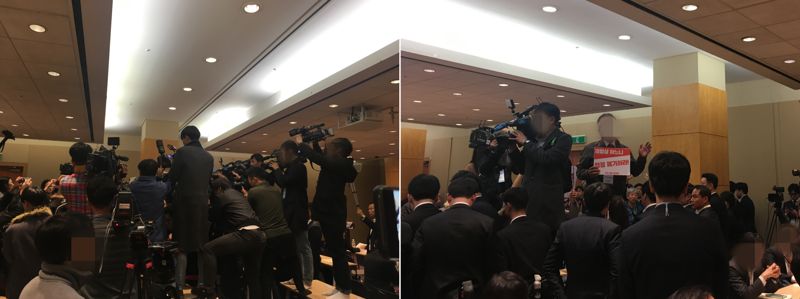
At a public hearing on the KORUS FTA amendment organized by MOTIE on November 10, 2017, agricultural and livestock representatives express concerns about market opening and oppose the amendment. /Photo=Yoon-kyung Seo It is said that 'history is a mirror that reflects the future.' As one era ends and another begins, the foundation of the new era is always the previous one. At that point,'Seo’s Latte Column'begins. Drawing on time and experience from the field, I reflect on 'those days' and look toward 'new days.'
[email protected] Yoon-kyung Seo Reporter