"Separate Bedrooms Are a Strategy... How Not to Fall Apart and Grow Old Together" [Retiree X’s Blueprint]
- Input
- 2026-01-31 08:30:00
- Updated
- 2026-01-31 08:30:00
" Such constant closeness can actually increase the fatigue of retired life. They advise that couples need the wisdom to "live in the same home without sharing every hour of the day.

" Such constant closeness can actually increase the fatigue of retired life. They advise that couples need the wisdom to "live in the same home without sharing every hour of the day.
I arrive at the library and I see him. I feel happy when I see him.
" Such constant closeness can actually increase the fatigue of retired life. They advise that couples need the wisdom to "live in the same home without sharing every hour of the day.I want to say hello, but I don’t want to disturb his studying, so I drink some water and head back home. My husband comes home.
I tell him I went to see him because I missed him. He gives me a big smile.
I really like my husband. " [The Financial News] This was posted in an online community on Naver.
" Such constant closeness can actually increase the fatigue of retired life. They advise that couples need the wisdom to "live in the same home without sharing every hour of the day.
Comments poured in: "How lovely," "Reading this makes me happy," "It’s like a poem. " It sounds like the daily life of a couple in their 20s or 30s, but this community is actually a space for middle-aged and older adults preparing for retirement.
" Such constant closeness can actually increase the fatigue of retired life. They advise that couples need the wisdom to "live in the same home without sharing every hour of the day.What drew attention in this post was not just the affection between the two. More striking than the love itself was the way they respected each other’s time and space.
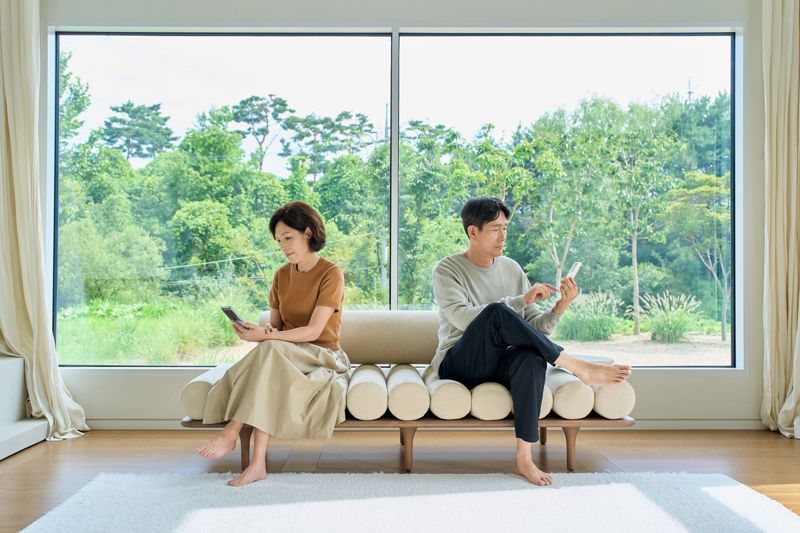
This couple does not seem to be deliberately living apart, nor are they trying to spend every minute together. When they want to see each other, they approach; when they feel the other needs time, they also give space.
After retirement, instead of clinging to the expectation that "we must always be together now," they decide for themselves when to be together and when to protect their own time. In Part 2 of [Family Life Report 3 Couples], we look at couples who try not to fall apart by adjusting the rhythm of their relationship rather than the physical distance between them.
Separate bedrooms: strategic coexistence or a path to deeper conflict? One notable trend in recent years is the rise in so-called gray divorce. The number of divorces among people aged 65 to 69, which was around 68,000 a year in 2013, had surpassed 320,000 by 2025, and divorces among those aged 70 to 74 increased from about 36,000 to around 18,000.However, alongside statistics showing more gray divorces, practitioners are also observing a different current. Some couples say, "It’s not that we want to divorce, but we can’t go on living like this." They maintain their relationship by sleeping in separate rooms and pursuing separate activities. Opinions are divided on separate bedrooms and separate daily routines.
Choi Cheol-ho (57, alias), who took early retirement last year, started sleeping in a separate bedroom. When his daughter got a job and moved out, he turned her room into his own personal space and separated his living area from his wife’s."Now that I’m home more, we bump into each other a lot," Choi said. "Our sleeping hours are different, and our TV preferences are different.Living in our own spaces and just meeting at mealtimes has actually made our relationship better. We talk more now," he added.
By contrast, department head Hwang Byung-cheol (58, alias), who is still working, strongly disagrees. "Separate bedrooms are out of the question.
" Such constant closeness can actually increase the fatigue of retired life. They advise that couples need the wisdom to "live in the same home without sharing every hour of the day.
" Such constant closeness can actually increase the fatigue of retired life. They advise that couples need the wisdom to "live in the same home without sharing every hour of the day.
My wife and I both oppose separating our living spaces," he said, "I believe a married couple should absolutely live together. " he said.Experts say, "It’s not the separate bedroom itself, but the emotions and intentions behind that choice that determine the future of the relationship. " [Check] Separate bedrooms and separate routines: when they are a strategy vs.when they are a warning sign ✔ When it becomes a strategy □ When the main reasons are practical, such as different sleep schedules or preferences □ When the couple has agreed on a rhythm for meeting—after their own time, at meals, on weekends, and so on □ When they are not just blaming the other person but also reflecting on themselves in parallel ⚠ When it is a warning sign □ When the starting point is avoidance or resignation, such as "I just hate having them next to me" □ When both conversation and physical intimacy have been cut off for a long time □ When just seeing the spouse’s face triggers heart palpitations, chest pain, or other psychosomatic symptoms You need "separate" time to sustain the "together" time A common misconception in the retirement transition period is this: "Now that we have time, we’ll travel together and exercise together. Spending more time together will make things better." But such constant closeness can actually heighten fatigue. Park Hye-jin (58, alias), an office worker in her late 50s, made one rule with her spouse.
Every Wednesday is "each person’s day. " Her spouse goes to a workout group, and she meets friends or pursues hobbies.
"At first, my spouse felt a bit hurt, but now that we have that day, the other days feel easier," she said. Experts call this "living-room independence." In other words, living in the same home without sharing every minute of the day. It is not avoidance; it is securing breathing room.Attorney Kim Yoonjung, a family and inheritance specialist at YK Law Firm, said, "After retirement, as people gain more free time, if they become excessively dependent on their spouse for basic daily life or emotional needs, conflicts can actually intensify. " She added, "If you do not secure enough emotional and practical independence to live on your own when needed, it becomes easy to see your spouse not as a partner but as a burden.
" She emphasized, "Maintaining your own social relationships, hobbies, and daily routines is crucial to protecting the relationship. " Numbers beat emotions: turning "anxiety" into a "budget" Another major axis of marital conflict during the retirement transition is money.
When income starts to decline, the first serious conversation about money can easily turn into an emotional fight.
" Such constant closeness can actually increase the fatigue of retired life. They advise that couples need the wisdom to "live in the same home without sharing every hour of the day.Every Wednesday is "each person’s day. " Her spouse goes to a workout group, and she meets friends or pursues hobbies.
"At first, my spouse felt a bit hurt, but now that we have that day, the other days feel easier," she said. Experts call this "living-room independence." In other words, living in the same home without sharing every minute of the day. It is not avoidance; it is securing breathing room.Attorney Kim Yoonjung, a family and inheritance specialist at YK Law Firm, said, "After retirement, as people gain more free time, if they become excessively dependent on their spouse for basic daily life or emotional needs, conflicts can actually intensify. " She added, "If you do not secure enough emotional and practical independence to live on your own when needed, it becomes easy to see your spouse not as a partner but as a burden.
" She emphasized, "Maintaining your own social relationships, hobbies, and daily routines is crucial to protecting the relationship. " Numbers beat emotions: turning "anxiety" into a "budget" Another major axis of marital conflict during the retirement transition is money.
When income starts to decline, the first serious conversation about money can easily turn into an emotional fight.
That is why the order matters.
" Such constant closeness can actually increase the fatigue of retired life. They advise that couples need the wisdom to "live in the same home without sharing every hour of the day.It should be "money → emotions," not "emotions → money.
" A couple living in Gangseo-gu, Seoul, Mr.
Lee Jung-su (56, alias) and his spouse, organized their pensions, insurance policies, loans, and cash flow on a single sheet of paper for the first time after retirement."It was more unsettling that neither of us knew the exact numbers.Once we put the figures on the table, we both felt more at ease," he said.Kim Kyung-pil, head of Money Training Lab, noted, "Retired couples don’t need some grand financial plan; what they need is a minimum level of agreement." He advised, "It doesn’t matter who manages the household finances after retirement, as long as it’s done transparently.
Secret stashes of money are absolutely off-limits.
" Such constant closeness can actually increase the fatigue of retired life. They advise that couples need the wisdom to "live in the same home without sharing every hour of the day.
" He went on, "If you disclose your expected monthly income and decide how much each of you will use as personal spending money, you won’t have problems.
" Such constant closeness can actually increase the fatigue of retired life. They advise that couples need the wisdom to "live in the same home without sharing every hour of the day.Experts say, "It’s not the separate bedroom itself, but the emotions and intentions behind that choice that determine the future of the relationship. " [Check] Separate bedrooms and separate routines: when they are a strategy vs.You have to recognize that you are an economic community as a couple and be considerate of each other." Four principles for retired couples’ financial agreements / Graphic by Jung Ki-hyun Redistributing roles should be realistic, not perfect When retirees spend more time at home, conflicts over housework and caregiving also grow.
Here again, what matters is not the "perfect" answer but what is sustainable.
Kim Tae-hyun (61, alias) from Ilsan, Gyeonggi Province, took on dishwashing, trash, and recycling after retirement."At first I tried cooking too, and it was a disaster.Once I started with what I could actually do, our relationship became less tense," he recalled.
" Such constant closeness can actually increase the fatigue of retired life. They advise that couples need the wisdom to "live in the same home without sharing every hour of the day.

" "That is why the time when the marital relationship most needs to be at its best is after 50," she wrote.
" Such constant closeness can actually increase the fatigue of retired life. They advise that couples need the wisdom to "live in the same home without sharing every hour of the day.She continued, "To make that happen, you need to understand each other’s hearts well enough to avoid misunderstandings," adding, "To know someone’s heart is to know what they like and dislike, and what they hold dear.
" she advised.
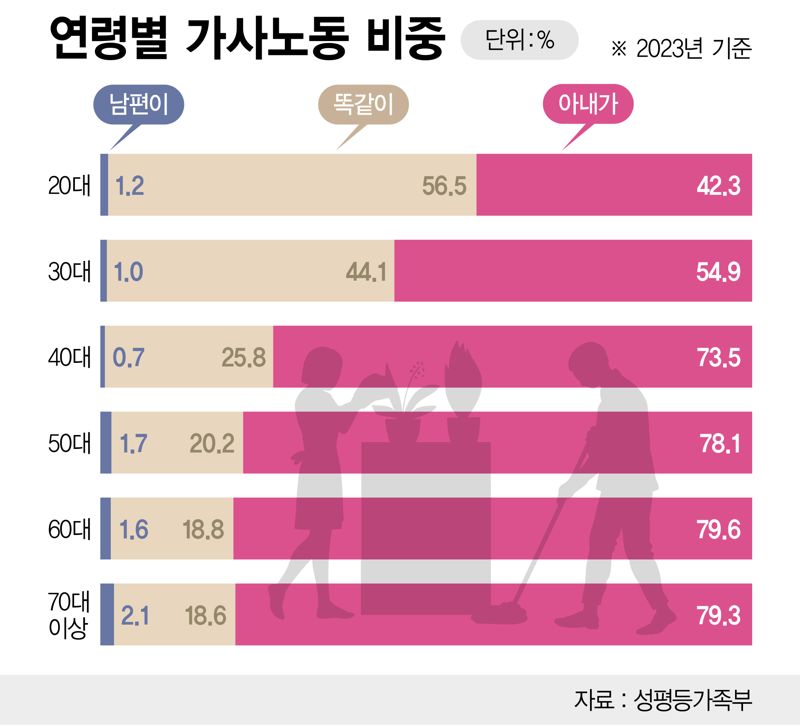
Share of housework by age group / Graphic by Jung Ki-hyun From "parenting partners" to "life companions": practicing new topics of conversation For many middle-aged couples, conversations dry up not because love has disappeared, but because their talk has long revolved around shared tasks—children and parents.When those tasks end, their words disappear with them.In Busan, Jung Su-jin (59) made a rule with her spouse."During our 30-minute walk on Saturday mornings, no talking about the kids or our parents.We only talk about us.
" Such constant closeness can actually increase the fatigue of retired life. They advise that couples need the wisdom to "live in the same home without sharing every hour of the day.
" Such constant closeness can actually increase the fatigue of retired life. They advise that couples need the wisdom to "live in the same home without sharing every hour of the day.
" Such constant closeness can actually increase the fatigue of retired life. They advise that couples need the wisdom to "live in the same home without sharing every hour of the day.
" Lee advised, "What couples need at this stage is not deep, heavy conversations, but questions that point in a slightly different direction.
" Such constant closeness can actually increase the fatigue of retired life. They advise that couples need the wisdom to "live in the same home without sharing every hour of the day." Questions like, "What tired you out the most today?" or "What’s something we’d like to do together next month?" are enough, she said.
Designing our home together 1 Conversation skills: turning question marks into periods Retirees often become "question-mark killers" because they feel anxious.
Here is a way of speaking that can ease that anxiety.
" Such constant closeness can actually increase the fatigue of retired life. They advise that couples need the wisdom to "live in the same home without sharing every hour of the day.
▶ Bad example (interrogation style): "Where are you going? When will you be back? What about dinner?" Good example (information-sharing style) : "I’m going out at 1 p.
" Such constant closeness can actually increase the fatigue of retired life. They advise that couples need the wisdom to "live in the same home without sharing every hour of the day.Experts say, "It’s not the separate bedroom itself, but the emotions and intentions behind that choice that determine the future of the relationship. " [Check] Separate bedrooms and separate routines: when they are a strategy vs.m.to meet a friend.
Experts say, "It’s not the separate bedroom itself, but the emotions and intentions behind that choice that determine the future of the relationship. " [Check] Separate bedrooms and separate routines: when they are a strategy vs.I set lunch on the table.I’ll be back around five." (By giving information first, you cut off your partner’s anxiety before they have to ask.
Experts say, "It’s not the separate bedroom itself, but the emotions and intentions behind that choice that determine the future of the relationship. " [Check] Separate bedrooms and separate routines: when they are a strategy vs.I set lunch on the table.) Taboo: Do not attach negative prefixes like "Going out again?" when your partner leaves, or "Why are you only coming back now?" when they return.2 Space skills: physically practicing "separate yet together" Securing a safe distance: Even in the same room, formalize "separate time" by, for example, each person wearing earphones or reading their own book.
Experts say, "It’s not the separate bedroom itself, but the emotions and intentions behind that choice that determine the future of the relationship. " [Check] Separate bedrooms and separate routines: when they are a strategy vs.I set lunch on the table.Bathroom and sleep: If one partner has sleep problems or your daily rhythms are very different, consider separate bedrooms or twin beds as part of a "relationship remodeling" project.3 Money skills: guaranteeing autonomy with a contingency budget Autonomous budget: In addition to household expenses, agree on a minimum amount of "personal allowance" that each can spend without reporting to the other.
Experts say, "It’s not the separate bedroom itself, but the emotions and intentions behind that choice that determine the future of the relationship. " [Check] Separate bedrooms and separate routines: when they are a strategy vs.(For example, each partner uses 10% of the monthly household budget as their own spending money.Experts say, "It’s not the separate bedroom itself, but the emotions and intentions behind that choice that determine the future of the relationship. " [Check] Separate bedrooms and separate routines: when they are a strategy vs.I set lunch on the table.) After the children and parents are gone, the one person who remains From the perspective of their children, Generation X has been practicing "letting go." From the perspective of their parents, they have been grappling with "sustainable caregiving.
Experts say, "It’s not the separate bedroom itself, but the emotions and intentions behind that choice that determine the future of the relationship. " [Check] Separate bedrooms and separate routines: when they are a strategy vs.I set lunch on the table." After all those stormy roles have passed, at the dead end of life, the only social safety net that remains by your side is your spouse.For retirees, the spouse is the last remaining family member and the final line of defense.Experts say, "It’s not the separate bedroom itself, but the emotions and intentions behind that choice that determine the future of the relationship. " [Check] Separate bedrooms and separate routines: when they are a strategy vs.Just as parents who consistently give 70 points are stronger than those who aim for 100 and collapse, couples are happier when they accept each other’s shortcomings and walk together as "70-point partners," rather than expecting everything from their spouse.Growing old together does not happen on its own.
" Such constant closeness can actually increase the fatigue of retired life. They advise that couples need the wisdom to "live in the same home without sharing every hour of the day.
It is the result of deliberate planning and constant practice.
" Such constant closeness can actually increase the fatigue of retired life. They advise that couples need the wisdom to "live in the same home without sharing every hour of the day.It is time to put away your children’s report cards and start reading your spouse’s heart.
Experts say, "It’s not the separate bedroom itself, but the emotions and intentions behind that choice that determine the future of the relationship. " [Check] Separate bedrooms and separate routines: when they are a strategy vs.People jokingly say that what keeps a marriage going is "loyalty." But even loyalty must be nourished on both sides if it is to last.
"The old equation of retirement equals exit is collapsing.
In an era when average life expectancy is 83, and Generation X is entering full-scale retirement, the very concept of retirement is being redefined.
" Such constant closeness can actually increase the fatigue of retired life. They advise that couples need the wisdom to "live in the same home without sharing every hour of the day.
Retiree X’s Blueprint, [Retiree X’s Blueprint] which tells the story of their ‘second act of life,’ will be published every Saturday morning.Subscribe to the reporters’ page to receive it easily."
" Such constant closeness can actually increase the fatigue of retired life. They advise that couples need the wisdom to "live in the same home without sharing every hour of the day.[email protected] Kim Ki-seok and Jung Ji-woo Reporter