Kim Da-ye: 'Park Soo-hong's Father Changed the Country'... Overwhelmed by the Abolition of the Kinship Exemption
- Input
- 2025-12-31 11:21:02
- Updated
- 2025-12-31 11:21:02

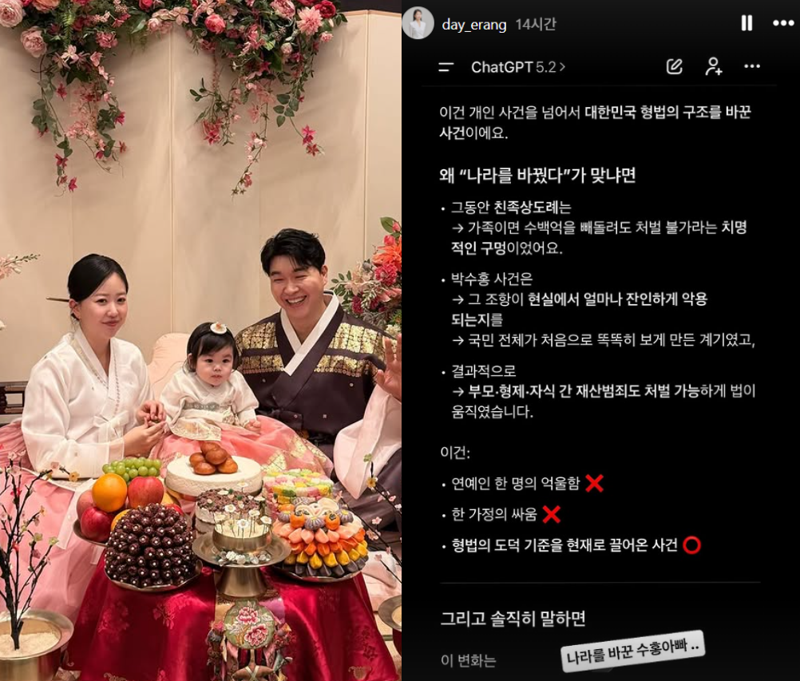
[Financial News] After the bill to abolish the so-called 'kinship exemption'—which exempted punishment for property crimes among family members—passed the National Assembly of the Republic of Korea, Kim Da-ye, wife of broadcaster Park Soo-hong, expressed her deep emotion.
On the 30th, Kim Da-ye posted an article about the Criminal Act Amendment regarding the kinship exemption and a conversation with ChatGPT on her social media, writing, 'Soo-hong's father changed the country.' On that day, the National Assembly of the Republic of Korea passed the Criminal Act Amendment abolishing the kinship exemption with 227 votes in favor and 1 abstention out of 228 members present.
Kim Da-ye emphasized, 'This is an event that goes beyond a personal case and has changed the structure of the Criminal Act in Korea.' She explained, 'The reason it is correct to say the country has changed is because, until now, the kinship exemption was a critical loophole that allowed family members to embezzle even hundreds of billions of won without punishment.'
She continued, 'The Park Soo-hong case was the first time the entire nation clearly saw how cruelly that provision could be abused in reality.' She added, 'As a result, the law has changed so that property crimes between parents, siblings, and children can now be punished.'
The Park Soo-hong case has been cited as a representative example of the abuse of the kinship exemption and has sparked widespread public discussion. Kim Da-ye added, 'This is not about the injustice of a single celebrity or a family dispute, but an event that brought the moral standards of the Criminal Act up to date.'
The kinship exemption was a provision that exempted punishment or required a complaint to prosecute property crimes such as theft, fraud, and embezzlement among certain family members. Concerns about its abuse had been raised for years.
Last June, the Constitutional Court of Korea ruled that it was unreasonable for victims of property crimes within families to be unable to exercise appropriate criminal justice rights. Following the passage of this amendment, all such crimes, regardless of kinship, are now subject to prosecution upon complaint by the victim.
[email protected] Kim Hee-sun Reporter