Innospace’s ‘HANBIT-NANO’ Successfully Launched but Mission Ended Early... Investigation Underway
- Input
- 2025-12-29 11:29:37
- Updated
- 2025-12-29 11:29:37
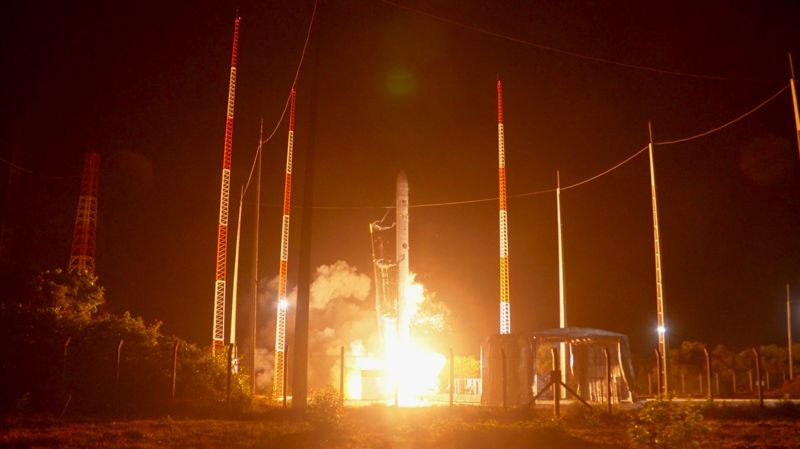
[Financial News] Innospace, a private space launch vehicle company, announced on the 29th that it conducted the first commercial launch of ‘HANBIT-NANO’ at the Alcântara Launch Center (CLA) in Brazil on the 23rd. Following safety procedures, the Spaceward mission was terminated early during flight, and the company has begun analyzing the cause of the launch failure based on the collected data.
The two-stage launch vehicle HANBIT-NANO lifted off as scheduled at 10:13 a.m. KST on the 23rd (10:13 p.m. on the 22nd local time in Brazil), beginning its ascent along the planned vertical trajectory. The first-stage main engine, a 25-ton thrust hybrid rocket engine, ignited successfully and passed through the initial phase stably. This marks the world’s first flight of a medium-to-large hybrid rocket engine.
Thirty seconds after liftoff, an anomaly was detected in the HANBIT-NANO vehicle. Shortly after, the launch vehicle separated into several pieces and fell within the designated ground safety zone, where it exploded upon impact. No casualties or additional facility damage were reported. Innospace executed all missions safely in accordance with international safety standards established with the Brazilian Air Force, following the intended design and relevant protocols.
On the same day, Innospace began an initial analysis of the cause of the flight termination with the Brazilian Air Force, based on flight measurement and tracking data. According to video footage and preliminary data, the coordinated and professional flight termination procedures between the launch vehicle operator and the launch site operator functioned as intended during the anomaly. This demonstrates the maturity of the vehicle’s safety design and integrated operational system in real-world conditions. However, the final cause of the launch failure will be determined through an official investigation and review process led by the Center for Investigation and Prevention of Aeronautical Accidents (CENIPA) under the Brazilian Air Force.
Customer satellites and payloads aboard this mission will be compensated for losses through the customers’ own insurance policies arranged in advance. It is expected that there will be no significant impact on Innospace’s commercial launch service contracts or future business plans. Some debris from the HANBIT-NANO launch vehicle that fell within the ground safety zone has been recovered and will be used for joint cause analysis and technical improvements by both organizations.
Through this launch, Innospace plans to continue additional technical verification procedures based on all data from the vehicle’s liftoff, initial flight, and ground observations, in preparation for subsequent launch missions. A relaunch attempt of HANBIT-NANO is being considered for next year at the CLA, based on the secured launch slot.
Soojong Kim, CEO of Innospace, stated, “The space launch vehicle industry is a highly advanced technological field where thousands of variables operate simultaneously throughout design, manufacturing, ground testing and integration, launch operations, and flight. Only a limited number of companies have reached the stage of actual commercial launch. In particular, the first commercial launch is considered the highest hurdle, as it must meet not only technical completeness but also reproducible trust and safety standards.”
[email protected] Yeon Ji-an Reporter