Stricter Penalties for Drug-Impaired Driving Next Year... Conditional Licenses for Repeat Drunk Drivers Introduced
- Input
- 2025-12-28 09:00:00
- Updated
- 2025-12-28 09:00:00
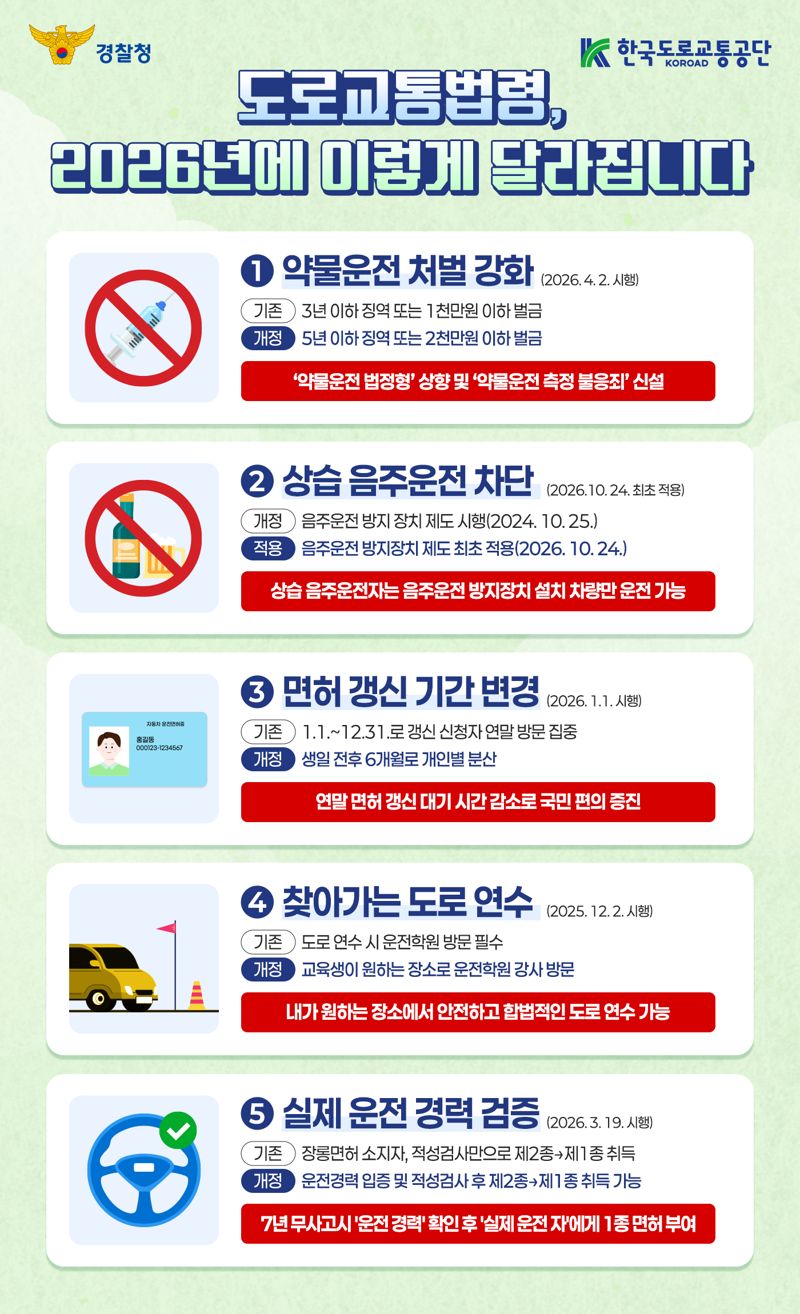
[Financial News] Starting next year, penalties for drug-impaired driving will be significantly strengthened, and a conditional license system for repeat drunk drivers will be introduced.
The Korean National Police Agency (KNPA) announced on the 28th that it has established amendments to the Road Traffic Act containing these measures, aiming to enhance road safety while reducing public inconvenience. The new regulations will take effect next year.
The revised bill introduces a new offense for refusing drug testing, reflecting the recent surge in cases where drivers under the influence of psychotropic substances threaten public safety. Penalties for drug-impaired driving will be raised from up to 3 years in prison or fines up to 10 million KRW to up to 5 years in prison or fines up to 20 million KRW.
Additionally, the licenses of high-risk drivers caught for drug-impaired driving and similar offenses will be mandatorily revoked, enabling authorities to promptly remove dangerous drivers from the roads.
A new system to curb repeat drunk driving will also be implemented. From October 2026, drivers who have been caught driving under the influence at least twice in the past five years and seek to regain their licenses after the disqualification period will be required to install a Breath Alcohol Ignition Interlock Device (BAIID) in their vehicles. This conditional license system will only allow driving if the BAIID is installed, and the device is designed to prevent the engine from starting if alcohol is detected.
Efforts to rationalize the driver’s license system are also underway. Previously, holders of a Class 2 license could obtain a Class 1 license through a simple aptitude test if they had a clean record for seven years. Starting next year, however, only those who can prove actual driving experience, such as by submitting automobile insurance certificates, will be eligible to upgrade to a Class 1 license after passing the aptitude test.
Improvements have also been made to reduce public inconvenience related to license renewals. To address the issue of renewal requests peaking at the end of each year, the renewal period will now be calculated individually—six months before and after each person’s birthday—instead of the previous annual batch system. According to the KNPA, this change will help distribute renewals more evenly and enable faster administrative services.
Furthermore, learner drivers will be able to receive legal on-road training at their preferred locations and routes without visiting a driving school in person. The entire process from applying for on-road training to payment has been integrated into an online system.
Kim Hoseung, Director of Traffic Safety at the KNPA, stated, "We will strictly crack down on behaviors that threaten lives on the road while actively working to alleviate everyday inconveniences experienced by the public."
[email protected] Jang Yu-ha Reporter