Police Forcefully Subdue 'Former Prosecutor' Smoking in Apartment Hallway? The Truth Behind the Viral Video...
- Input
- 2025-12-26 13:54:47
- Updated
- 2025-12-26 13:54:47
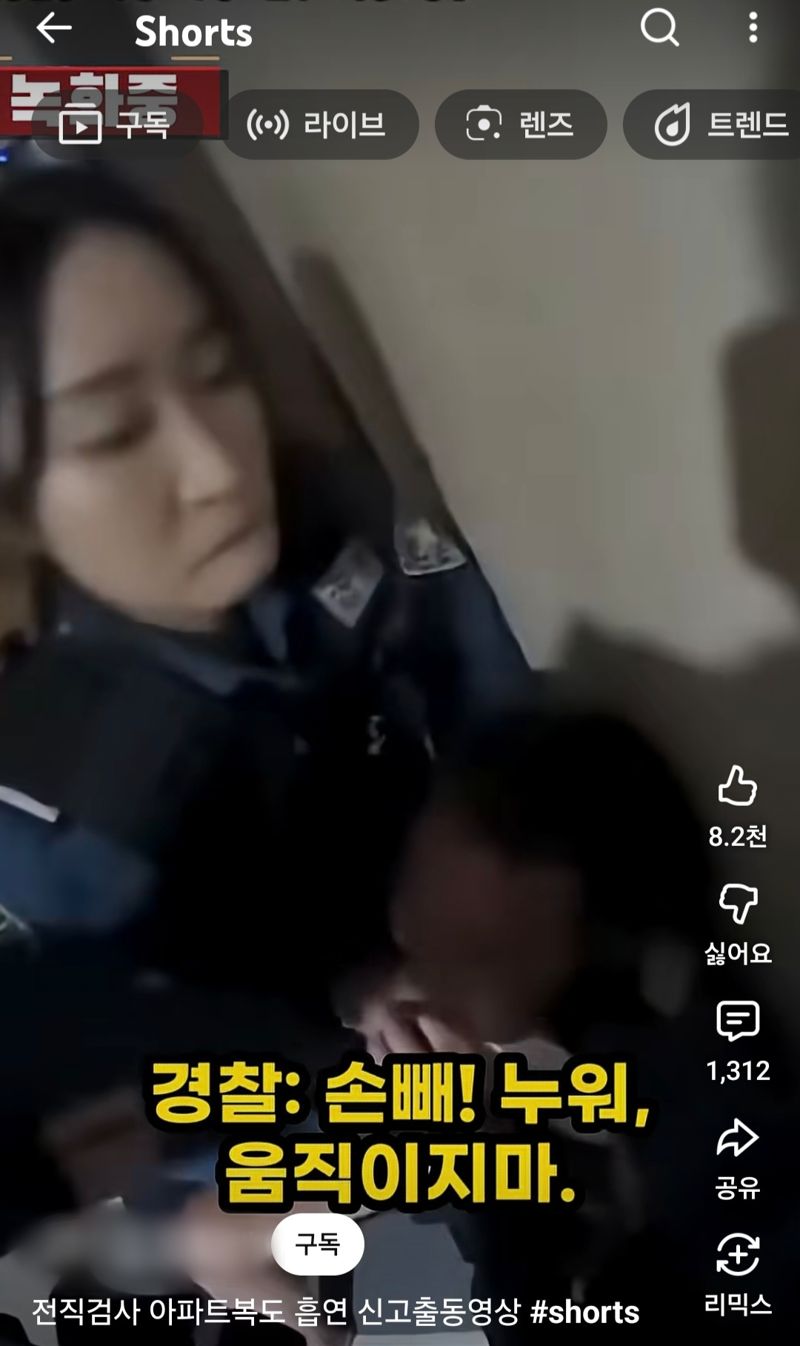
[The Financial News]#. Police respond to a report of someone smoking in an apartment hallway. The man they encounter at the door introduces himself as a 'former prosecutor' and protests aggressively. As the argument escalates, the man shouts and lunges forward, prompting the police to restrain him by pressing his neck and bringing him to the ground. The tense scene is quickly brought under control, and the entire incident is edited to resemble footage from a police body-worn camera.#. In another video, a vehicle suspected of drunk driving ignores police orders to stop and attempts to flee. The police bang on the car and shout, "Hey, stop right there!" A struggle ensues between the driver and the police, with shouting and profanity exchanged in a chaotic scene. The video captures realistic audio and shaky visuals, mimicking actual law enforcement footage.According to a compilation by The Financial News on the 26th, over the past two months, 'fake police body-worn camera videos' created with AI have been spreading rapidly across various online platforms such as YouTube, Instagram, and TikTok. This trend has sparked growing concern among the public about potential harm. These videos feature scenarios reminiscent of police body-worn camera footage at crime scenes involving assault, arguments, or drunk driving, but they are entirely fabricated and have no connection to actual police activity.
The main issue is that many viewers believed these videos depicted real events. There were no labels or watermarks indicating they were created with AI, and the realistic appearance of the characters and natural staging made it difficult to distinguish fact from fiction. Some viewers commented, "I thought it was real police action," and "Isn't this excessive force?" Kim, a 27-year-old office worker, said, "At first, I mistook the video for actual police conduct, and only realized it was AI-generated after reading the comments. It would be even harder for seniors or children to tell the difference."
Notably, confusion has intensified since the expansion of police body-worn camera use began in the metropolitan area on the 27th of last month. As social networking services (SNS) accelerate the spread of photos and videos and shape public opinion, there are growing concerns that AI-generated fake videos, which are difficult to distinguish from reality, could amplify misunderstandings about police responses.
The channel in question has surpassed 4,000 subscribers on YouTube, and as of the previous day, its total video views exceeded 10 million. As controversy mounted, the Korean National Police Agency (KNPA) announced on the 23rd that it would launch a preliminary investigation into the channel. The problematic videos have now been deleted or set to private.
Experts stress that this issue should be addressed as a matter of security. Lee Ung-Hyeok, a professor in the Department of Police Science at Konkuk University, stated, "Although this is not a matter of war or military security, it ultimately fosters distrust in public authority and constitutes a social security threat undermining the legitimacy of law enforcement." He emphasized, "Mandatory labeling of AI-generated content is essential, and the law should be amended to strengthen penalties and send a strong message."
[email protected] Kim Ye-ji Reporter