"Facial Paralysis After Popping a Pimple"... Popping Pimples in This Facial Area Can Be Fatal [Health Talk]
- Input
- 2025-12-26 06:17:16
- Updated
- 2025-12-26 06:17:16
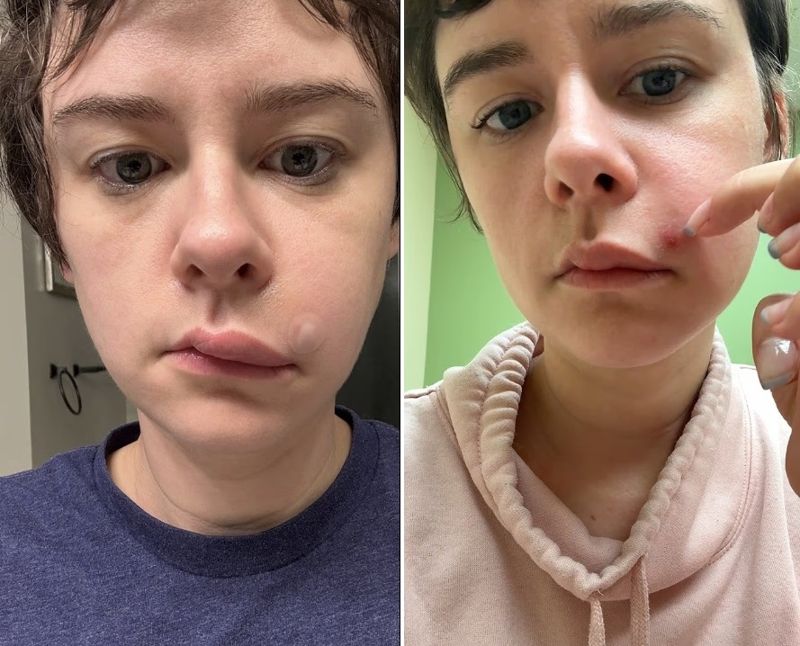
[The Financial News] A story has emerged about a woman in her 30s who squeezed a pimple on her face without much thought and ended up in the emergency room after experiencing paralysis on one side of her face.
According to the Daily Mail on the 26th, Lindsey DeOliveira, a 32-year-old resident of Georgia, USA, recently found a pimple between her lips and nose and popped it as she usually would. However, the area began to swell rapidly the next day, and one side of her face started to droop.
Lindsey immediately sought medical attention and was prescribed antibiotics. Despite this, her condition continued to worsen, leading her to visit several hospitals before eventually ending up in the emergency room.
She explained, "Although I was prescribed antibiotics at the hospital, my condition did not improve. As the pain and swelling intensified, I returned to the hospital, where I received an injection in my hip and was given a new medication."
She added, "In the emergency room, doctors saw my swollen face and lips and suspected an allergic reaction."
Lindsey later consulted a dermatologist and was diagnosed with Cellulitis. The dermatologist explained that squeezing the pimple had damaged her skin, allowing bacteria to enter and spread the infection.
Cellulitis is a bacterial infection that penetrates deep layers of the skin, causing redness, swelling, heat, and pain. If treatment is delayed, the infection can spread throughout the body via the bloodstream, making immediate antibiotic therapy essential.
She underwent Magnetic Resonance Imaging (MRI) to check whether the infection had spread to her sinuses, eyes, or brain. Fortunately, it was confirmed that the infection had not spread to other areas.
Lindsey said, "It was only about two hours after receiving stronger antibiotics in the emergency room that the swelling noticeably subsided. Although a small scar remained, my face returned to almost normal within a few days."
Meanwhile, a similar case was reported in August. In the United States, a woman named Lissy Marie visited the emergency room after her face swelled and became painful just four hours after popping a pimple below her left nostril. Medical staff prescribed four medications, including steroids and antibiotics, to treat the infection, and she fully recovered after three days.
Popping Pimples on the Face Can Be Dangerous
The main reason Lindsey experienced this situation was that the pimple was located in the 'danger triangle of the face.'
The area from the bridge of the nose to the corners of the mouth is called the 'danger triangle.' The veins in this region are connected to the cavernous sinus inside the skull. If the skin in this area is injured, bacteria can enter and cause an infection, which in severe cases can spread to the brain and become life-threatening.
Experts advise against squeezing or touching purulent pimples or wounds around the nose and mouth. If swelling, heat, or pain worsens rapidly, or if facial asymmetry appears, immediate medical attention is recommended.
Particular caution is needed if hand hygiene is poor, as this significantly increases the risk of infection.
Joshua Zeichner, a dermatologist in New York, warned, "The area of the face connecting the nose and mouth is considered especially dangerous because it is closely linked to the brain."
It is also not advisable to squeeze pimples on the forehead, cheeks, or other skin areas by hand. In the early stages of acne, exfoliation and sebum control are important. It is best to gently cleanse with a mildly acidic cleanser and use a moisturizer to protect the skin barrier.
Pustular acne filled with pus may sometimes require extraction, but forceful squeezing should be avoided. The safest method is to have extraction performed at a medical facility such as a dermatology clinic, using sterile instruments and in a hygienic environment.
If self-extraction is unavoidable, hands and tools must be thoroughly disinfected, and extraction should only be performed when pus is fully formed. After extraction, using a Hydrocolloid patch can help prevent infection and promote wound healing.
moon@fnnews.com Moon Young-jin Reporter