"The Venture DNA That Fears No Failure Has Created Today’s Miracle" [Editorial News Analysis]
- Input
- 2025-12-25 18:26:05
- Updated
- 2025-12-25 18:26:05
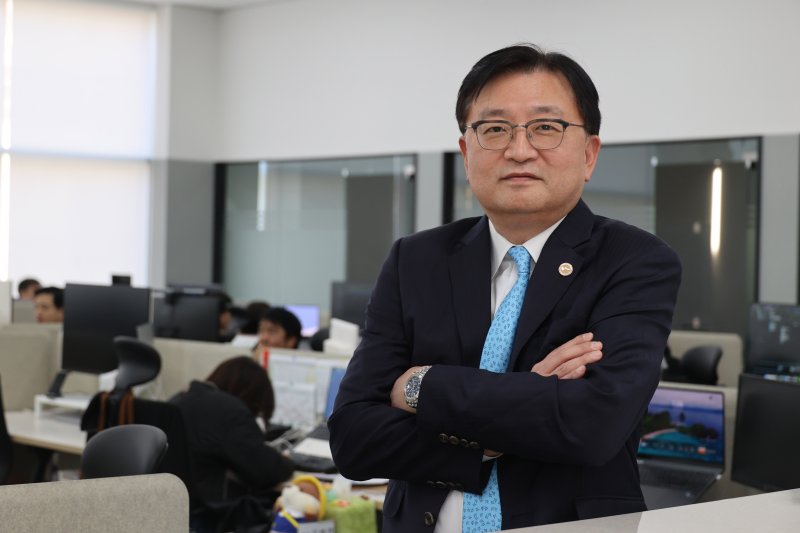
— What is your overall assessment of the past 30 years of Korean ventures?
▲ In a word, I would say we are still very hungry. Venture companies have been the driving force and innovators of Korea’s economy. The numbers speak for themselves: 30 years ago, there were about 2,000 venture firms; now, there are over 40,000. As of 2023, total revenue from venture companies reached 242 trillion won, ranking third among all business groups. They employ 930,000 people—more than the combined workforce of Korea’s four largest conglomerates. But the important thing is that there is still much more to do. Given our achievements over the past 30 years, I am confident that future results will be even more explosive.
— Can you elaborate on the achievements of venture companies?
▲ Outside of the United States and China, few countries have seen as much venture success as Korea. Companies like Naver Corporation, Kakao Corporation, NCSOFT Corporation, and Krafton Inc. are all products of the venture ecosystem. Nearly 30 venture-founded companies now post annual sales exceeding 1 trillion won, with 85 companies in the 500 billion won club and nearly 1,000 in the 100 billion won club. AI ventures are just getting started, yet some are already attracting international attention. FuriosaAI and Rebellions are making bold moves in the U.S. market. There’s no reason to limit oneself to being a doctor or working for a large corporation.
— How does today’s startup environment compare to 30 years ago?
▲ In the past, information, capital, and networks were in extremely short supply. Entering the market took a long time, and starting a business required tremendous courage. Early failures often led to immediate withdrawal, and entrepreneurial experience was not highly valued. Today, things have improved dramatically. The government’s venture certification system has yielded significant results, and private investment infrastructure has become much more robust. Dedicated startup funds, accelerators that are speeding up growth support, and global expansion programs are all new developments. The Tech Incubator Program for Startup (TIPS), where private investors discover startups and provide seed funding, is also groundbreaking.
— Still, many prefer to start businesses in the U.S. rather than in Korea. Why is that?
▲ The value one can gain from a successful startup is much higher in the U.S.—often more than tenfold. One of our problems is the lack of a robust venture M&A market. It’s nearly impossible to sell a company before it goes public, meaning there’s no real exit strategy. Most are unfamiliar with selling a company midway, and even when they do, it’s hard to get a fair price because future value isn’t properly assessed. As a result, the only option is to sell shares after listing, which lengthens the investment recovery period. This leads many to believe that the value of starting a business in Korea is lower than in the U.S.
— The five-year survival rate for venture companies is just 25%. Why is that?
▲ The fact that there aren’t many long-lasting tech ventures isn’t necessarily a problem. As I mentioned, some people should grow their businesses and sell them. However, we need more entrepreneurs who are committed to becoming number one in their field for over a decade. Many companies attract attention early with technology and ideas but fail to turn those into sustainable businesses over time. I believe the short-term focus of the investment environment is partly to blame. Expanding the M&A market to provide more exit options is crucial in this regard.
— What are the strengths of Korean ventures?
▲ The Korean venture ecosystem grew alongside the rollout of high-speed internet in 1995, riding the wave of the IT revolution. We were quicker than anyone to catch market trends. Korea is the only country in the world not dominated by MS Word or Google. We are among the few nations with platform sovereignty. Our path forward is to strengthen our global market presence and move from being fast followers to first movers.
— There are concerns about a lack of fundamental technology and global leadership.
▲ This is less a problem of venture capability and more about capital and markets not allowing time for fundamental technology to accumulate. The issue lies in the small size of the domestic market and a structure focused on rapid investment returns, making it hard for ventures to invest in long-term fundamental research. We need a system that can tolerate failure.
— How are the government’s AI venture support measures being received on the ground?
▲ Currently, there are fewer than 1,000 AI startups in Korea. The sector remains weak. Less than 5% of manufacturing companies have adopted AI. At this stage, the government must take the lead in building an AI superhighway and provide broad-based support. Once the infrastructure is in place, opportunities will continue to arise. The government is laying the AI computing foundation by making large-scale purchases of graphics processing units (GPUs) and pushing for proprietary foundation models. I think the basic framework is well designed. There is no shortage of general STEM talent, but we need people capable of creating new models with their own technology. For humanoids, we need individuals who can fill specific roles with their expertise. There are quite a few such Korean tech talents overseas, and we need more incentives to attract them back.
— What do you think about the government’s vision for Korea to become a global top-three AI power?
▲ Ultimately, it’s about creating a multitude of AI services, and Korea is the best-suited country for this. For example, AI-powered auto parts can dramatically boost productivity and be supplied to car factories in the U.S., Germany, and elsewhere. The same goes for shipbuilding. AI-applied components can sweep the global market, and AI venture founders can make this happen. There will be endless new startup ideas in the next five years, which is why this period is so important. There’s no reason we can’t be a top-three AI nation. However, looking at the National Assembly of the Republic of Korea, it’s frustrating. Why can’t we relax the 52-hour workweek for high-tech jobs? The Science, ICT, Broadcasting, and Communications Committee is also slow to act, and the Korea Communications Commission (KCC) is always embroiled in disputes, leaving key science and technology issues unaddressed. These things need to change quickly.
— Korean ventures have faced significant global barriers. What’s your view?
▲ Korea’s manufacturing data is the best in the world. By combining manufacturing with AI and specializing in content through AI, we can create new businesses. Unlike before, products developed for the domestic market can now be sold overseas. K-content has paved the way.
— Only about 1% of global venture capital flows into Korean ventures. What are your thoughts?
▲ It’s certainly a disappointment, but this has been the case since the 1970s. Our predecessors created miracles in such an environment. The history of all Korean industries is similar. I believe we have venture DNA within us.
— What is the core of the venture DNA and spirit?
▲ It’s the spirit of not fearing failure. Regulations and obstacles don’t matter. Those who overcome them first reap the greatest benefits, and sharing those benefits is also part of the venture spirit. In this sense, successful venture entrepreneurs and leaders should lead by example.
— What is needed for a 'K-Nvidia' to emerge?
▲ Such companies are already emerging. The Korean startup FuriosaAI was confident enough to turn down an acquisition offer from Meta. Rebellions, an AI semiconductor chip startup, is at the forefront of the anti-Nvidia Corporation ecosystem. As more entrepreneurs like these appear, the AI startup ecosystem will naturally strengthen. To foster more K-Nvidias, we need more venture capital. Deep tech startups based on technology require long timelines and face high uncertainty before commercialization. Bold policies, such as requiring the 67 statutory funds to invest in venture startups, are needed to expand venture capital.
— What are your memories of the venture pioneers from 30 years ago?
▲ They took on challenges with a sense of urgency. Minhwa Lee and Jang Heung-Sun, in particular, always emphasized that ventures must ultimately become industries. Without industrial development, companies have no future. That’s why they established the venture association and devoted themselves to enacting the Special Act on the Promotion of Venture Businesses. Such a law was unprecedented globally at the time. They then created the KOSDAQ market. They believed that having more companies would benefit the nation, and I’ve never forgotten those words. After all, jobs and taxes ultimately serve the country.
— What advice would you give to aspiring entrepreneurs?
▲ I hope they are convinced that starting a business is better than becoming a doctor. If you are determined to take responsibility for your own life, there are countless startup opportunities in the AI era. I urge them to seize those opportunities. Co-founding with like-minded partners is also a good idea. If you have the will and the technology, don’t give up. If you take on the challenge, you will find a way.
[email protected] Reporter