"Honey, What’s for Dinner?" Don’t End Up Divorced in Your Later Years as a Husband Who Expects Three Meals a Day—Create a Life Outside Home Instead [Retiree X’s Blueprint]
- Input
- 2026-01-24 08:53:44
- Updated
- 2026-01-24 08:53:44
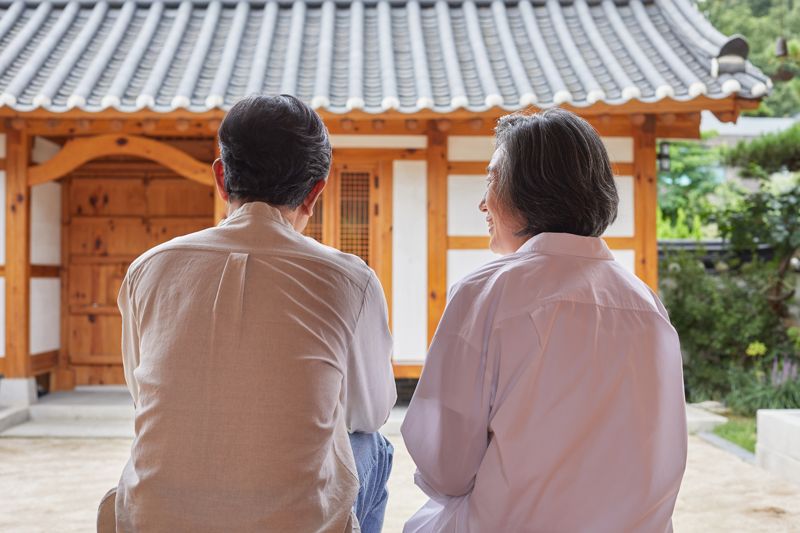

Few scenes make people smile as much as children’s laughter. One of them is the sight of an elderly couple walking slowly, hand in hand, from behind. Yet that peaceful “journey together” is not a future everyone can take for granted.
[The Financial News] For parents of Generation X, emotional distance between spouses was a kind of order. There was a time when the father walked ahead and the mother followed behind, and holding hands was a special event. Times have changed, and for the MZ generation, showing affection has become much more natural. Stuck in between, Generation X feels awkward. They neither keep the distance their parents did, nor freely redesign their relationships like the MZ generation, yet they now stand at the entrance to “growing old together.”
For decades, couples have raised children and cared for aging parents, “living together but enduring separately.” They became used to their roles as parents, but had little chance to practice “how to live as a couple.” Conflicts were postponed under the excuse of being busy, and conversations hardened into exchanges only about survival and tasks.
Retirement shatters this fragile balance in an instant.The moment the company, their buffer zone, disappears, the couple for the first time becomes two people who fully share “24 hours a day.” Generation X has spent years letting their children go (practicing how to let them become independent) and seeing their parents off (wrestling with caregiving). Now the last and hardest assignment remains: the marriage itself.
How will they live the next 20 years or more together from here on?
The vanished company as a ‘buffer zone’
Suddenly, the couple starts seeing each other “every single day.”
While they were working, the company functioned as a huge buffer between husband and wife. In a routine of leaving in the morning and coming home in the evening, minor conflicts were naturally postponed. Differences between them could be glossed over with the excuse of being “too busy.”
But the transition into retirement strips that buffer away in a moment.
According to the Ministry of Data and Statistics, as of 2023, life expectancy is 80.6 years for men and 86.4 years for women. Assuming retirement around age 60, couples are likely to live together for at least another 20 years. The real issue is not “how long they live,” but what rhythm they find to endure that time together.
Park, a 56-year-old living in Songpa District, Seoul, described the six months between leaving his job and finding new work this way.“We never had any big fights.But the little things kept bothering me—her tone of voice, the TV volume, even when we ate.Things I used to overlook because I was tired suddenly stood out all day long.”
Retirement that comes at different times
Lifestyle rhythms fall out of sync even before income does.
In reality, spouses rarely retire at the same time. One partner leaves the organization through mandatory or early retirement, while the other continues working or expands their own activities.At this point, the core of the conflict is less about who earns money and more about the gap in daily rhythm.Choi, 59, who lives in Dobong District, Seoul, fills his days with exercise and hobby clubs after taking early retirement. His spouse, however, maintains her job and personal schedule. “I thought we’d spend more time together,” he said, “but we’ve actually become busier in our own ways. Now we neither ask in detail about each other’s day nor feel the need to explain.”
They did not grow apart because they were together. Distance emerged because each entered the transition at a different speed. The retired partner feels, “Now our real life together begins,” while the one still working feels, “My daily life is still rolling on.” They share the same house but live by different timetables.
One who suddenly wants to be together vs. one whose schedule is already full
The partner who leaves work first naturally wants to invest more time in the relationship. There is also a psychological tendency to fill the gap left by shrinking workplace relationships with the closest relationship at home.
But for the partner whose schedule and roles remain intact, this change can feel like a burden.
On online communities, there are many posts that would surprise many men. The section is titled “Husband Stories,” but many posts play on the Korean word for husband to mean “someone else’s side” or “on the other side.” There are plenty of heartwarming stories, but titles like “Why is he like this?” or “Are you on good terms with your husband?” already convey hurt and irritation.
Kim Mi-seon (alias, 59), who lives in Songpa District, Seoul, said, “Since my husband retired, he keeps asking me to have lunch together or go for a walk,” and added, “I understand how he feels. But my day is already packed. I have work and appointments. The hardest moments are when I feel I have to adjust my pace to match someone else’s retirement.”
For the retired partner, the mindset is, “Let’s finally spend time together,” while for the other it becomes, “Why do I have to clear my schedule?”The root of the conflict is not a lack of affection, but the different speeds of transition and the different ways they have prepared for life.
The desire for comfort vs. the weight of reality
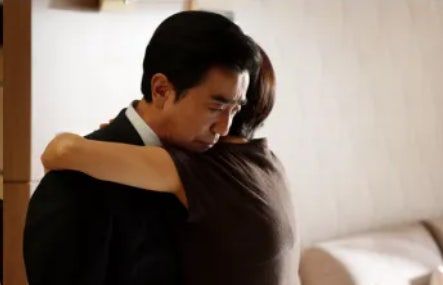
Dramas and variety shows often portray a spouse naturally comforting a partner who has just retired. Recent stories like “The Dream Life of Mr. Kim” reinforce this expectation. There is a shared emotional narrative that “now it’s time to embrace the one who has worked so hard.”
Reality, however, starts with the calculator. It is not that there is no desire to offer comfort, but that there is not enough capacity to do so.Kim Jung-hee (alias, 58), who lives in Yangcheon District, Seoul, said, “He worked at the same place for 25 years, so of course it must be hard for him, and he really does look worn out,” but added, “Honestly, I’m anxious. When I think about future education costs and living expenses, I don’t have the emotional room to care for his feelings as much as I’d like. I feel sorry, but at some point I find myself reaching for the calculator first.”
The ‘question-mark killer’ husband
There is a phrase often used these days: “retired husband syndrome.”It is not an official medical diagnosis. The term, first used in Japan in social and psychological contexts, broadly describes the patterns of conflict and stress that emerge in a marriage after the husband retires.
Generally, it refers to a situation where the husband stays home all day and depends on his wife for almost everything—daily routines, emotional support, and household life—while the wife experiences fatigue, stress, and even depression. Recently, however, instead of using the term as is, experts more often describe it as “marital conflict during the retirement transition” or “failure to renegotiate roles after retirement.”
“Where are you going?” “When will you be back?” “When are we eating?”These are questions many, though certainly not all, retirees ask repeatedly. That is why some online posts provocatively call such a spouse a “question-mark killer,” a husband who fires off endless questions. It is meant somewhat affectionately, but the frustration behind it is real.
What the numbers say
Viewed purely through statistics, the retirement period is a time of crisis. Conversations shrink and satisfaction declines.
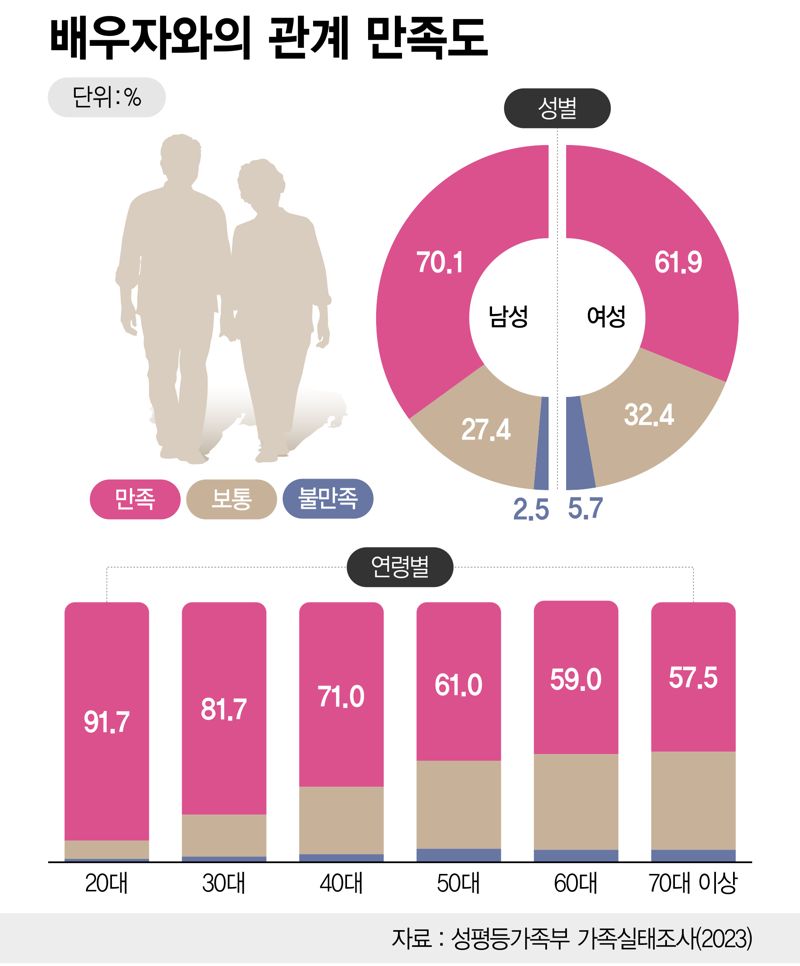
According to the 2023 Family Survey by the Ministry of Gender Equality and Family (MOGEF), satisfaction with one’s relationship with a spouse declines with age. While 91.7% of people in their 20s reported being satisfied, the figure drops to 61.0% in their 50s and 59% in their 60s. By gender, 70.1% of men and 61.9% of women reported satisfaction, revealing a noticeable gap.
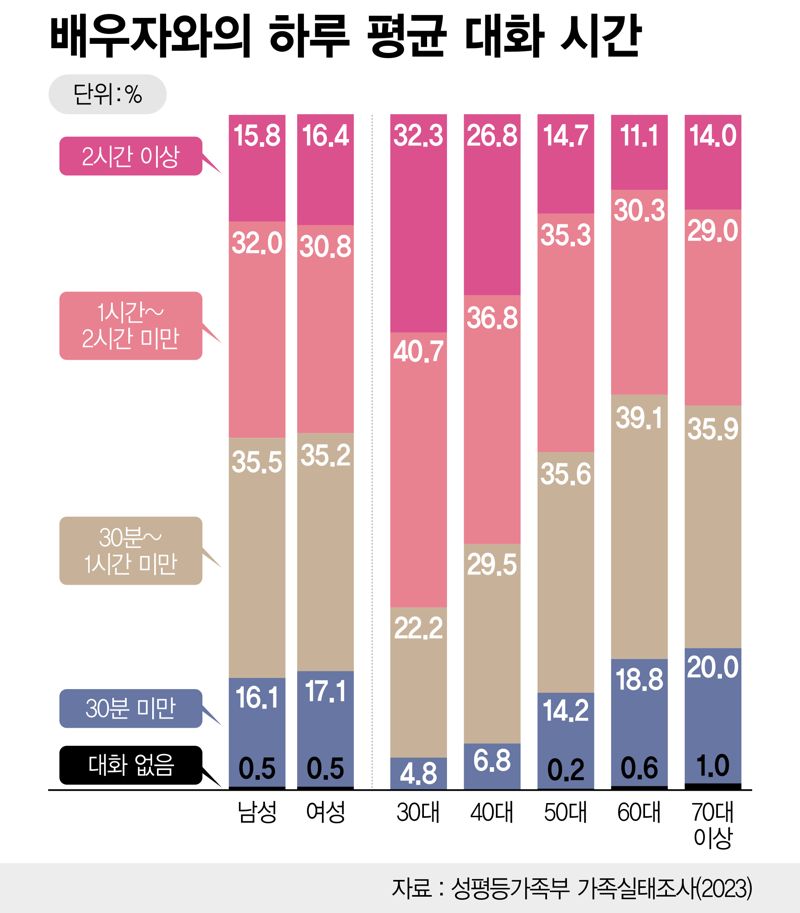
Average daily conversation time with a spouse also decreases. The share of people in their 40s who talk with their spouse for more than an hour a day is 63.6%, but this falls to 50% in their 50s and 41.4% in their 60s. More time together does not automatically translate into more “connected time.”
The sense that conflicts are growing is partly borne out in the data as well.The number of divorces among people aged 60 and olderhas been on the rise over the past decade.
However, it is difficult to interpret this directly as “the collapse of relationships.” Even under similar conditions, some couples choose divorce, while others maintain the relationship by adjusting distance and setting new rules. Divorce is only one possible outcome; before that, there is a long stretch of time in which adjustment is still possible.
Attorney Kim Yoonjung of YK Law Firm, who specializes in family and inheritance law, noted, “It’s hard to say that marital conflict or divorce after retirement is a problem that suddenly appears,” and explained, “In most cases, the conflicts already existed during the marriage, but they simply did not surface because the couple was preoccupied with raising children and managing their careers.” She continued,“Once the children grow up and careers wind down at retirement, there is no longer a compelling reason to keep enduring. That’s when long-postponed issues in the marriage tend to erupt all at once.”she added.
Not the end of the relationship, but the start of a transition
Marital relationships after retirement do not sustain themselves automatically. Problems do not arise simply because the couple lives together, but because each begins to live a different kind of retirement. If left unattended, the distance widens; if adjusted, a new balance can emerge.
Seo-won Lee, director of the Nauri Family Counseling Center and adjunct professor at the Sogang University Graduate School of Public Policy, said, “In many Western countries, couples’ relationships improve after retirement, but in Korea, where couples have not spent much time together before, the relationship often goes into a steep decline,” adding, “You need to work on improving the relationship even before retirement.” Lee went on, “To build a better relationship, you need a shift in mindset. Give your partner the right to choose, and approach them with curiosity rather than suspicion.”
Every morning, couples leave home in different directions. The point where those days meet again may be the dinner table or a single day on the weekend. What matters is not forcing your partner to match your pace, but acknowledging each other’s speed.
The old formula “retirement equals exit” is collapsing. In an era when average life expectancy is 83, and Generation X is entering full-scale retirement, the very concept of retirement is being redefined. Their stories of a “second act of life” are gathered inRetiree X’s Blueprintwhich will be delivered to readers every Saturday morning. Subscribe to the reporter’s page to receive it more conveniently.
[email protected] Reporter Kim Ki-seok Reporter