K-Content Industry Faces Its Golden Time Next Year: Artificial Intelligence, Intellectual Property, and Attachment Capital Are Key
- Input
- 2025-12-22 11:11:14
- Updated
- 2025-12-22 11:11:14


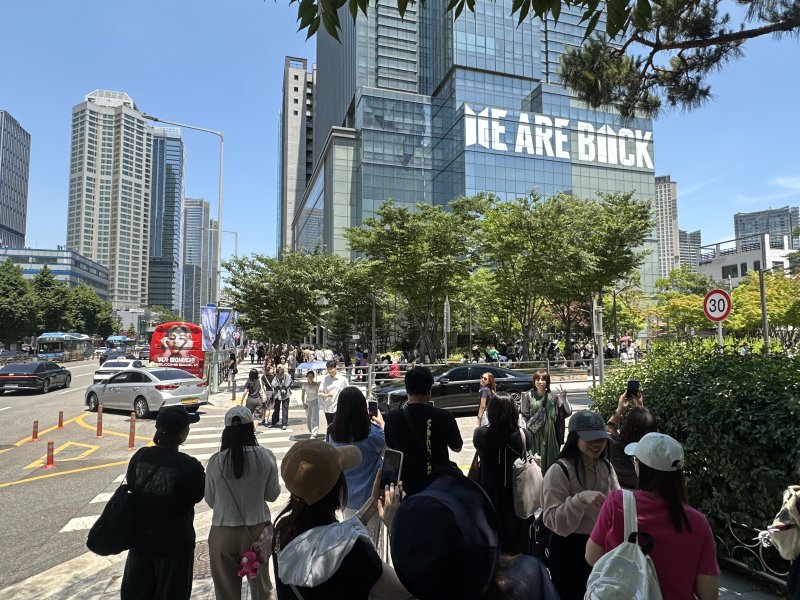
[Financial News] There is a growing consensus that next year will be the 'golden time' for the K-Content Industry. While this year has been marked by the expansion of generative Artificial Intelligence (AI), the advancement of Intellectual Property (IP) business, and the diversification of K-content in global markets, 2026 is expected to determine whether these changes will be solidified within the industry structure.
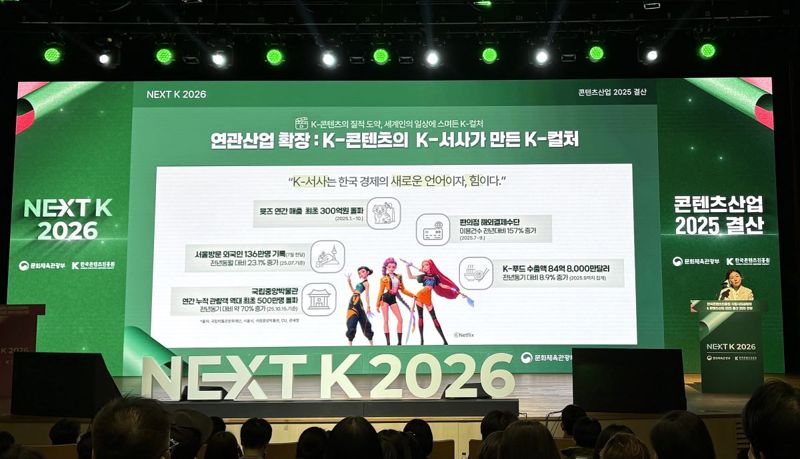
The 'NEXT K 2026' event, which reviewed and forecasted the K-Content Industry, was held at COEX in Gangnam-gu, Seoul, on the 17th.
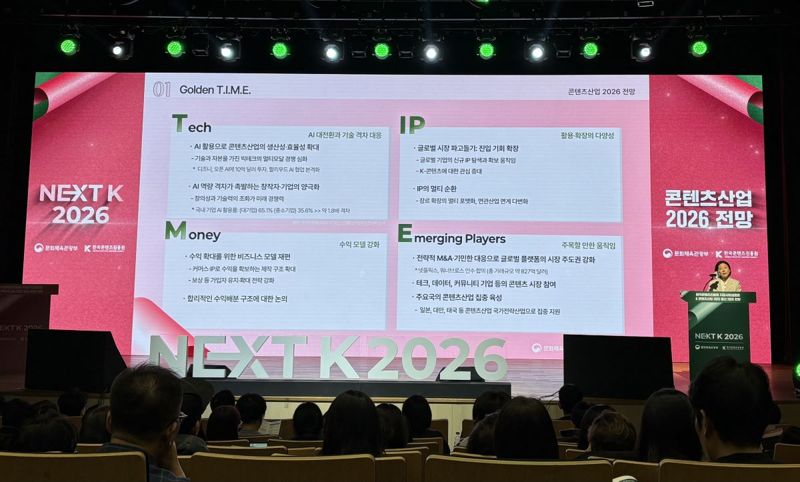
Song Jin, head of the Content Industry Policy Research Center at the Korea Creative Content Agency (KOCCA), stated, "2026 will be a golden time that determines the sustainable growth of K-content and its leap toward the next K. Strategic choices regarding key tasks such as responding to the great transformation brought by Artificial Intelligence (AI), utilizing IP, and diversifying revenue models could widen the gap in industrial competitiveness."■ Surge in Generative AI Usage: Video Sector Jumps from 3% to 30%According to the report '2025 Content Industry in Data,' the most notable change this year has been the rapid increase in the use of generative Artificial Intelligence (AI). In the first half of the year, the utilization rate of generative AI among content industry businesses reached 20%. This figure represents a critical point at which innovative technology spreads across the industry, indicating that AI is becoming a fundamental infrastructure throughout the sector.
The scope of application has quickly expanded to all stages, including content production (63%), creation (40%), planning (37.4%), and marketing/promotion (29%). In the broadcasting and video industry, the utilization rate was only 3% in the second half of 2024 but surpassed 30% in the first half of this year.
The advancement of Intellectual Property (IP) business is also noteworthy. IP transaction revenue accounted for 29.3% of total content industry sales. Strategies such as expanding universes through seasonal series and spin-offs like 'Office Workers' and 'Cheongdam International High School Art Club,' and minimizing production gaps, have become commonplace. As a result, IP has become an industrial asset managed and expanded over the long term, rather than a one-off hit.
K-content continued to rise in the global market this year. According to the Bank of Korea's content service trade statistics, K-content exports have shown explosive growth since 2021, particularly in Latin America and the Middle East. Domestically, the consumption environment has shifted to a platform-centric structure. This year, the usage rate of OTT services such as YouTube and Netflix approached 90%. These changes have brought opportunities but also exposed structural issues. As global platforms dominate distribution, declining profitability has become a major concern for the broadcasting and video industries.■ "The Era of Content Sales Is Over": Broadcasting as a Marketing PlatformThe key words for the content industry in 2026 presented at the event included Golden T.I.M.E., AI Reset, Content IP League, Attachment Capital, HIP 2.0, and Sensitivity to Boundaries. Among these, IP and Attachment Capital were highlighted as major keywords for content companies' monetization strategies.
Oh Young Hwang, head of content at Joongang Tongyang Broadcasting Company (JTBC), noted, "In the face of a triple crisis—reduced production, shrinking investment, and a declining advertising market—the era of content sales has ended. We are now entering an era of accumulating and utilizing IP. Broadcasting should be redefined not as a revenue channel, but as a marketing platform."
SAMG Entertainment's IP strategy, centered on the animation 'Teenieping,' was highlighted as a successful case. Teenieping began as a children's TV animation but expanded its fan base to adults through its theatrical release. Subsequently, the IP's touchpoints were broadened through collaborations with K-pop artists, automobile companies, sports, and finance. This approach was designed to encourage fans to engage in 'experiential consumption' within the Teenieping universe, going beyond simple product sales.
Jae Seung Song, head of strategy planning at SAMG Entertainment, explained, "The purpose of collaboration is to provide consumers with new forms of play and experiences. Fans no longer just watch content once and move on. By continuously creating touchpoints and offering new experiences within them, fandoms can be maintained and expanded."■ Fandom as 'Attachment Capital': A Powerful Asset and a Potential RiskAnother key word to watch in next year's content industry is 'Attachment Capital.' Fandom is now defined not merely as a consumer group, but as Attachment Capital. This means that the trust, affection, and participation of fans accumulate to create social, cultural, and economic value.
Fandom is now seen not as 'people who have watched content,' but as 'members of a universe.' Fans contribute opinions to story development, create secondary works, and sometimes collectively raise issues about the direction of production.
Choi Minkuen, a producer at Munhwa Broadcasting Corporation (MBC), emphasized, "Planning that fails to understand fandom is likely to fail. It is no longer an era where creators simply present the stories they want to tell. Now, content must be offered after accurately understanding the universes and desires that fans want."
Amid these changes, the role of creators is also evolving. They are now more like designers of 'playgrounds' where fans can participate and expand. The concept of 'verisimilitude' as a new realism was also highlighted.
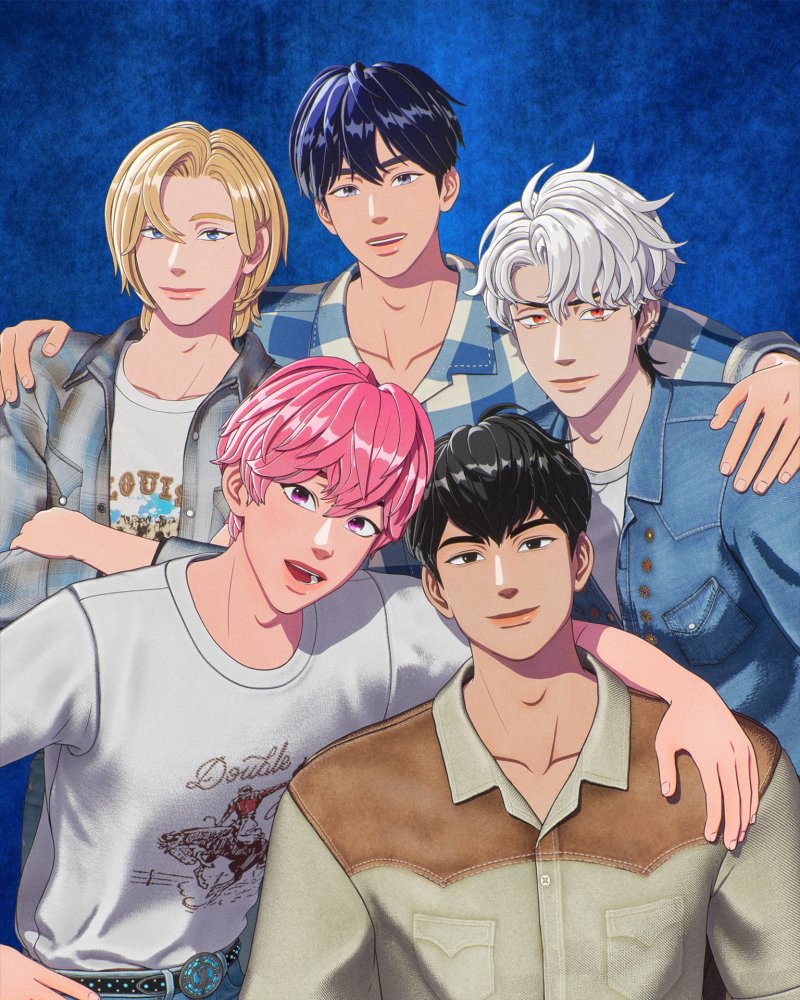
Choi also mentioned the popularity of the virtual idol group Plave, noting, "Even exaggerated settings or unrealistic characters can succeed if fans accept the universe they belong to."
Song Jin also stated, "Fandom has become more than just consumers—they are now investors. If quality control, transparent communication, and feedback systems for fandom break down, Attachment Capital can quickly turn into a risk. Fan trust is the most powerful asset and also the most volatile variable."
jashin@fnnews.com Shin Jin-a Reporter