Government Launches Pan-Ministerial Task Force to Address Coupang Incident... 10,000 GPUs to Be Distributed Early Next Year, AI Bio Development Planned
- Input
- 2025-12-18 08:50:00
- Updated
- 2025-12-18 08:50:00
To address the Coupang personal information leak, the government will establish a pan-ministerial task force (TF) led by the Second Vice Minister of the Ministry of Science and ICT (MSIT), with participation from relevant agencies.
Starting in February next year, the government will distribute approximately 10,000 Graphics Processing Units (GPUs) to industry, academia, and research sectors. To strengthen nationwide Artificial Intelligence (AI) competency, the government will provide AI education and training. The 'K-NPU' strategy will also be promoted to secure the performance of domestically developed Neural Processing Units (NPUs) that robustly support independent AI models. Five key areas—including drug development, brain and anti-aging, and medical devices—have been selected for the development of AI bio models.
MSIT announced on the 18th that, during the Ministerial Meeting on Science and Technology, ten core agenda items were approved to secure global leadership in future strategic technologies.
Establishing a Pan-Ministerial Response System for the Coupang Incident
The government decided to form a pan-ministerial TF for the Coupang incident due to heightened concerns raised during the National Assembly hearing, including Coupang’s lukewarm response, potential user damages, and the need to improve information security systems. The decision was based on the belief that a comprehensive government response is necessary for a prompt resolution. The pan-government TF will focus on investigating and prosecuting security breaches, protecting users, reforming information security certification systems, and enhancing corporate accountability. The first meeting is scheduled by the end of this month, and the TF leader will regularly convene inter-ministerial meetings and monitor progress.Of the roughly 13,000 GPUs secured through this year’s first supplementary budget, about 10,000 units allocated for government use will be distributed sequentially from February to the industrial sector (including SMEs and startups), academia, research institutions, and national AI projects.
Additionally, initiatives such as the 'AI National Secretary,' 'AI-based Tax Service Innovation,' 'AI-based Weather and Climate Prediction System,' 'AI Patent Analysis and Examination,' 'AI-based Wildfire and Haze Prediction,' and 'AI-based CCTV Monitoring' will be promoted.
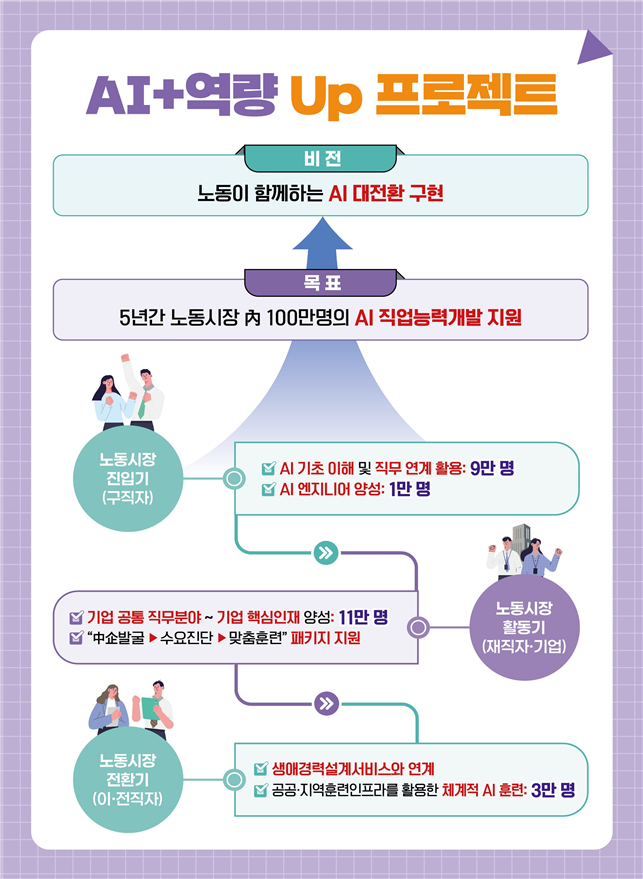
The government will also implement a plan to nurture AI talent in the labor market, focusing on those entering, active in, or transitioning within the workforce, to strengthen their AI utilization capabilities.
For job seekers, systematic AI education and training will be provided, covering AI literacy, practical application, and solution development. The 'K-Digital Training AI Campus' will be operated to help entry-level young developers grow into AI engineers and AI application developers. To encourage youth participation, support for trainees will be significantly increased, including a monthly stipend of up to 600,000 won.
For small and medium-sized enterprises (SMEs) and incumbent workers, a package support system will be offered, including discovering SMEs seeking AI training, diagnosing training needs, and linking tailored training programs. In particular, vocational training consultants with domain and AI expertise will be trained to provide consulting on SMEs’ training situations. Additionally, remote AI training will be offered free of charge to up to 100,000 workers, and company-specific training courses and problem-solving programs will be systematically provided.
For middle-aged individuals and others preparing for new careers or transitions, Korea Polytechnics, a public vocational education and training institution, will offer not only basic AI utilization education but also specialized AX training. Regional job transition training utilizing AI will also be newly supported.
Plans are also in place to systematically establish the infrastructure needed for AI training. In regions lacking AI training infrastructure, four 'Physical AI Labs' and twenty 'AI Specialized Joint Training Centers' will be newly established. In response to field feedback about a shortage of AI instructors, the 'AI Instructor Academy Program' will be launched to systematically train teachers and instructors.
A joint strategy to advance the domestic AI semiconductor industry ecosystem was also discussed by relevant ministries.
This initiative aims to overcome the high power consumption and operational costs of GPUs and to secure a leading position in the AI inference market by fostering the domestic AI semiconductor industry. The K-Nvidia Initiative includes three major action plans: technological innovation, demand creation, and investment and talent development, all aimed at establishing Korea as a global powerhouse in AI semiconductors.
To secure the performance of domestically developed NPUs that robustly support independent AI models, the K-NPU project will be promoted through performance enhancement, the establishment of large-scale testbeds, and the development of evaluation and feedback systems to implement a K-AI and NPU package. Additionally, the government will secure physical AI-specialized NPUs and next-generation ultra-low-power AI semiconductor technologies, and pursue technological independence across hardware and software for the autonomous operation of large-scale AI computing infrastructure.
Efforts to create demand and markets linked to the national AI transformation will be intensified. In the public sector, the government will promote the 'K-NPU Public Leadership Seven Projects,' including building AI infrastructure for administrative tasks, public safety and defense AX, and AI CCTV conversion. In the private sector, NPU development, demonstration, and mass production projects will be carried out in key industries such as automobiles, home appliances, robotics, and defense, with focused support for global expansion of the K-AI and NPU package through local demonstration and consulting.
Fostering AI Experts Nationwide
Through the National Growth Fund, the government will promote the tentatively named K-Nvidia Initiative to support investment and financing for the development and mass production of next-generation products. The AI and semiconductor policy fund will provide over 300 billion won in early-stage startup growth capital by 2030. The government will also address the shortage of fabless talent by nurturing advanced and practical AI semiconductor professionals, and establish innovation hubs linking industry, academia, and research in the southern semiconductor innovation belt.AI-based innovation will also be promoted in bio research and industry. Five key areas—including drug development, brain and anti-aging, and medical devices—have been selected for the development of AI bio models. The government will also build and open a Multimodal-Multiscale Bio-Foundation Model for broad industrial use.
By the first half of next year, a pilot AI bio hub will be established and expanded to more than two locations after 2027, supporting regional economic growth. These hubs will offer a package of support for R&D, infrastructure, data utilization, and talent development, building an AI bio ecosystem through collaboration among industry, academia, research, and medical sectors.
By 2030, the government aims to secure over 7 million high-quality bio data sets and will promote legislation and system improvements to encourage bio data utilization. Additionally, dedicated high-performance computing infrastructure for AI model training in bio will be built in stages.
The government will restructure TIPS R&D into three stages—TIPS, TIPS for Scale-up, and Global TIPS—to match the stages of startup creation, growth, and global expansion, and will expand 'Commercialization Matching Investment' and large-scale corporate IR events to encourage private investment. The support scale for the Deep Tech Challenge Project (DCP), in which the private sector invests in government-proposed, innovative challenges tackled by SMEs and startups, will be increased to 5 billion won per project, and a new Ecosystem Innovation R&D Program worth 20 billion won per project will be launched.
In major strategic sectors such as ABCEDF, the government will support technological innovation of promising companies through pan-ministerial cooperation, linking the discovery of outstanding companies, R&D, and subsequent growth, while expanding the participation of specialized institutions in each field. To strengthen regional innovation capabilities, TIPS R&D will be utilized, with more than 50% of TIPS and TIPS for Scale-up allocated to regional companies, an increased share for regional operators, and the creation of dedicated regional investment funds to further vitalize regional investment.
[email protected] Jang Min-kwon Reporter