[Exclusive] Record 1.15 Million Hacking Attempts on Virtual Asset Exchanges This Year—Double Last Year’s Figure [Crypto Briefing]
- Input
- 2025-12-16 15:10:23
- Updated
- 2025-12-16 15:10:23

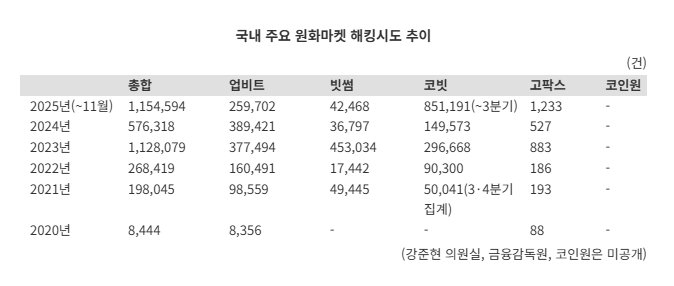
[Financial News] The risk of hacking at domestic virtual asset exchanges is rising. This year, the number of hacking attempts at the four major virtual asset exchanges reached 1.15 million, hitting an all-time high. The figure has doubled compared to last year, showing a steep upward trend.
According to data obtained by Junhyeon Kang of the Democratic Party of Korea (DPK) from the Financial Supervisory Service (FSS) on the 16th, there were 1,154,594 hacking attempts targeting Upbit, Bithumb, Korbit, and GOPAX through November this year—the largest number since records began. Korbit submitted data compiled through the third quarter, while Coinone did not disclose figures for security reasons. Therefore, the actual number of hacking attempts targeting the five major won-based virtual asset exchanges this year is likely even higher.
The annual number of hacking attempts at the four major virtual asset exchanges was 268,419 in 2022, 1,128,079 in 2023, and 576,318 in 2024, meaning this year's figure is more than double that of last year. Compared to 2022, the number has increased more than fourfold in three years. In 2023, the COVID-19 pandemic led to more remote work and internet use, which the Democratic People's Republic of Korea (DPRK) exploited as a channel for concentrated hacking attempts.
By company, Korbit recorded the highest number of hacking attempts this year at 851,191—an eightfold increase from last year's 149,573. This marks a shift from previous years, when exchanges with higher market shares like Upbit and Bithumb saw the majority of hacking attempts.
Experts analyze that the popularization of generative Artificial Intelligence (AI) has made it easier for non-experts to attempt hacking, leading to an increase in attacks on small and mid-sized virtual asset exchanges.
Suk-Jin Hwang, a professor at the Graduate School of International Information Security, Dongguk University, explained, "In the past, people had to write programs themselves to launch attacks, but now there are more cases of hacking attempts using AI." He added, "Large exchanges maintain security at the level of financial institutions, so many hackers appear to be targeting small and mid-sized exchanges, assuming their security is weaker."
A Korbit representative stated, "Recently, there have been an unusually high number of hacking incidents targeting the global virtual asset industry." The representative continued, "In particular, the number of attacks surged this year after a global vulnerability related to the 'React Server' was disclosed."
Experts agree that as hacking risks grow across the industry, security measures must be strengthened—not only by increasing related budgets, but also by expanding simulated hacking drills. Professor Hwang emphasized, "With the advancement of digital technologies such as AI, there are limits to preventing hacking itself. The key is how quickly recovery can occur after an incident." He stressed, "Security capabilities should be enhanced through regular monitoring and expanded simulated hacking drills to continuously identify and address vulnerabilities."
yimsh0214@fnnews.com Im Sang-hyuk Reporter