Korea and UK Conclude Korea-UK FTA Revision Talks: Expanded Tariff Benefits for Automobiles, UK High-Speed Rail Market Opens
- Input
- 2025-12-16 08:49:56
- Updated
- 2025-12-16 08:49:56
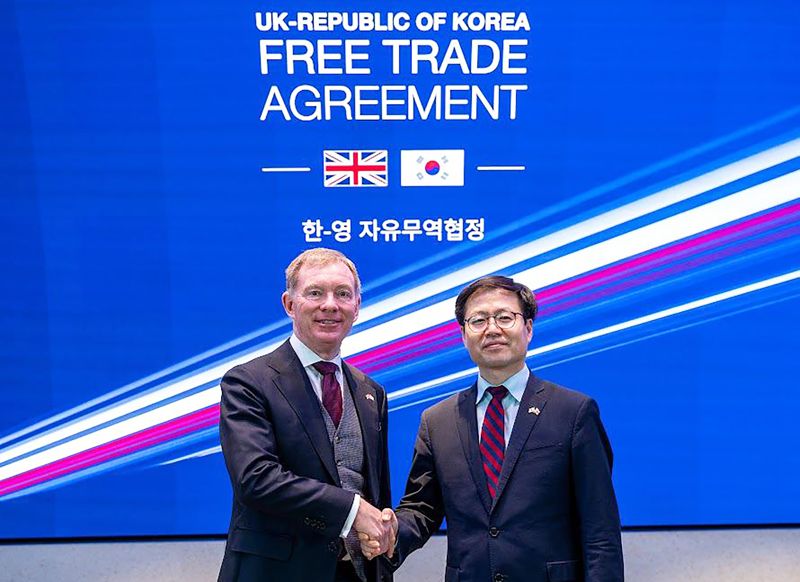
[Financial News] After more than two years of negotiations, Korea and the United Kingdom have finalized the Korea-UK Free Trade Agreement (Korea-UK FTA) revision talks. As a result, the scope of tariff-free benefits for automobiles—which account for one-third of Korea’s exports to the UK—will be expanded, and the UK’s high-speed rail (HSR) market will be opened, raising expectations for increased exports.
On the 15th (local time), Yeo Han-koo, Korea’s Trade Minister, and Chris Bryant, UK Department for Business and Trade Minister for Trade, concluded the Korea-UK FTA revision talks in London and signed a joint declaration.
Following the UK's declaration to leave the European Union (EU), Korea and the UK initially signed the Korea-UK FTA with the same terms as the European Union–South Korea Free Trade Agreement (EU–South Korea FTA) to ensure continuity in trade and investment and to maintain a stable and predictable business environment. Subsequent negotiations have now been concluded.
According to the joint declaration, for automobiles—which accounted for 36% ($2.39 billion) of Korea’s exports to the UK last year and are subject to a 10% tariff—the value-added requirement for tariff-free benefits has been lowered from 55% to 25%. Previously, more than 55% of value-added (such as parts and materials) had to originate from either country to qualify for duty-free status, but this threshold has now been reduced.
In particular, for electric vehicles, the value-added percentage can vary significantly depending on the price of imported materials such as lithium and graphite used in battery manufacturing. With this relaxed standard, Korean companies are expected to benefit more from the FTA’s tariff exemptions.
The rules of origin for promising export items such as K-beauty and K-food have also been eased. Going forward, chemical products such as cosmetics (with tariffs up to 8%) will be eligible for duty-free treatment if processes like chemical reactions, refining, mixing, or blending are performed in either country. Additionally, processed foods such as dumplings, tteokbokki, gimbap, and kimchi (with tariffs up to 30%) previously required raw materials like flour and vegetables to be sourced locally for duty-free benefits. With the removal of this requirement, products made domestically using major ingredients imported from third countries will now also qualify for tariff exemptions.
In the government procurement market, the UK’s high-speed rail (HSR) market has been newly opened. This corrects the previous imbalance, where only Korea had unilaterally opened its market.
In the services sector, the online gaming industry—where Korean companies are highly competitive—has been newly opened. The agreement also establishes a foundation for Korean companies to enter the UK services market in emerging sectors based on new technologies such as Artificial Intelligence (AI).
Another key achievement is the revision of the visa system, which addresses entry visa risks for personnel needed by Korean companies entering the UK. The agreement includes provisions to facilitate the entry of Korean engineers and maintenance specialists for manufacturing plants in the early stages of establishment. Notably, a visa type that does not require English proficiency—a major barrier for technical personnel—can now be utilized. Korean companies can also invite staff from partner firms to the UK via service contracts.
The agreement also introduces new trade rules, establishing comprehensive cooperation frameworks in areas such as digital trade norms, supply chains, and innovation. The two countries have adopted strengthened data trade rules, including the liberalization of cross-border data transfers, prohibitions on localization requirements for computing facilities, bans on source code submission requirements, and enhanced online consumer protection standards.
To address recent shortages of key raw materials such as rare-earth elements (REE), Diesel Exhaust Fluid (DEF), and batteries, a new supply chain cooperation chapter has been established. In the event of supply chain disruptions, the two countries have agreed to convene an emergency meeting within 10 days via a designated hotline to discuss joint response measures.
Yeo Han-koo, Korea’s Trade Minister, stated, “The revised Korea-UK FTA is significant not only for its market liberalization elements but also for the inclusion of comprehensive cooperation rules to promptly respond to the evolving trade environment, such as digital trade and supply chain stabilization.”
Chris Bryant, UK Minister for Trade, noted, “Korean culture, such as K-drama and K-pop, has already captivated many Britons,” adding, “The conclusion of the revision talks will support the outstanding service industries and businesses of both countries, thereby promoting economic growth.”
Following the announcement of the agreement, the government plans to promptly complete legal reviews and the Korean translation of the agreement text for formal signing. After the official signing, procedures such as economic impact assessments and parliamentary ratification will be carried out to ensure the agreement’s smooth implementation.
[email protected] Park Ji-young Reporter