HD Hyundai, Samsung Heavy Industries, and Hanwha Ocean: The Autonomous Navigation Triumvirate
- Input
- 2025-12-16 15:00:55
- Updated
- 2025-12-16 15:00:55
[Financial News] HD Hyundai, Samsung Heavy Industries, and Hanwha Ocean are fiercely competing in the field of 'autonomous navigation,' which is considered a key future growth driver in the global shipbuilding industry. With labor shortages and advances in artificial intelligence (AI), the global autonomous vessel market is expected to expand significantly, and these companies are striving to secure leadership. The global autonomous vessel market is projected to reach 330 trillion won by 2030, drawing attention to the race for dominance.
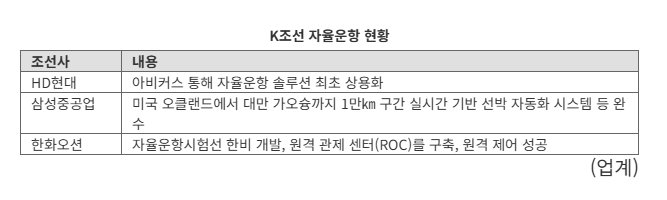
Autonomous Navigation Demonstrates Fuel Efficiency and MoreAccording to industry sources on the 16th, HD Hyundai, through its subsidiary Avikus established in 2020, became the first in the industry to commercialize an autonomous navigation solution. It met the second level of the International Maritime Organization (IMO) autonomous navigation standards, which allows for remote control with crew on board.
In July last year, Avikus installed its system on two vessels operated by HMM and achieved a 4–6% reduction in fuel costs compared to ships without the system. The Avikus autonomous navigation solution was also adopted for fleets at KMTC, H-LINE Shipping, Hyundai Glovis, and others, undergoing six months to a year of testing, which verified its fuel-saving effects. Across 200,000 miles of fleet operation, about a 5% reduction in fuel consumption was reported. Currently, Avikus is the only company offering a commercial product that covers perception, decision-making, and control for autonomous navigation.
Previously, autonomous vessel technology was led by European companies such as Kongsberg Gruppen in Norway and Rolls-Royce Marine in the UK. Although Avikus entered the market later, it is now being recognized as a global player as it accumulates orders.
Chung Ki-sun, Chairman of HD Hyundai, has also shown great interest in Avikus’s autonomous navigation solutions. When HD Hyundai participated in the Consumer Electronics Show (CES), he identified Avikus's autonomous navigation technology as one of the three core innovations to lead the group's future.
Samsung Heavy Industries equipped Evergreen Marine Corp.'s 15,000 TEU container ship with an autonomous navigation system. This year, it successfully completed functional tests of a real-time vessel automation system, condition-based maintenance, and remote monitoring technologies—including vessel video information—over a 10,000 km route from Oakland, USA to Kaohsiung, Taiwan. In October, it also received basic design approval for its remote vessel operation system from ClassNK in Japan.
Furthermore, Samsung Heavy Industries recently opened the Samsung Remote Operation Center (SROC) at Evergreen Marine Corp.'s headquarters in Taipei, Taiwan. This marks the first collaboration of its kind between a shipbuilder and a shipping company. From the land-based SROC control tower, Evergreen Marine Corp. can monitor vessel information and the status of key equipment in real time, enabling more efficient inspections and maintenance. Both companies plan to expand technical development in areas such as remote periodic inspections and prepare for the full-scale era of remote autonomous vessels.
Jong-Woong Choe, head of the Autonomous Navigation Research Center at Samsung Heavy Industries, stated, “The launch of SROC will serve as a ‘Second Bridge’ supporting safe navigation and emergency response during the digital transformation of ships. Through this, we hope Korean shipbuilding can lead remote autonomous navigation technology and contribute to the establishment of international standards.”
Development of Large-Scale and LNG SolutionsIn December 2021, Hanwha Ocean developed the autonomous navigation test vessel Hanbi. It also signed MOUs with the Gyeonggi Free Economic Zone Authority (GGFEZ), Siheung-si, and Seoul National University Siheung Campus to collaborate on the development and demonstration of autonomous navigation technologies. In November 2022, Hanwha Ocean successfully completed a sea trial of its autonomous vessel near Jebudo Island in the West Sea.
Hanwha Ocean established a testbed using its dedicated autonomous navigation test vessel, enabling immediate application, verification, and refinement of developed technologies on actual ships. The company also built a Remote Operation Center (ROC), allowing for remote control. Even in challenging maritime communication environments, Hanwha Ocean provides a digital twin-based control solution that enables remote monitoring with minimal data. For the development of autonomous navigation solutions for large vessels, it is currently installing safety navigation packages on Liquefied Natural Gas (LNG) carriers operating on the open sea, conducting trial operations, and accumulating data.
Hanwha Ocean stated, “In line with the establishment of the International Maritime Organization (IMO)’s Maritime Autonomous Surface Ships Code (MASS Code), we aim to secure smart ship technology capable of full autonomy and lead the future shipbuilding market. By 2030, we plan to achieve stage 4 autonomous navigation technology.”
[email protected] Kang Gu-gwi Reporter