"DPRK Provocation → Seizure of Legislative and Judicial Powers → Elimination of Opposition → Dictatorship": Yoon's Scenario
- Input
- 2025-12-15 12:00:51
- Updated
- 2025-12-15 12:00:51
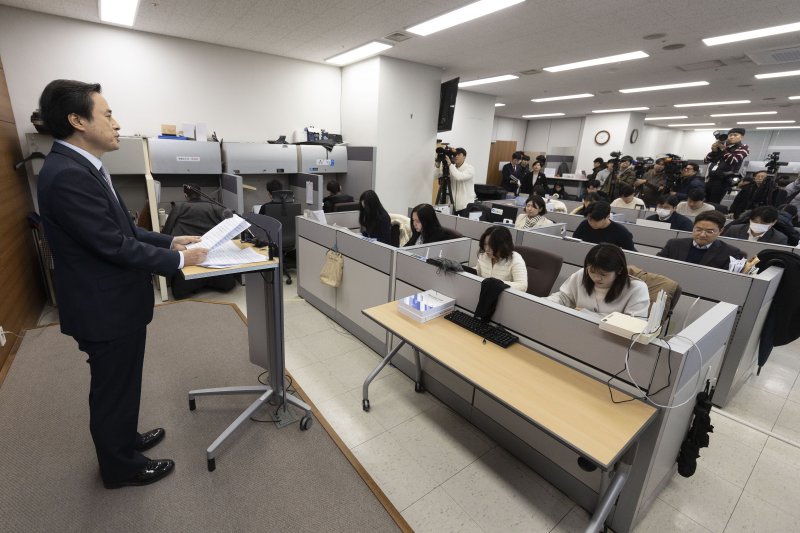
[The Financial News] A scenario involving a DPRK military provocation leading to a wartime situation or a similar crisis, followed by Martial Law, military control, seizure of legislative and judicial powers, elimination of opposition forces, and the establishment of a dictatorship—this is what the Special Prosecutor Team for Insurrection and Treason uncovered after 180 days of investigation into former President Yoon Suk Yeol’s Martial Law plans.
Announcing the investigation results on the 15th, Special Prosecutor Cho Eun-seok stated, "Yoon Suk Yeol prepared for Martial Law before the April 2024 general election, attempted to provoke a DPRK military response to justify declaring Martial Law, but failed. He declared Martial Law with the intent to seize legislative and judicial powers through military force, eliminate political opposition, and monopolize and maintain power."
On the 15th, the special prosecutor team released its findings in the 'Special Prosecutor’s Investigation Results on Insurrection and Treason by Former President Yoon Suk Yeol and Others.' According to the team, Yoon began preparations for Martial Law before October 2023. Of his 1,060-day term, from his inauguration on May 10, 2022, to his impeachment on April 4, 2025, more than half (54%) was spent focusing on Martial Law rather than state affairs. Considering that state governance was virtually impossible for about four months after the declaration of Martial Law, the actual period of normal administration was even shorter.
On December 3 of last year, Yoon cited the anticipated post-election parliamentary impeachments, legislative dictatorship, and budget cuts as reasons for declaring Martial Law in his public address. However, the special prosecutor team determined that Yoon had been considering 'emergency powers' since the early days of his presidency and had mentioned this to his associates several times, beginning covert preparations for Martial Law in 2023.
The special prosecutor team also noted that Yoon relocated the Office of the President of South Korea to the Yongsan military base, creating an environment of close proximity between the president and military leadership. While the relocation may not have been initially intended for Martial Law, the proximity between the Office of the President and the military could have influenced the subsequent Martial Law process.
In fact, the special prosecutor team found that an abnormal military operation was conducted to provoke a DPRK military response as a pretext for declaring Martial Law, but this failed as the DPRK did not respond militarily. During related trials, suspicions were raised about leaflet drops toward the DPRK and the use of military drones to provoke a DPRK military response during Yoon’s administration.
The special prosecutor team also discovered that Yoon and others considered the timing of Martial Law in relation to military personnel appointments scheduled for October of the following year. The team concluded that preparations for Martial Law became more concrete at this point. Regarding the decision to declare Martial Law on December 3, the team explained, "It appears the timing was chosen to exploit the confusion following the U.S. presidential election and before the inauguration, in order to prevent U.S. intervention."
There were suspicions that the Martial Law schedule was moved up to suppress investigations related to First Lady Kim, but the special prosecutor team stated, "No evidence was found that Kim Keon-hee was involved in Martial Law, nor was there any record of her activities on that day."
The special prosecutor team concluded that Yoon enforced Martial Law to eliminate political opposition by force and to monopolize and maintain power.
It was determined that Yoon sought to establish an unchecked dictatorship by mobilizing the military to seize judicial power and using an emergency legislative body to take control of legislative authority, thereby concentrating all legislative, judicial, and executive powers.
Supporting evidence included a directive sent to then-Minister of Economy and Finance Choi Sang-mok regarding 'cutting off National Assembly funds and allocating a budget for the emergency legislative body,' a document delivered to then-Minister of the Interior and Safety Lee Sang-min and others about 'cutting off electricity and water to media companies and blockading the DPK headquarters,' a memo from former commander Yeo listing 'politicians to be arrested,' and a note in former commander Noh’s notebook stating 'destroy all left-wing forces in preparation for the next presidential election.'
The special prosecutor team stated, "It was confirmed that Yoon Suk Yeol, rather than acting out of conviction, sought to eliminate those who opposed or defied him by labeling them as anti-state forces and using Martial Law as a means to remove them."
According to the special prosecutor team, in July 2024, Yoon referred to former party leader Han, whom he had appointed as Minister of Justice, as a 'commie' in a conversation with Kang Ho-pil, then Deputy Chairman of the ROK JCS. Three months later, on October 1, during a dinner with military commanders, Yoon reportedly said, 'Bring me Han Dong-hoon. I will shoot him dead.' The team also determined that Yoon attempted to arrest judges who delivered rulings he found unfavorable.
[email protected] Lee Hwan-joo, Jeong Kyung-soo Reporter