"Police Resources Tied Up Responding to 'Drunken' Calls... Is There No Solution for Year-End Intoxicated Individuals?"
- Input
- 2025-12-16 14:46:38
- Updated
- 2025-12-16 14:46:38

[Financial News] As year-end gatherings return, reports to the 112 Police Emergency Number concerning intoxicated individuals continue to rise. Critics argue that police resources are being wasted as officers are tasked not only with crime and emergency response but also with managing intoxicated persons. The recurring structure, in which frontline officers bear legal responsibility if incidents occur during the protection of intoxicated individuals, has prompted calls for systemic reform.
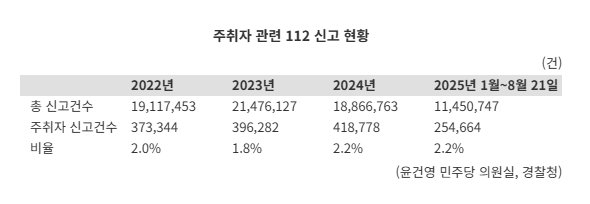
According to data obtained from the Korean National Police Agency (KNPA) by the office of Yun Kun Young, a member of the Security and Public Administration Committee from the Democratic Party of Korea (DPK), the proportion of intoxication-related reports among all 112 Police Emergency Number calls nationwide has remained between 1.8% and 2.2% over the past four years.
While the percentage may seem minor, the absolute number of cases has steadily increased each year. In fact, reports involving intoxicated individuals rose from 373,344 in 2022 to 396,282 in 2023, reaching a record high of 418,778 last year. Notably, while the total number of 112 Police Emergency Number calls dropped from approximately 21.48 million in 2022 to about 18.87 million last year, intoxication-related reports continued to climb.
This trend has persisted into the current year. From January to August, 254,664 intoxication-related reports were filed, which, if extrapolated, suggests an annual total of around 380,000. Considering the year-end surge, the figure may approach last year's record.
By region, these reports are concentrated in the Seoul metropolitan area and major cities. In 2023, the Gyeonggi Nambu Provincial Police Agency recorded the highest number with 76,236 cases, followed by the Seoul Metropolitan Police Agency with 67,226. The Gyeonggi Bukbu Provincial Police Agency (30,589) and the Gyeongnam Provincial Police Agency (34,419) were also among the top. Combined, Seoul and Gyeonggi accounted for about 42% of all intoxication-related reports nationwide.
This reflects the characteristics of the metropolitan area, such as a high concentration of entertainment venues, dense population, and a large number of people active late at night. The concern is that these regions also have high demand for responses to violent and everyday crimes. Officers and patrol units tied up handling a single intoxication report may delay responses to other urgent incidents, a persistent worry among frontline personnel.
A crime prevention chief at a Seoul police station, identified as Mr. A, stated, "Most incidents occur between 10 p.m. and midnight. When officers are occupied with intoxication cases, they sometimes cannot respond promptly to other incidents." He added, "The burden is much heavier at year-end due to more gatherings and company dinners compared to other periods." He further explained, "Each intoxication report typically requires two officers and one patrol car, and if the individual is armed, even more personnel are needed."
Yeom Gun-woong, a professor at U1 University’s Department of Police and Fire Administration, remarked, "With police duties expanding to include investigations, assembly and protest management, and responses to drug, cyber, and financial crimes, it is questionable whether the police can continue to handle all intoxication-related reports alone." He suggested, "It is necessary to either increase staff at Police Precincts and police boxes or hire special personnel to support intoxication-related tasks, and to shift towards sharing responsibilities with other ministries and local governments."
Incidents and controversies surrounding the protection of intoxicated individuals continue to recur. In October last year in Goyang, Gyeonggi Province, a man in his seventies under police protection fell onto the road and suffered a severe head injury, leaving him unconscious. While the family claimed the police failed to provide adequate protection, the police maintained that the accident occurred unexpectedly during the fulfillment of their duties. Previously, officers who left an intoxicated man in his sixties sitting on the steps outside his home after finding him lying on the street were fined for involuntary manslaughter after the man died.
Chief A said, "In the past, there were cases where officers took intoxicated individuals home, only for them to die from hypothermia. Nowadays, we try to hand them over to their guardians whenever possible," but he admitted, "There are many factors, such as underlying health conditions, that are difficult to assess on the spot."
Experts point out that these burdens stem from structural issues. Lee Ung-Hyeok, a professor of police studies at Konkuk University, commented, "Protecting intoxicated individuals is not merely a public safety issue but an urgent health and welfare matter. In principle, the Ministry of Health and Welfare should be equipped with facilities and professional staff to manage this responsibility." He criticized the longstanding practice of shifting this duty to the police without establishing proper systems and facilities. He emphasized, "The Ministry of Health and Welfare must legally provide and manage facilities, spaces, and specialized personnel, while the police should focus on discovery, reporting, and handover roles."
[email protected] Kim Ye-ji Reporter