[Editorial] World’s First Implementation of AI Law: Regulation Should Be Cautious to Avoid Stifling Industry
- Input
- 2025-12-14 19:01:37
- Updated
- 2025-12-14 19:01:37
The domestic Framework Act on the Development of Artificial Intelligence was established in response to widespread calls for comprehensive legal support from the government to help Korea become a global AI powerhouse. However, from the outset, there has been considerable criticism that the law focuses more on regulation than on industry promotion. The public notice for the enforcement decree only began in mid-last month and will continue until the 22nd of this month. Reviews by the Ministry of Government Legislation (MOLEG) and the Regulatory Reform Committee are still pending, meaning the enforcement decree will only be finalized right before the law takes effect. It is understandable that the industry is concerned about the lack of time to respond to these regulations.
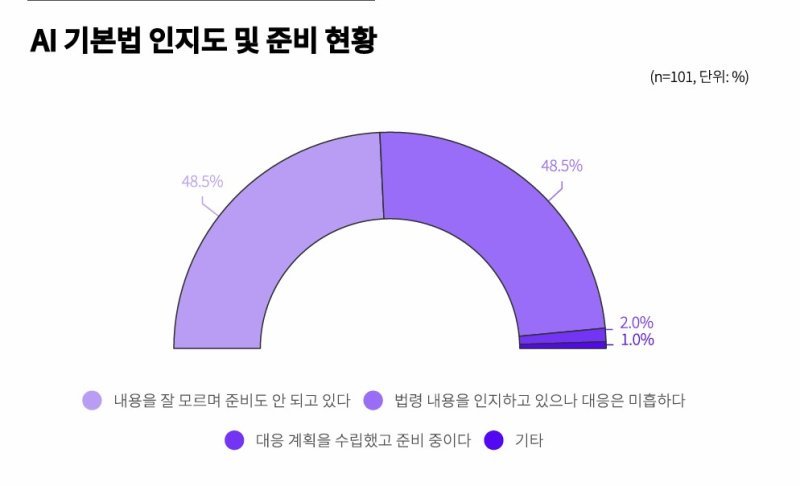
According to an industry survey, 98% of startups reported that they have not established a practical response system for the implementation of the Framework Act on the Development of Artificial Intelligence. This means that most startups are unprepared. Half of the respondents stated they were not even aware of the law’s content, while the remainder acknowledged the law but admitted their response was inadequate. Once the law is fully enforced, the industry could face significant confusion.
Clear standards must be established to ensure that the mandatory use of watermarks to indicate AI-generated content does not become excessive regulation. To ensure AI transparency, the government has mandated that businesses must notify users in advance if products or services are operated using High-Impact Artificial Intelligence (High-Impact AI) or Generative artificial intelligence (Generative AI). Regulations are necessary to prevent AI from being misused in crimes involving deepfake materials or indiscriminate medical advertising. However, it is questionable whether it is appropriate to apply uniform standards across the entire content industry. If every piece of work created with AI is labeled as 'AI-generated' simply because AI was used, countless creators who worked tirelessly overnight may see their works indiscriminately tagged. This could rapidly shrink the content industry. The industry also complains that there is no clear consensus on the definition of High-Impact AI. The law defines it as 'AI that may have a significant impact on or pose risks to an individual's life or body,' but this is open to interpretation. A comprehensive review is needed.
Korea should consider why the EU, despite enacting its law first, decided to delay full implementation. While the EU did respond to persistent demands from U.S. big tech companies, there are deeper reasons. Most notably, the delay reflects the circumstances of member states that are lagging in the AI race. European countries are already trailing the U.S. and China in AI competitiveness, and excessive regulation would further slow their technological catch-up. This is why the EU has stepped back from the forefront of AI regulation. Japan is showing a similar trend. In September, Japan announced its AI Guidelines for Ensuring Appropriateness, emphasizing self-regulation. This contrasts with Korea, where administrative fines and government investigative powers are mandated. Many believe this is also why Korean AI startups are expanding their business in Japan.
Appropriate regulation in line with evolving technology is necessary, but it should not hinder industrial growth. It is essential to fully incorporate feedback from the field and find a balance between technological advancement and regulation.