"The More You Sell, the Less You Earn"... The Uncomfortable Truth Behind Ginseng Exports to China
- Input
- 2025-12-14 09:07:44
- Updated
- 2025-12-14 09:07:44
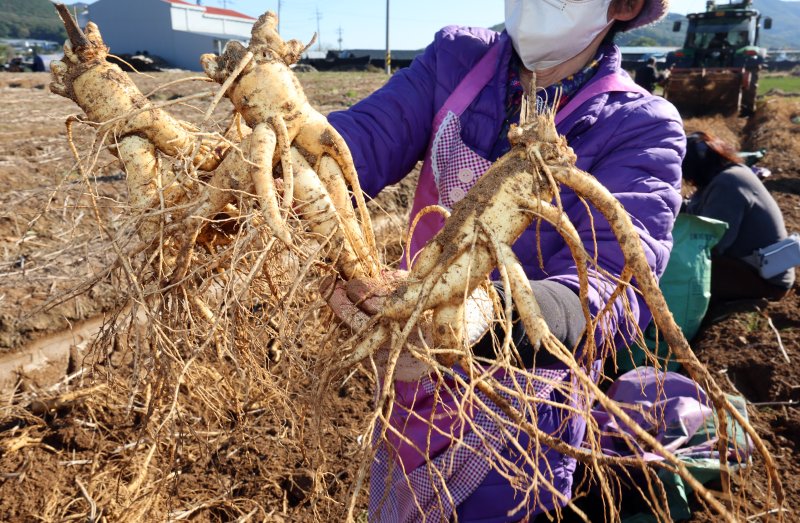
[Financial News] Although demand for Korean Ginseng in China continues to grow due to the wellness trend, a sharp drop in unit prices has put profitability at risk. As China’s economic downturn dampens consumer sentiment, the export structure has shifted from high-priced Whole Ginseng Root to more affordable and convenient processed products.
According to KATI Agro-Fisheries Trade Information (KATI), Ginseng exports to China from January to October this year reached 4,378 tons, an increase of 845 tons (23.9%) compared to last year’s annual export volume of 3,533 tons. This figure is also up by 1,613 tons (58.3%) compared to the 2023 annual export volume of 2,765 tons.
However, export revenue has declined. Ginseng exports to China were valued at $102.06 million in 2023, dipped slightly to $98.86 million last year, and stood at only $67.24 million for the first ten months of this year. While export volume increased, total revenue decreased, causing the export price per kilogram to plunge from $36.9 to $15.3 over two years—a drop of $21.6 (58.5%).
The main reason for this export imbalance is the shift in export items. With China’s prolonged real estate crisis freezing domestic consumption, demand for high-priced Whole Ginseng Root, typically given as gifts, has declined, while the share of cost-effective processed products has risen.
A closer look at the breakdown by product shows that exports of high-end Whole Ginseng Root fell from $38.85 million in January–October last year to $29.55 million during the same period this year, a decrease of $9.3 million (23.9%). In contrast, exports of extract products rose from $8.86 million to $10.16 million, an increase of $1.3 million (14.7%), expanding the share of processed food products in total exports.
Chinese government regulations and shifting consumer trends have also posed challenges. An industry insider explained, "In China, six-year-old Whole Ginseng Root is classified as a pharmaceutical product rather than a general food, resulting in high regulatory barriers for customs clearance. Combined with the economic downturn, this has significantly restricted local activities involving high-priced products."
Korean companies are seeking breakthroughs by diversifying their products to match changing consumer trends in China. Korea Ginseng Corporation (KGC, CheongKwanJang) launched the Everytime Red Ginseng Astragalus Drink in China last September, combining Ginseng with Astragalus mongholicus, a medicinal herb familiar to local consumers. The company is also differentiating itself from local health supplement firms by developing customized products using popular health ingredients among Chinese consumers, such as saffron, oyster, and Dendrobium moniliforme.
Experts advise reducing dependence on China and diversifying export markets. Seo Kyung-duk, Professor at the Department of Creative Convergence, Sungshin Women's University, noted, "Unlike the recent global trend in health supplements, traditional Ginseng consumption is stagnating. It is necessary to promote the benefits of Ginseng beyond the domestic and Chinese markets and diversify export destinations."
[email protected] Park Kyung-ho Reporter