Seoul National University Bundang Hospital Lung Cancer Center Surpasses 10,000 Cumulative Lung Cancer Surgeries
- Input
- 2025-12-11 09:29:14
- Updated
- 2025-12-11 09:29:14
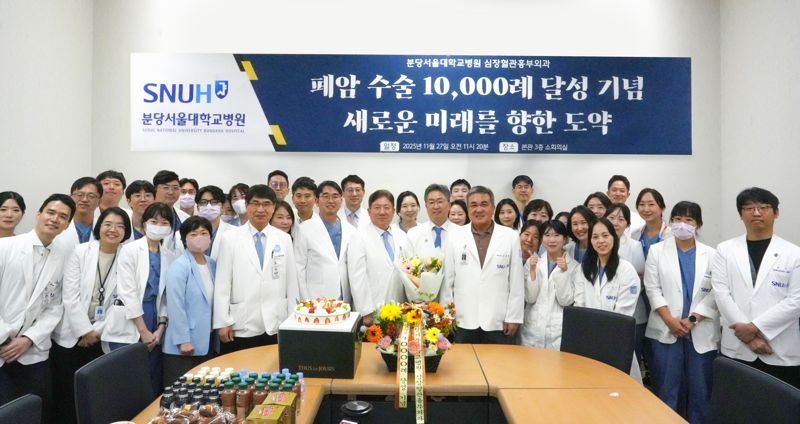
[Financial News] Seoul National University Bundang Hospital announced on the 11th that its Lung Cancer Center has achieved 10,000 cumulative lung cancer surgeries since its opening in 2003, solidifying its unrivaled status in the field of lung cancer treatment both domestically and internationally.
Since surpassing 5,000 cumulative surgeries in 2020, the center has performed an average of over 900 surgeries annually, demonstrating rapid growth.
Lung cancer is the leading cause of cancer-related deaths in Korea, with a five-year survival rate of just 40.6%, significantly lower than the overall cancer average of 72.1%. This is largely due to late diagnoses and frequent recurrence or metastasis, as early symptoms are often absent.
The Lung Cancer Center at Seoul National University Bundang Hospital proactively introduced Video-Assisted Thoracic Surgery (VATS) to improve both treatment outcomes and quality of life for patients.
Since 2008, the center has demonstrated the superior survival rates and shorter hospital stays of VATS compared to open thoracotomy for early-stage lung cancer. Currently, 98.9% of lung cancer surgeries are performed using minimally invasive techniques such as VATS and robotic surgery.
Led by world-renowned thoracic surgeon Kwan-Min Kim, who has performed over 10,000 thoracic surgeries, the center has increased the proportion of minimally invasive procedures, contributing to improved long-term survival rates. As a result, the five-year survival rate for stage 1-3 lung cancer patients who underwent surgery at the center reached 76.8%. Even for stage 3A lung cancer, which generally has a poor prognosis, the five-year survival rate was 64.8%, a figure that ranks among the best worldwide.
Recently, the center has focused on improving patients’ quality of life by introducing segmentectomy, a procedure that preserves lung function by removing only the necessary lung segments based on precise assessment of tumor location and metastasis.
Seok Ki Cho, Director of the Lung Cancer Center, stated, "We are also conducting safety studies on wedge resection, which is even less invasive than segmentectomy," adding, "We will continue striving to set new standards in lung cancer treatment."
The remarkable progress in lung cancer surgery outcomes is supported by a close multidisciplinary collaboration system involving the Department of Pulmonology, Hemato-Oncology, Department of Radiology, Department of Pathology, and Department of Radiation Oncology.
Through this system, patients with advanced lung cancer receive combined chemotherapy and radiation therapy, as well as specialized treatments such as Photodynamic Therapy (PDT), Hyperthermic Intraperitoneal Chemotherapy (HIPEC), and Cryotherapy, thereby expanding the range of available therapies.
In particular, Professor Jin-Haeng Chung and his team in the Department of Pathology introduced the concept of 'Spread Through Air Spaces (STAS)' and conducted the world’s largest prospective study, demonstrating that positive STAS is associated with higher recurrence rates and lower survival.
The results of this research, validated by multinational institutions, played a decisive role in prompting the International Association for the Study of Lung Cancer (IASLC) Staging Committee to recommend incorporating the STAS concept into the T category of lung cancer staging. This has become a crucial milestone for determining proactive treatment strategies for patients.
The center is also dedicated to providing emotional support for patients after surgery. Founded in 2006, Soomsorihoe (lung cancer patient support group at Seoul National University Bundang Hospital) fosters solidarity among patients through regular meetings, and members who have experienced full recovery actively counsel and share hope with those awaiting surgery or undergoing treatment.
Kwan-Min Kim emphasized, "Achieving 10,000 lung cancer surgeries is the result of multidisciplinary collaboration, relentless research, and emotional support through the patient group. We will continue to do our utmost to provide world-class treatment and emotional stability for our patients."
[email protected] Kang Jung-mo Reporter