"Nuclear Power Plants Are an Export Industry on Par with Semiconductors—We Must Not Let This Industry Die" [Editorial News Analysis]
- Input
- 2025-12-10 18:32:35
- Updated
- 2025-12-10 18:32:35
There is growing attention as companies with high electricity consumption may face increasing difficulties.
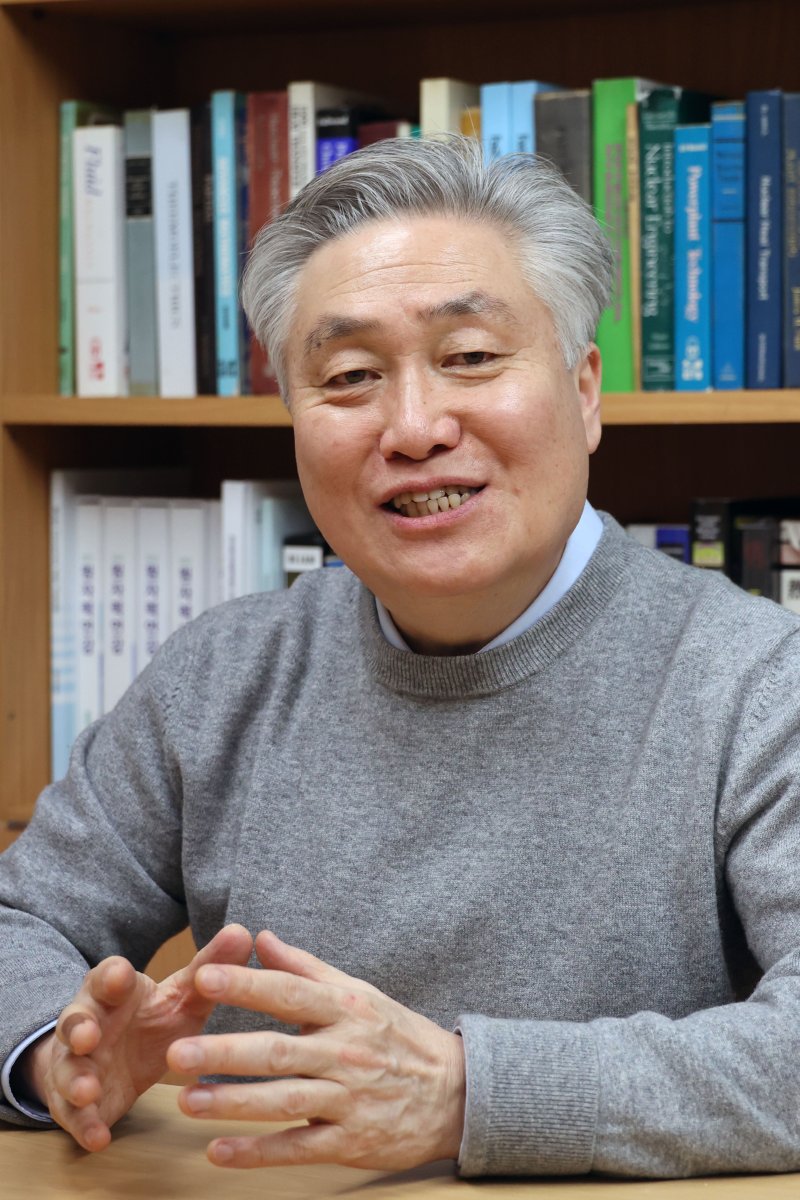
We spoke with Beomjin Chung, former president of the Korean Nuclear Society (KNS) and professor at Kyung Hee University, who emphasizes the importance of NPPs, to hear his views on the direction of energy policy.
—The government's direction on NPP policy seems ambiguous.
▶I believe politicians are using energy policy for their own purposes. The phase-out of NPPs was intended to promote the Renewable energy business. Renewable energy is not difficult. The Lee Jae-myung administration is showing signs of nuclear phase-out. However, considering the discussions on nuclear submarines in the United States–Korea Free Trade Agreement (KORUS FTA) and cooperation with the Republic of Türkiye on nuclear energy, it seems they are practically interested in nuclear power.
—Are NPPs dangerous?
▶Energy policy must satisfy three criteria: security, economics, and the environment. These principles often conflict, as cheap and eco-friendly options are rare. This is the so-called 'trilemma,' but nuclear power meets all three. With a three-year reserve of nuclear fuel, costs are low and waste is minimal. Risk is not part of the trilemma; if something is truly dangerous, it should not be done at all. The government reviews and deems it safe, yet some insist it is dangerous—this is wrong. The head of the Nuclear Safety and Security Commission (NSSC) declared it safe, but other ministers disagreed. Such matters should be entrusted to professional government agencies. The trilemma is a global index for evaluating energy; risk is not included. Wielding 'risk' as a universal excuse is a grave mistake.
■ Politicians Are Exploiting Energy Policy
—What are the advantages of NPPs in terms of security and economics?
▶Nuclear power is outstanding for energy security. For energy-importing countries, the reserve period is crucial: petroleum reserves last 108 days, gas for 48 days, coal for about two weeks, and nuclear fuel for a year. Looking at the cost to produce 1 kWh of electricity: NPPs cost 52 KRW, coal 158 KRW, gas 237 KRW, and Renewable energy 272 KRW. Renewable energy is five times more expensive than NPPs. Maintenance costs for Renewable energy, such as expanding the power grid, are about ten times higher than for nuclear power. If regular noodles cost 8,000 KRW, would you pay 40,000 KRW for eco-friendly noodles that taste the same? In terms of the environment, solar power generates a lot of waste. NPP waste is minimal because 1 gram of nuclear fuel produces energy equivalent to 3 tons of coal. The amount of waste is one-millionth that of coal, and even though it is radioactive, the quantity is extremely small. No carbon dioxide (CO2) is emitted, making it environmentally friendly. Opting for Renewable energy is like choosing a crisis before one actually arrives. Increasing Renewable energy raises electricity rates. The real question is how much our economy can tolerate.
—The NDC target has been raised, and the country joined the Powering Past Coal Alliance (PPCA).
▶The crucial role of coal is being overlooked—namely, frequency regulation. According to government electricity management standards, a frequency of 60 Hz ±0.1 Hz is allowed. Deviations degrade electricity quality and hinder advanced industries. Coal provides this function, and so can NPPs. Wind and solar cannot, as they lack turbines to control speed. Power sources with turbines are called flexible power sources, which are necessary for integrating Renewable energy. If coal is phased out, the proportion of flexible power sources drops, destabilizing the power grid.
—Doesn't Liquefied Natural Gas (LNG) emit less carbon?
▶That is not the case. Natural gas is Methane, which has a greenhouse effect more than 30 times that of carbon dioxide (CO2). Methane leaks during extraction, transportation, liquefaction, and vaporization. In terms of greenhouse gases, there is little difference between coal and gas. Yet, coal is mainly targeted for criticism. The Powering Past Coal Alliance (PPCA) is based on scientific misunderstanding. Reducing CO2 emissions is extremely costly and requires economic sacrifice—do we really need to be the number one country in this regard?
—What are your thoughts on RE100 (Renewable Energy 100%)?
▶RE100 (Renewable Energy 100%) is a concept advocated by a UK-based NGO, calling for 100% of electricity used in manufacturing to come from Renewable energy. During the Moon Jae-in administration, it was argued that RE100 would act as a trade barrier. Recently, companies like Google and Microsoft have announced support for nuclear power and Small Modular Reactors (SMR), even though they originally committed to RE100. The carbon reduction effect of NPPs is now recognized. There is no need for us to pursue costly RE100. The same applies to RE100 industrial complexes. Even The Climate Group, which leads the global RE100 campaign, now acknowledges nuclear power.
—What is Japan’s nuclear policy after the Fukushima nuclear accident?
▶Japan declared two to three years ago that it would use nuclear power for over 20% of its electricity supply. After the Fukushima nuclear accident, NPPs that passed new safety reviews were restarted, and new plants are being built. Interest in solar power has waned, while nuclear power continues to expand. Japan and Korea share similar circumstances—both are islands in terms of electricity. In Europe, countries can borrow power from neighbors via interconnected grids. Japan and Korea cannot, so both must maintain NPPs and secure ample reserve capacity.
—The 12th Basic Plan for Long-term Electricity Supply and Demand is being developed.
▶The 8th to 11th plans all underestimated electricity demand. If this continues, a blackout could occur someday. Reserve margins have also been set too low. The damage from power outages is far greater than the waste from overcapacity. It is better to have a surplus. When establishing the plan, the government should disclose expected electricity rates. Setting targets without securing sites for Renewable energy is pointless. There are no locations or project operators. If supply plans are not executed as intended, it will be problematic.
■ The Production Cost of Renewable Energy Is Five Times That of NPPs
—Companies are increasingly anxious about carbon reduction and electricity costs.
▶When drafting power supply plans, the impact on industry must be considered. The most important factor is electricity rates. If rates rise, industries cannot operate. There are conflicting pledges within the Lee Jae-myung administration. They claim to foster artificial intelligence (AI), but the raw material for AI is electricity. Renewable energy cannot meet this demand. A single AI data center requires as much electricity as five NPPs. Samsung’s second semiconductor plant will need the equivalent of 10 GW, or ten NPPs. Samsung may have to pay an additional 10 trillion KRW in electricity bills, making profits impossible. Manufacturing will no longer be feasible in Korea. Instead of focusing on product innovation, companies are preoccupied with securing electricity. This is an abnormal situation. The Yoon Suk-yeol administration raised industrial electricity rates by 75%, yet KEPCO remains in deficit. If Renewable energy expands and coal or nuclear power is reduced, the deficit will grow. Too much is being sacrificed economically for the sake of cleanliness and safety.
—How are American companies responding?
▶Microsoft, Google, and Amazon.com, Inc. have announced investments in nuclear power and SMRs. Hyperscale data centers are rapidly emerging. The U.S. is facing a massive electricity shortage. Companies are seeking their own solutions. Soon, KEPCO may be unable to supply enough power, forcing companies to generate their own electricity or prompting the rise of private power producers.
—What is the global trend regarding NPPs?
▶Germany has changed its policy. Switzerland, Italy, Spain, and the Netherlands are returning to nuclear power. Poland, which previously abstained, now plans to adopt it, and the Czech Republic is expanding its use. Nuclear power is now mainstream in Europe, while Renewable energy is declining. In Taiwan, where Taiwan Semiconductor Manufacturing Company Limited (TSMC) is the leading company, power shortages lead to cutting household electricity to supply industry. Korea does the opposite, raising industrial rates. I see this as a form of populism. Regardless of political ideology, current energy policy is steeped in populism.
—How does the United States handle NPP lifespan extensions?
▶It is not an extension, but continued operation. The 40-year design life is not the actual lifespan but the business period. It is not about reviving defunct plants, but extending the business period of well-operating NPPs. Korea’s continued operation system needs improvement. The U.S. grants 20-year extensions, while Korea allows only 10 years at a time, with much time lost to paperwork. The 10-year extension starts not after the review, but from the previous operating license. If the application is delayed by two years and the review takes three, only five years are gained. The law is flawed.
■ Energy Policy Steeped in Populism Is Flawed
—How do you assess solar and wind power policies?
▶Destroying forests to install solar panels is madness. Forests are of far greater value. We live in an era of confused values. Electricity rates have already soared, and there have been fires. Money has flowed to China, but low-quality solar panels are now losing efficiency. There are many absurdities. In Jeju, wind power is abundant, but electricity demand peaks in July and August when the wind does not blow. In winter, demand drops but wind increases. Wind power cannot be stopped, which is problematic. Yet, construction continues. The same situation is occurring in South Jeolla. On some days, abundant sunlight leads to excess solar power that cannot be consumed, forcing NPPs to shut down.
—What about the cost of Renewable energy?
▶According to power market operation rules, KEPCO is required to purchase 272 KRW Renewable energy electricity over 52 KRW nuclear power electricity. The rule is to use the cheapest fuel cost first, but KEPCO must buy electricity that is five times more expensive. This structure inevitably leads to deficits. Among electricity produced at the same time, the system should allow for the selection of the lowest-cost electricity, not just the lowest fuel cost.
—What about the patent dispute with Westinghouse Electric Company?
▶Technological self-reliance and independence are different. Self-reliance is like standing with a cane; independence is standing without one. Korea is technologically self-reliant, not independent. We have obtained licenses from the U.S. for permitted countries. We can export to countries like the United Arab Emirates (UAE) that only want reactors, but for countries that want the technology itself, such as the Czech Republic, U.S. approval is required.
—What is the outlook for NPP exports?
▶Globally, there is a trend toward building more NPPs, and Korea has much to contribute. Westinghouse Electric Company sources reactors and turbines for its domestic and export plants from Korean companies, which also handle construction. Korea’s NPP industry rivals semiconductors, automobiles, and shipbuilding as an export sector. Letting this industry die makes no sense.
■ Beomjin Chung, former president of the Korean Nuclear Society (KNS), graduated from the Department of Nuclear Engineering at Seoul National University (SNU) and earned his master’s and doctoral degrees from the same institution. He is currently a professor in the Department of Nuclear Engineering at Kyung Hee University. He served as the 36th president of KNS and has advised the government on energy policy as a member of the Power Policy Deliberation Committee of the Ministry of Trade, Industry and Energy (MOTIE) and the Policy Coordination Committee of the Ministry of Science, ICT and Future Planning (MSIP).
[email protected] Reporter