[Editorial] "700 Trillion Won Investment for Top 2 Semiconductor Powerhouse"—Securing Power Supply Must Come First
- Input
- 2025-12-10 18:20:12
- Updated
- 2025-12-10 18:20:12
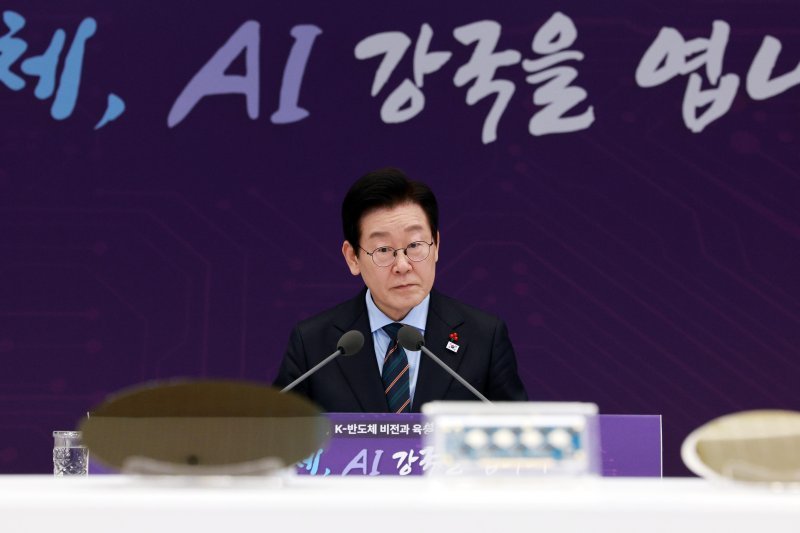
The strategy and roadmap focus on strengthening the previously vulnerable system semiconductor ecosystem. Presiding over the meeting, President Lee Jae-myung remarked, "I hope that by digging a wider well, more people can benefit from the advancement of the semiconductor industry." More than 40 CEOs from domestic semiconductor companies, including Samsung Electronics and SK hynix, were also in attendance.
The global semiconductor market is currently undergoing a period of great upheaval. With major global tech companies entering the fray, the chip war is becoming increasingly complex. U.S. tech firms are making notable moves to challenge Nvidia Corporation's dominance in graphics processing units (GPUs) in the AI era. The launch of the Tensor Processing Unit (TPU) by Google, in partnership with Broadcom, signals a reshaping of the market. Unlike the general-purpose GPU, the TPU is a chip specialized for AI tasks such as inference. It offers higher power efficiency and lower costs, potentially disrupting Nvidia Corporation's lead. Industry giants like Meta Platforms and Amazon.com are also accelerating their own chip development.
As the AI chip war among big tech companies intensifies, demand for memory semiconductors could far outstrip supply. For Korea, a powerhouse in memory semiconductors, this presents a new opportunity. However, it is crucial not to underestimate the threat posed by China's rapid pursuit in this sector, which has eroded Korea's overwhelming advantage. China's semiconductor ambitions are fiercer than ever. The U.S. decision to lift restrictions on Nvidia Corporation's H200 chip for China reflects an acknowledgment of China's formidable technological and manufacturing capabilities.
Latecomers such as ChangXin Memory Technologies (CXMT) in China are unveiling chips with performance comparable to those of Korean companies. Both the government and industry must devote all efforts to developing breakthrough technologies that can outpace China's pursuit. The AI technology race is impossible without a long-term national support roadmap. The same applies to achieving results in system semiconductors, where Korea lags behind. The first joint government-private sector semiconductor roundtable was held in this context.
For the government's AI semiconductor development strategy to succeed, it must be backed by sufficient power, talent, and funding. Electricity is the resource that drives the AI ecosystem. To ensure a stable power supply, the utilization of nuclear power must be increased. This is why countries around the world are ramping up nuclear power plant construction. Companies such as Google and Microsoft Corporation are also prioritizing securing nuclear power, believing that the outcome of the AI race hinges on electricity.
The Korean government is currently re-examining previously confirmed plans for new nuclear power plants from scratch. It has announced that the decision on whether to proceed with new construction will be made through public opinion surveys and discussions. It is reported that many members of the committee tasked with discussing practical matters are from environmental and civic groups, raising concerns about potential bias in the outcome.
The government also announced plans to establish a Graduate School of Semiconductor Technology to secure high-level talent and to train 300 master's and doctoral-level professionals with direct involvement from companies. Exploring various ideas to secure talent is worthwhile. However, supporting flexible work arrangements for advanced personnel is also the government's responsibility. For advanced technology positions, exceptions to the 52-hour maximum workweek regulation should be allowed, and bold incentives must be considered.