"Leap to Become World’s No. 2 in Semiconductors" – 700 Trillion KRW Investment for Semiconductor Cluster by 2047
- Input
- 2025-12-10 15:17:25
- Updated
- 2025-12-10 15:17:25
[Financial News] The government has announced plans to invest approximately 700 trillion KRW by 2047 to establish the world’s largest and most advanced Semiconductor Cluster, aiming to become the world’s second-largest semiconductor powerhouse. The relatively weak fabless company and System Semiconductor ecosystem will be significantly strengthened, and a Southern Semiconductor Innovation Belt connecting Gwangju, Busan, and Gumi will be established.
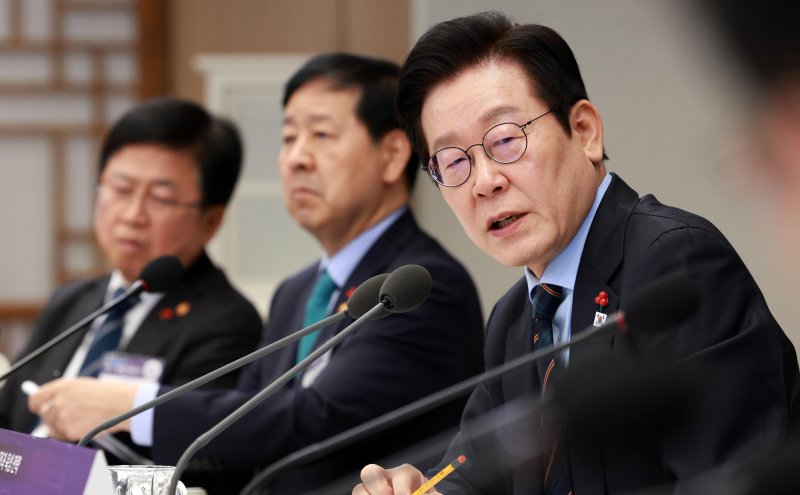
On the 10th, relevant ministries held a briefing at the Office of the President of the Republic of Korea titled “K-semiconductor Vision and Development Strategy for the AI Era,” where these semiconductor development strategies were discussed.
The government plans to maintain its technological edge in memory, such as High Bandwidth Memory (HBM), while creating new gaps in AI-specialized technologies. Research and development (R&D) will focus on semiconductors specialized for AI inference, such as on-device AI semiconductors (Neural Processing Unit, NPU) and Processing-In-Memory (PIM). By 2032, 215.9 billion KRW will be invested in next-generation memory, and by 2030, 1.2676 trillion KRW will be allocated to AI-specialized semiconductors.
To ensure timely expansion of production capacity, support for the ongoing Semiconductor Cluster will continue without interruption. The plan is to establish a global semiconductor production hub by leveraging the integration of existing production bases and value chains. The government will take responsibility for building key infrastructure such as power and water, and will strengthen public sector support. By 2047, more than 700 trillion KRW will be invested to build 10 new semiconductor fabrication plants.
The government is also focusing on strengthening the System Semiconductor ecosystem, which has been a weakness. To elevate fabless companies to a global level, a collaborative ecosystem will be created where demand companies lead from the front and foundries provide close support. The localization of middle-tech semiconductors, such as Microcontroller Units (MCU) for vehicle control and Power Management Integrated Circuits (PMIC), will be supported, and joint projects between demand companies and fabless companies will be launched for the development and commercialization of on-device AI technologies. The National Growth Fund will be used to create a public fund for fabless companies, and investments will be made in strategic cooperation between IP and fabless companies.
A project will be launched to achieve technological independence in defense semiconductors, which currently have a 99% import dependency. Specifically, through cooperation among relevant ministries such as the Defense Acquisition Program Administration (DAPA), the Ministry of Trade, Industry and Energy, and the Ministry of Science and ICT (MSIT), the government will pursue technology development across the entire defense semiconductor value chain, from materials and design to processing and systems.
To strengthen the ecosystem, emphasis will also be placed on the Materials, Parts, and Equipment Industry and talent development. This year, the country’s first mass-production testbed for the Materials, Parts, and Equipment Industry in collaboration with chip manufacturers, 'Trinity Fab,' will be launched, with the goal of opening by 2027. The Semiconductor Specialized Graduate School and Semiconductor Academy will also be gradually expanded by 2030.
Meanwhile, the Southern Semiconductor Innovation Belt, connecting Gwangju (advanced packaging), Busan (power semiconductors), and Gumi (materials and parts), will lay the foundation for new semiconductor production bases.
Gwangju is home to leading global packaging companies and is expected to see new demand for packaging due to the establishment of AI data centers. The government will support Materials, Parts, and Equipment Industry companies in building a semiconductor packaging hub city in connection with anchor companies. In Busan, infrastructure will be expanded around the power semiconductor Materials, Parts, and Equipment Industry specialized complex, and the establishment of a Power Semiconductor Support Group is under consideration. In Gumi, which is centered on a specialized advanced semiconductor industrial complex, R&D and commercialization support will be concentrated on semiconductor materials and parts companies.
Going forward, new advanced industrial complexes for semiconductors and other high-tech industries will be designated only in non-capital regions. The farther from the capital region, the greater the preferential support for infrastructure and finance. For example, flexible working hours will be promoted for research personnel within local semiconductor clusters.
On this day, President Lee Jae Myung stated, "A robust ecosystem is essential for long-term growth and development. It would be beneficial for companies to contribute to balanced regional development. I hope you will turn your attention to the south, where renewable energy is abundant, and take an interest in building a new industrial ecosystem."
[email protected] Park Ji-young, Sung Seok-woo Reporter