Will the Ruling Party’s Retirement Age Extension Bill Be Delayed Until Next Year? ... 'Only Public Opinion Battles, No Substantive Discussion'
- Input
- 2025-12-09 15:51:33
- Updated
- 2025-12-09 15:51:33
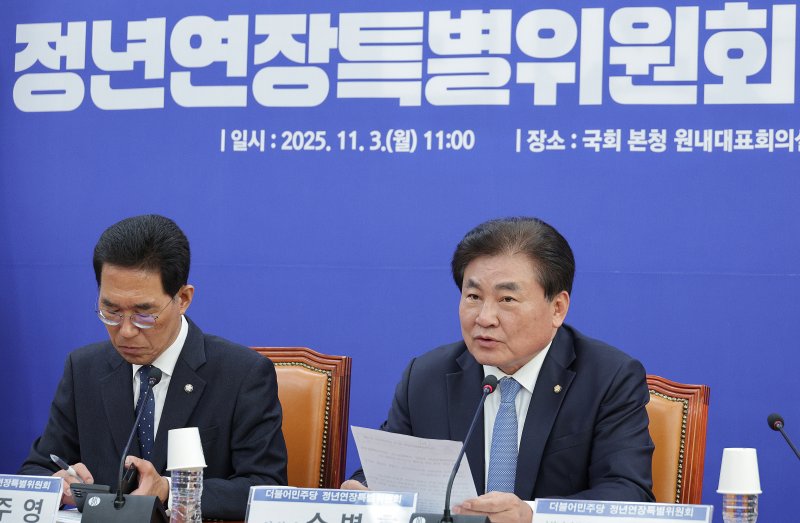
[The Financial News] The Democratic Party of Korea (DPK)’s phased plan to extend the retirement age to 65, developed with the labor sector and management representatives, is unlikely to be finalized within this year. Due to sharp differences between labor and management, both sides are preoccupied with public opinion campaigns rather than reaching a substantive agreement.
It is reported that the Special Committee on Extension of Retirement Age of the DPK held a working-level meeting on the 9th. However, neither committee members nor key figures from labor and management attended. Progress has been slow, and the meeting aimed to organize the discussion points.
The committee maintains its goal of presenting a final plan within the year. However, ongoing conflicts between labor and management have prevented the scheduling of further meetings since the session on the 2nd. Media coverage of the mediation proposal presented by the DPK at the last meeting has only deepened the divide between the two sides.
A key member of the committee told The Financial News, 'While our goal remains to reach an agreement within the year, it is realistically difficult for labor and management to come to terms.' The source added, 'Labor and management are not engaging in substantive discussions within the committee, focusing only on public opinion through media reports, making it impossible to produce a final plan.'
The background to the flurry of reports highlighting differences over retirement age is the DPK’s mediation proposal. The plan includes: raising the retirement age by one year every two years from 2028 to 2036, and guaranteeing reemployment for one year beyond the retirement age starting in 2027; from 2029 to 2039, raising the retirement age by one year every three years for the 61–62 age group, and every two years for the 63–64 age group; from 2029 to 2041, raising the retirement age by one year every three years, with reemployment guaranteed for one year beyond the retirement age from 2027. Additionally, even if wages are reduced as the retirement age increases, such changes will not be considered a 'disadvantageous change to employment rules.'
Although these proposals reflect a middle ground between the demands of labor and management, both sides oppose them. The labor sector argues that the plan has regressed, insisting that the statutory retirement age of 65 and wage system reforms should be left to labor-management autonomy until 2033. Management representatives complain that the plan imposes a heavy burden by mandating both a rigid retirement age extension and reemployment after retirement.
Furthermore, the labor sector faces internal disagreements. Desired outcomes differ by occupation, industry, and especially age group. As a result, the committee launched the Youth Task Force on the 2nd to gather opinions. In addition to labor-management conflict, the committee notes that collecting youth perspectives is time-consuming, making the timeline tight.
A committee official stated, 'We are doing our best to achieve labor-management consensus, but collecting youth opinions through the Task Force has only just begun.' The official added, 'The situation continues to change compared to when we first set the goal of presenting a plan within the year.'
[email protected] Kim Yun-ho Reporter