'I Live Alone' Households Reach 8 Million... Average Debt at 40 Million Won, 17% Receive Basic Livelihood Support
- Input
- 2025-12-09 12:00:00
- Updated
- 2025-12-09 12:00:00
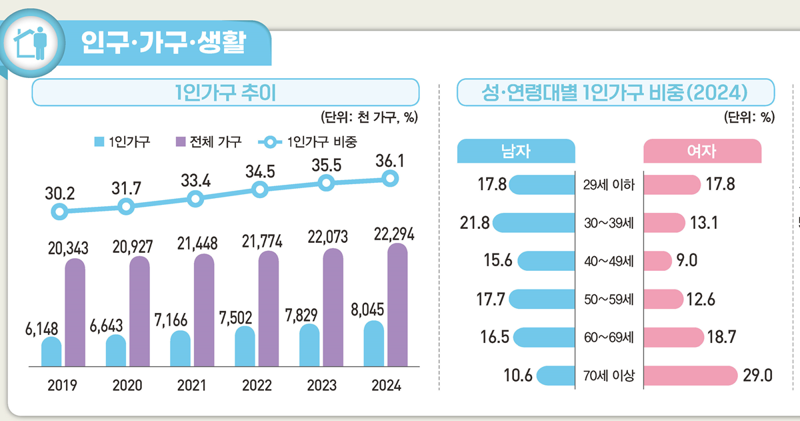
[Financial News] The number of single-person households living alone has surpassed 8 million, accounting for a record 36% of all households. Of these, 5.1 million are employed. Nearly half reside in Seoul and the greater metropolitan area. On average, single-person households carry 40 million won in debt and hold assets worth about 223 million won. Seventeen percent receive benefits under the National Basic Livelihood Security System (NBLSS) for vulnerable groups.
On the 9th, the Ministry of Data and Statistics announced that, as of last year, there were 8,045,000 single-person households, making up 36.1% of all households. By age group, those aged 70 and older accounted for the largest share at 19.8%. The proportions for those in their 60s, 30s, and under 29 were similar, each around 17%.
Kim Ji-eun, Director of Social Statistics Planning at the Ministry of Data and Statistics, stated, "Single-person households now represent the largest share among all household types, reaching a new record in this survey," and added, "There is a growing need for diverse social welfare and economic policies reflecting these societal changes."
According to the statistics released by the Ministry of Data and Statistics, among single-person households, women aged 60 and older accounted for the highest proportion at 47.7%. This is attributed to higher life expectancy among women and a rise in late-life divorce, leading to more elderly women living alone or independently.
In contrast, among men, those under 39 made up the largest group at 39.6%. This reflects a social trend where men are marrying later and many live alone due to work in other regions.
Among middle-aged individuals aged 40 to 59, single-person male households (33.3%) significantly outnumbered their female counterparts (21.6%). This is believed to be due to 'goose fathers' working away from home for their families, as well as an increase in single-person households resulting from divorce or separation.
Among single-person households, 5.1 million are employed and supporting themselves. The number of such working households has increased annually, surpassing 5 million for the first time last year. The largest share work in business and personal/public services (42.3%).
These single-person households earn an average annual income of 34.23 million won from business or employment, which is 46.1% of the average for all households (74.27 million won). Each month, they spend 1.689 million won on housing, utilities, heating/cooling, and food. They also spend an average of 122,000 won per month on medical and pharmaceutical expenses.
Single-person households carry an average debt of 40.19 million won and hold assets worth 223.02 million won.
There are 1,397,000 single-person households receiving National Basic Livelihood Security System (NBLSS) benefits, accounting for 74.2% of such households. This proportion has been increasing annually, indicating a rise in elderly poor living alone. About 42.7% of single-person households reside in Seoul and Gyeonggi Province. Gyeonggi Province has the highest number at 1,775,000 (22.1%), followed by Seoul at 20.6%. Among other regions, Busan (6.8%) and Gyeongsangnam-do (Gyeongnam) (6.2%) had the highest numbers. By region, Seoul had the highest proportion at 39.9%, followed by Daejeon (39.8%), Gangwon (39.4%), North Chungcheong Province (Chungbuk) (39.1%), and North Gyeongsang Province (Gyeongsangbuk-do) (38.9%).
Most single-person households live in detached houses (39.0%) or apartments (35.9%). Three out of ten (32%) own their homes, compared to the overall homeownership rate of 56.9%. The rate of homeownership was highest among those aged 70 and older (50.9%), followed by those in their 60s (43.7%) and 50s (38.6%).
[email protected] Jung Sang-geun Reporter