Where Did Women Under 30 Travel Domestically in Q2? Yangyang Remains a Top Destination
- Input
- 2025-12-09 12:00:00
- Updated
- 2025-12-09 12:00:00
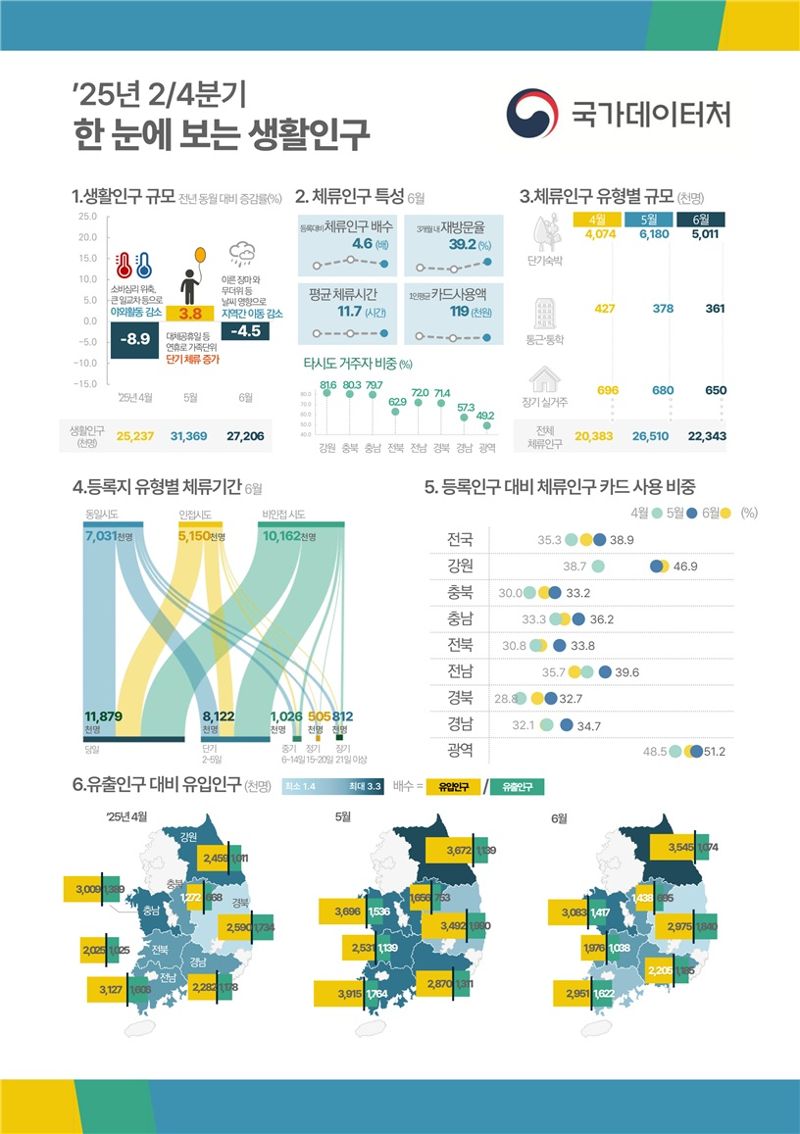
According to The Financial News, in the second quarter of this year, women under the age of 30 accounted for the highest proportion of the short-term floating population who stayed in domestic regions with declining populations for tourism and leisure purposes. In particular, the number of short-term stays in May, which included an extended holiday, increased compared to the same month last year.
According to the Ministry of Data and Statistics’ report on the living population for the second quarter released on the 9th, the total living population in all population-declining regions in May was approximately 31.37 million. Of these, the floating population was about 26.51 million, which is about 5.5 times the registered population. The living population in May increased by 1.16 million compared to the same month last year, while April and June saw decreases of 2.46 million and 1.27 million, respectively.
The living population includes not only residents but also those who stay in the area and contribute to its vitality. The floating population refers to people who visit for purposes such as commuting, schooling, or tourism, and is defined as those who stay for more than three hours on at least one day per month.
In the second quarter, the average length of stay for the floating population was about 3.2 days, with an average stay time of 11.6 hours and an average number of nights stayed at 3.7 days. As of June, about 68.5% of visitors were from other provinces, with Gangwon State having the highest proportion of non-local visitors.
By city and county, Gapyeong County in Gyeonggi Province had the highest floating population multiplier in April, while Yangyang in Gangwon State led in May and June. Gapyeong County also recorded the largest floating population in all three months.
Among the types of floating population, the short-term stay type (tourism/leisure) had a relatively higher proportion of women, those under 30 or in their 30s, and residents from non-adjacent provinces. The commuting/schooling type was more common among men and those in their 30s to 50s, while long-term residence was more prevalent among men under 30.
In the second quarter, the average card spending per person in all population-declining regions was about 120,000 won, with spending increasing with age. By type of stay, short-term stays saw the most spending in healthcare, commuting/schooling types in education, and long-term residents in education and transportation. The floating population accounted for more than 35% of total card spending compared to the registered population, and in metropolitan areas, this figure exceeded 48%.
[email protected] Seo Young-jun Reporter