'Mansahyeontong' Hyun-Ji Kim Is Not the End... Kim Nam-kuk's 'Sister Text' Brings Up the 'Chung-Ang University Group of Seven'
- Input
- 2025-12-05 09:45:32
- Updated
- 2025-12-05 09:45:32
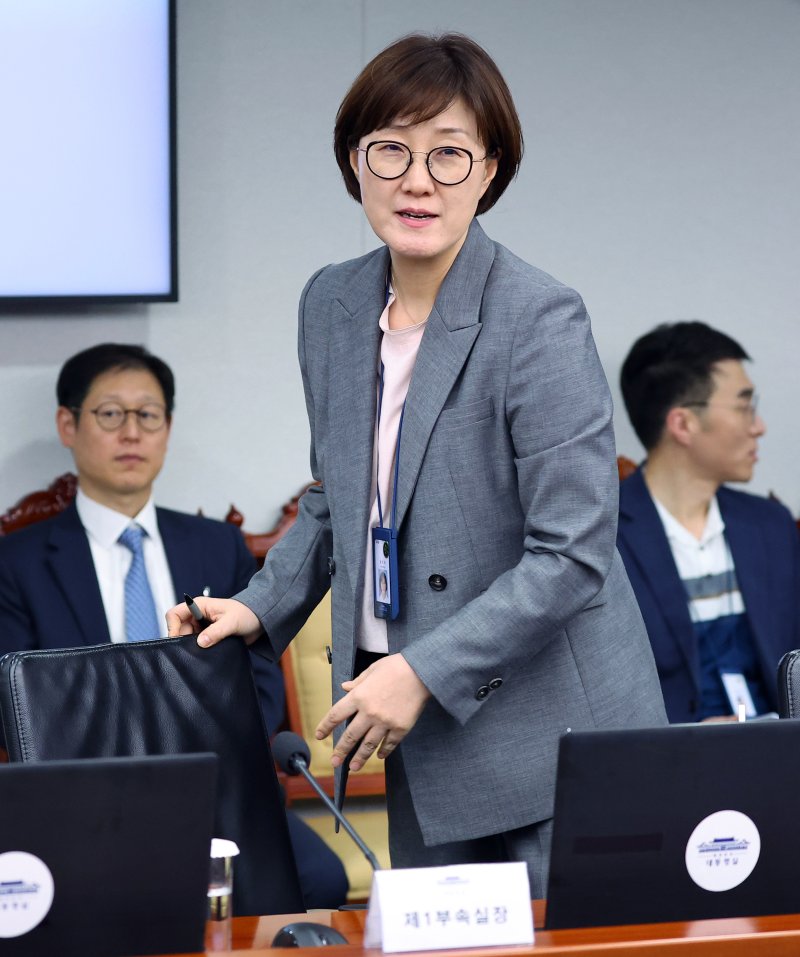
[Financial News] Following the resignation of Kim Nam-kuk, Digital Communications Secretary at the Office of the President of South Korea, over the controversy surrounding 'personnel solicitation text messages,' the presidential office immediately accepted his resignation to contain the situation. However, the debate over Hyun-Ji Kim, the First Secretary, being a 'key figure' has resurfaced after a period of quiet.
According to the Office of the President of South Korea, Kim Nam-kuk offered his resignation on the morning of the 4th, just two days after the controversy erupted, and the office promptly accepted it.
The controversy began when the content of text messages exchanged between Secretary Kim and Moon Jin-seok, Deputy Floor Leader of the Democratic Party of Korea (DPK), was captured by a media camera.
'Personnel Solicitation' Captured on Camera
The text message in question contained a request from Deputy Floor Leader Moon to recommend a specific person for the presidency of the Korea Automobile Manufacturers Association (KAMA). Secretary Kim replied, 'I will recommend it to Hoon-sik hyung and Hyun-Ji noona.'
The message quickly escalated into a 'personnel solicitation' controversy, and even after the Office of the President of South Korea announced that Secretary Kim had been sternly warned, the debate did not subside. As the controversy grew, Secretary Kim appears to have voluntarily offered his resignation.
Kang Yu-jeong, spokesperson for the Office of the President of South Korea, explained, 'Secretary Kim personally offered his resignation out of concern that he was becoming a burden to state affairs, and we accepted it.'
The People Power Party and other opposition parties dissected the text messages in detail, likening the process to slicing a salami.
The first issue raised was the organization for which the personnel request was made. The Korea Automobile Manufacturers Association (KAMA) is a private association over which the Office of the President of South Korea has no personnel authority. Its president is elected by the board of member companies after nominations. The 'solicitation text' sparked speculation that certain figures in the presidential office might exert influence.
Regarding this, spokesperson Kang stated, '(KAMA) is not related to our personnel authority,' and clarified, 'There was no personnel intervention.'
Another issue is the relationship among those mentioned in the texts. All are connected through Chung-Ang University, and both individuals exchanging messages are part of the 'Chung-Ang University Group of Seven,' known as Lee Jae Myung's closest circle. President Lee is also a Chung-Ang University alumnus.
The People Power Party criticized the Chung-Ang University network, pointing out, 'When Lee Jae Myung was the leader of the DPK, he claimed that those controlling President Yoon Suk Yeol and his administration were from the Chungam High School line.'
The Essence of the Controversy: 'Mansahyeontong'
At the heart of the issue is the fact that Hyun-Ji Kim was mentioned as 'Hyun-Ji noona' alongside Chief Presidential Secretary Kang Hoon-sik as the recipient of the personnel request.
The mere fact that the First Secretary, who is not involved in personnel matters, was mentioned together with the Chief Presidential Secretary, who chairs the personnel committee, has fueled suspicions that she is a key power broker.
In fact, at the beginning of President Lee's term, Hyun-Ji Kim was appointed as the Chief Administrative Secretary and was rumored to have significant influence over various appointments, earning her the nickname 'Mansahyeontong'—meaning 'everything goes through Hyun-Ji Kim.'
The controversy intensified in political circles when it became known that Kim had spoken with Kang Sun-woo, the candidate for Minister of Gender Equality and Family (MOGEF), amid allegations of staff abuse. Kang ultimately withdrew her candidacy.
Some observers see Secretary Kim's voluntary resignation, following the official warning from the Office of the President of South Korea, as an attempt to quickly quell the renewed 'Hyun-Ji Kim power broker' controversy.
The People Power Party also criticized Secretary Kim's resignation as a mere 'cutting off the tail.'
[email protected] Seo Yoon-kyung Reporter