"Suddenly, I Couldn't Even See the Script"... Actor Jung Kyung-ho Reveals First Sobriety Due to Presbyopia [Health Talk]
- Input
- 2025-12-05 05:54:37
- Updated
- 2025-12-05 05:54:37
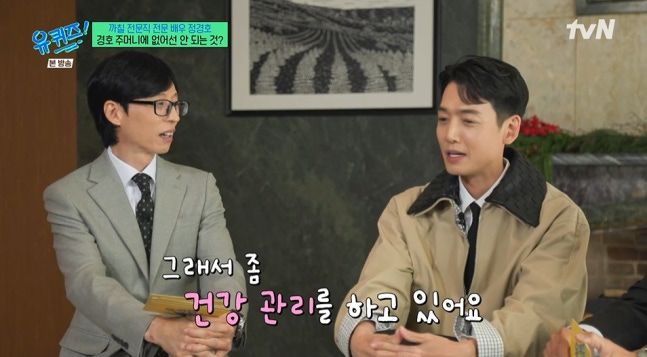
Actor Jung Kyung-ho revealed that he is abstaining from alcohol due to presbyopia.
Jung Kyung-ho appeared on the May 3rd broadcast of tvN's 'You Quiz on the Block' (hereafter 'You Quiz').
During the show, Jung shared, "Whenever I act, I always write the script once in a notebook. I tear out the page and carry it in my pocket instead of the script," adding, "I need the script on my right and artificial tears on my left. Without these, I feel uneasy."
He continued, "But one day, I couldn't see the script," and added, "So I've started taking better care of my health. For the first time in my life, I've been sober for 52 days," surprising everyone.
Symptoms often begin in the early 40s
Presbyopia is a natural change in the eyes where the lens loses elasticity with age, resulting in decreased near vision. Symptoms typically begin in the early 40s and can progress into the 60s.
Presbyopia is a type of aging phenomenon. As people get older, the eye's ability to adjust diminishes, which is caused by reduced elasticity or enlargement of the ciliary muscle (the muscle at both ends of the lens that adjusts its refractive power) or the lens itself.
When people are younger, the ciliary muscle and lens are highly elastic, so when looking at objects up close, the ciliary muscle contracts and the lens thickens, increasing its refractive power and allowing for clear vision. However, as age increases, the lens loses elasticity and becomes enlarged, so its refractive power does not increase when looking at nearby objects, resulting in blurred vision.
Many people notice symptoms in their early to mid-40s. In addition to impaired near vision, symptoms such as blurred vision may occur. The transition of focus between distant and near objects becomes slower, and reading can cause eye fatigue and headaches. Symptoms worsen in dim lighting or when reading small print, while the eyes feel more comfortable and vision improves as the object moves farther away.
How to prevent and treat presbyopia
To delay the onset of presbyopia, it is best to avoid reading in shaky or poorly lit environments. Focusing on moving text strains the eyes. In low light, the lens must work harder, causing the eyes to tire more easily.
It is also important to regularly eat foods rich in antioxidants. In particular, kale, lettuce, and spinach, which are high in lutein, are beneficial for eye health. Frequently consuming green and yellow vegetables or fruits can also help prevent high blood pressure, diabetes, and cardiovascular diseases.
Regularly exercising your eyes by alternating focus between near and distant objects can also help. After using your eyes intensively for more than an hour, it is recommended to rest by looking out a window at a distant view.
The most basic treatment for presbyopia is wearing glasses. After a refraction test to correct distance vision, a minimal convex lens is prescribed based on each person's near work habits, age, and arm length to provide clear and comfortable near vision. Presbyopia-correcting contact lenses are also available.
According to Seoul National University Hospital, in cases requiring surgery, the refractive power of both eyes can be set differently so that the dominant eye focuses on distant objects and the non-dominant eye on near objects. Various methods, such as inserting multifocal intraocular lenses, are available to correct presbyopia. Excimer Laser Surgery can also be performed.
However, since no method is considered a perfect cure yet, those considering surgical treatment should consult thoroughly with an ophthalmologist before proceeding.
moon@fnnews.com Moon Young-jin Reporter