[Editorial] Despite Adverse Conditions, $700 Billion in Sight as ‘K-Exports’ Soar
- Input
- 2025-12-04 19:29:01
- Updated
- 2025-12-04 19:29:01
This year’s export performance is more valuable than ever. As of November, cumulative exports reached $640.2 billion, breaking the all-time record for the first time in three years. If this momentum continues through the end of the year, annual exports are expected to surpass $700 billion for the first time in history. This achievement is especially meaningful, as it was accomplished despite a challenging trade environment. The global protectionist trend, sparked by former U.S. President Trump’s tariff wars, has erected trade barriers around the world. Korea has been struggling amid the ongoing U.S.-China rivalry. We applaud Korea’s industrial pioneers who have persevered and stayed the course in the face of adversity.
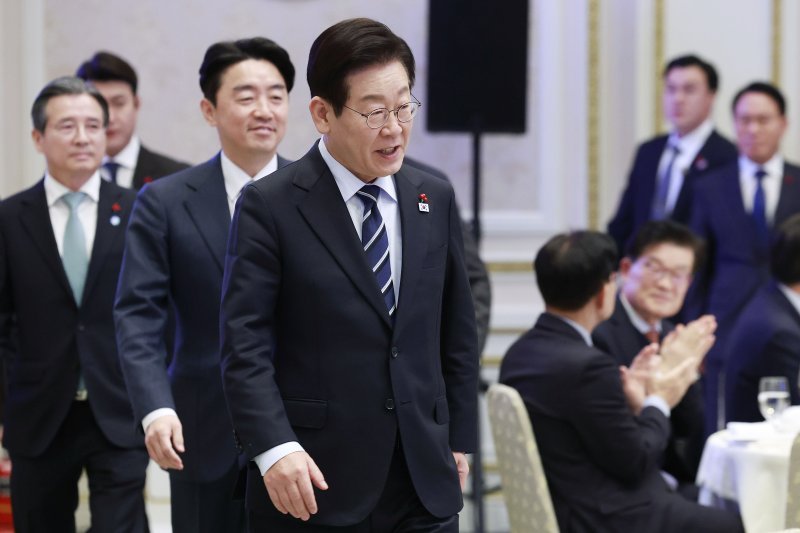
President Lee Jae-myung’s luncheon at Cheong Wa Dae for industrial pioneers on this day was in the same spirit. The event was attended by about 90 people, including Lee Young-jik, who oversaw the first steel production at Pohang’s No. 1 blast furnace in 1973; Lee Chung-gu, a key figure in the creation of Korea’s first domestic car, the Pony, in 1975; and Kang Myeong-ja, a first-generation sewing machine operator at the Guro Industrial Complex. No one would dispute that these individuals are unsung heroes behind Korea’s rise as an industrial and export powerhouse. Scientists and engineers who never gave up despite repeated failures, and female workers who toiled day and night, are all our export heroes.
Korea’s exports have achieved significant quantitative and qualitative growth. Compared to the era when wigs and sewn products were the mainstays, the transformation is remarkable. This year, the highest Export Tower award went to SK hynix for its record-breaking exports of High Bandwidth Memory (HBM). HBM, a core component for artificial intelligence (AI) semiconductors, continues to receive a flood of orders from global big tech companies. Global demand is outpacing Korea’s supply. We hope that the emergence of second and third generations of HBM will further solidify Korea’s status as a technology leader.
While semiconductors, automobiles, and ships have traditionally driven exports, the recent performance of K-food and K-Consumer Goods also deserves attention. Products like seaweed, instant noodles, and beauty items have achieved record export results, riding the wave of the Korean Wave. Global interest and affection for Korea continue to grow. Leveraging this trend can create new export opportunities and simultaneously boost tourism and domestic demand. We hope both companies and the government will work together on this.
However, Korea must move away from an export structure that relies on a few products and countries. Diversifying products and markets must be a constant pursuit. The effects of expanding beyond the U.S. and China to markets such as the Association of Southeast Asian Nations (ASEAN) and the European Union (EU) are already evident in the numbers.
Companies on the front lines of exports face numerous invisible trade barriers and other challenges. The Yellow Envelope Act and corporate tax increases, unilaterally handled by the government and ruling party, are also obstacles. Creating a business-friendly environment is essential if Korea is to achieve $1 trillion in exports in the near future.