Heemin Chung and Joan Miró: Distinct Paths, Shared Intersections... Shine at Thaddaeus Ropac
- Input
- 2025-12-04 15:42:53
- Updated
- 2025-12-04 15:42:53
[Financial News]Two distinct exhibitions were held on the first and second floors of the gallery. The significance was heightened by the juxtaposition of a young Korean artist and a master of modern art within the same space. It felt as if the historical visual language of a master intersected with the sensory experiments of today.The two exhibitions revealed contrasting senses of era, medium, and structure, almost as if in a field of critical discourse. Notably, the internationally renowned Thaddaeus Ropac gallery presented a new work by a Korean artist on equal footing with a master's exhibition, drawing attention for expanding the global context of Korean artists.Heemin Chung's solo exhibition 'Garden of Turmoil' and Joan Miró's (1893–1983) 'The Language of Sculpture' are presented simultaneously on the first and second floors, respectively. Thaddaeus Ropac Seoul announced that both exhibitions will run until February 7 next year.
First, Chung's 'Garden of Turmoil' on the first floor explores contemporary experiences where digital images and material surfaces overlap. He constructed multilayered surfaces by combining images collected from virtual worlds with 3D processes and his unique gel medium technique.
The exhibition title, 'Garden of Turmoil,' metaphorically expresses the modern anxieties that constantly waver within screens and simulacra. Chung reinterprets these digital landscapes through painterly and sculptural language.
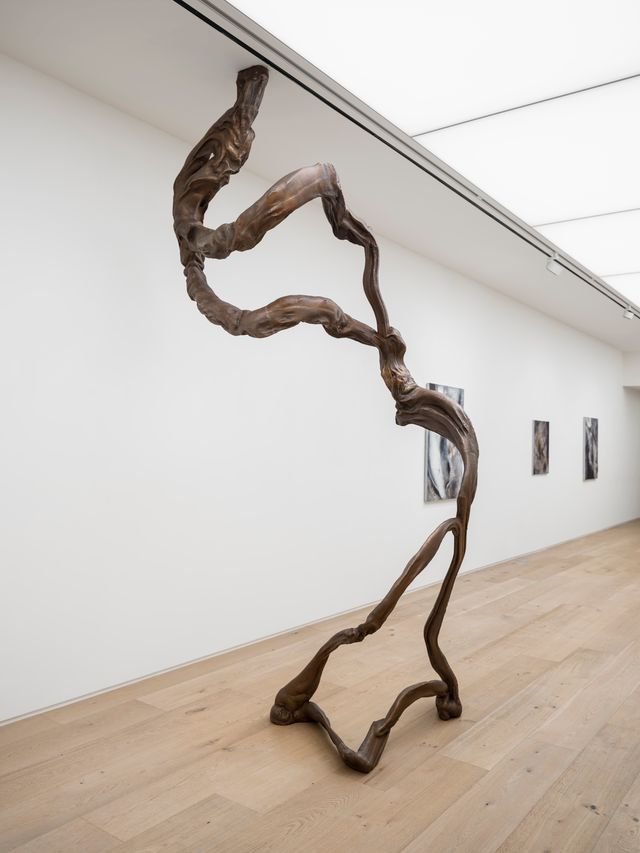
His representative work, 'Folded and Stretched 1 (2025),' evokes entangled branches or the helical structure of DNA, suggesting distortion, mutation, or sudden transformation. His sculptures capture the tension between order and entropy that defines both the natural world and digital systems. These organic forms, which also appear condensed in his paintings, are generated through processes of digital distortion.
By transforming digital images into paintings and sculptures, Chung explores the potential of materials. He traces how technology shapes contemporary perception and influences art, while also reflecting on its social role. Through various artistic experiments, he adds texture and volume to his works, investigating the materiality of media. He reinterprets traditional painting genres such as landscapes and still lifes with his own poetic and visual metaphors. 'Spheres (2025)' is a prime example of this approach.
Chung positions his work within the lineage of traditional painting techniques, emphasizing, "Painting, given its long history, is an effective medium for sensing changes in how we see and perceive, which is why it is so compelling."
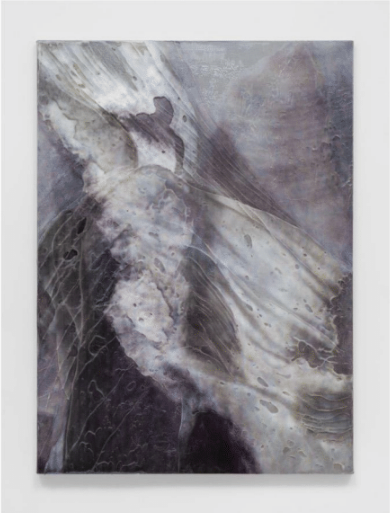
Chung considers his signature work, 'Time of Black Leaves (2025),' a landscape painting. The surface, where handcrafted materials and digital data accumulate without fully merging, simultaneously reveals organic and artificial sensations. It recalls synthetic plastics, data surfaces, and even bodily or geological cross-sections. Through these topographical canvases, he seeks to restore material autonomy to images that are consumed flatly in virtual spaces, separated from their material origins.
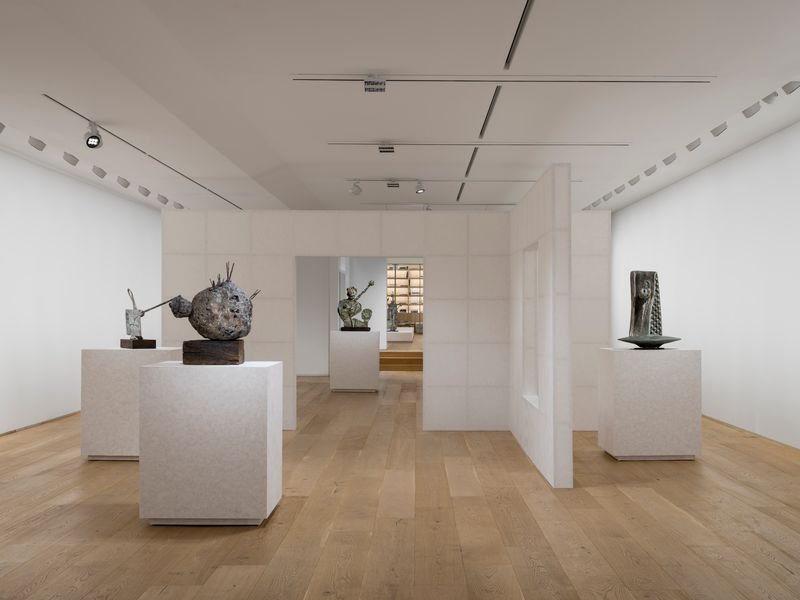
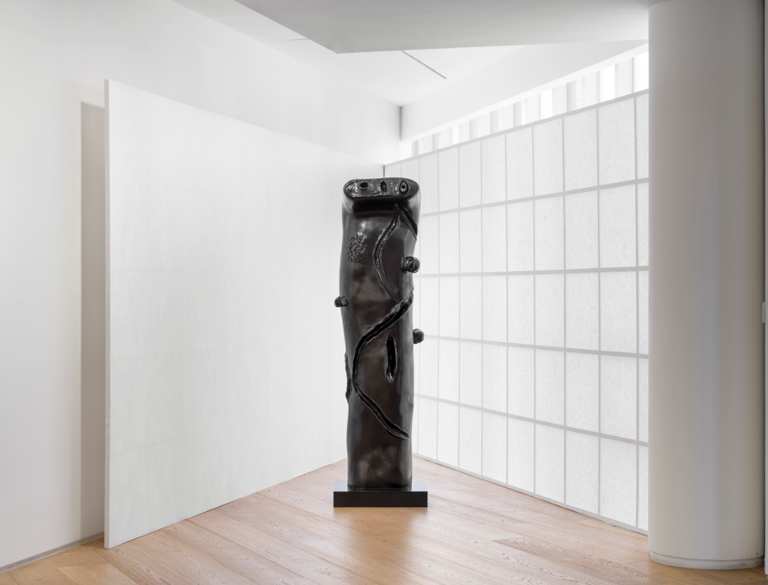
On the second floor, the exhibition 'The Language of Sculpture' introduces the late sculptures of Spanish Catalan master Joan Miró. A series of bronze sculptures created between 1976 and 1982 demonstrate how Miró developed his experimental sculptural language, which began with surrealist assemblage.
During his time in Mallorca, inspiration from local craft traditions, coastal landscapes, and various mineral forms was fully reflected in his sculptural experiments. Ordinary objects were recombined with Miró’s unique imagination and poetic sensibility, forming sculptural 'constellations.' The exhibition also features two portrait photographs of Miró taken by Irving Penn in 1948, delicately revealing the relationship between the master and his sculptural world.
In the early 1930s, Miró expanded from two-dimensional painting to three-dimensional forms through surrealist works such as 'Composition (1930)' and later 'Poetic Object (1936).' These works, which included found objects like a taxidermied parrot, are seen as a period when Miró’s unique sculptural sensibility began to take shape.
After beginning his collaboration with ceramist Josep Llorens Artigas in 1944, Miró resumed this partnership in 1953 and fully emerged as a sculptor. From the 1960s onward, sculpture became central to Miró’s artistic world. Notably, the site-specific work 'Labyrinth of Miró' installed at Fondation Maeght in Saint-Paul-de-Vence, southern France, is considered a pinnacle of his career.
On one of the two portraits of Miró by Irving Penn from 1948, displayed on the inner wall of the gallery, Miró stands alongside his sculptures under the sky on the rooftop of his home in Tarragona, Spain. In the other, he gazes intently into Penn's lens while holding organic bronze sculptures in his arms. The small bronze pieces in these photos, crafted by Miró in the 1940s, embody both his creativity and human warmth.
Laetitia Catoir, Senior Director at Thaddaeus Ropac, explained, "We did not plan these two separate solo exhibitions with a special connection in mind, but as we prepared the shows, we discovered some points of intersection between the artists. One particularly fascinating and exciting realization during the installation was the connection with Chung, whose works are currently on display on the first floor."
She added, "Joan Miró would collect everyday materials—such as hangers, wood, or pieces of bread—from around his studio in Mallorca and transform them into his sculptures as found objects. In Chung's case, he brings images or icons found in the digital world into his own sculptural or painterly practice. This parallel made preparing this exhibition especially enjoyable."
rsunjun@fnnews.com Yoo Sun-joon Reporter