[Editorial] People Power Party Apologizes for Martial Law Crisis, Now Must Move Toward Unity
- Input
- 2025-12-03 19:45:06
- Updated
- 2025-12-03 19:45:06
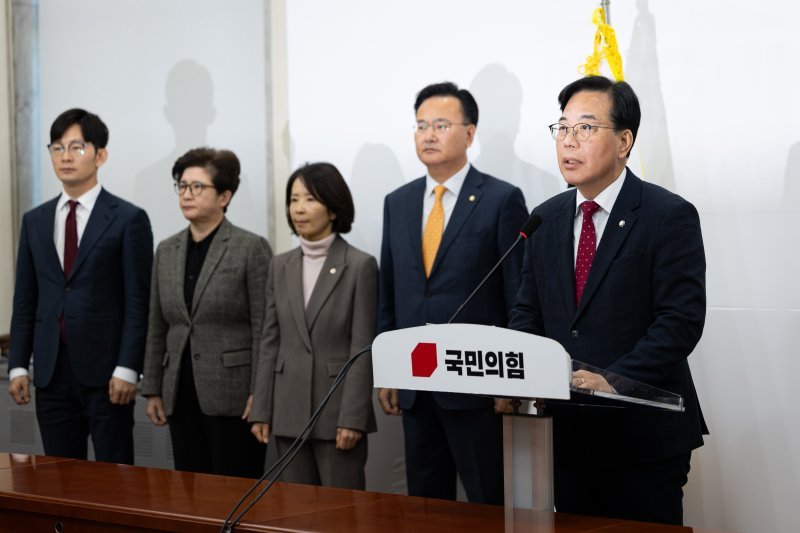
We must clearly state that, even if the imposition of martial law was triggered by the opposition’s 'legislative overreach' at the time, it was a grave misjudgment and an anachronism. In this context, Song Eon-seok’s belated but proper apology as floor leader of the People Power Party is only natural, even if overdue. The People Power Party must now look to the future, free from the past, and earn the public’s trust as a legitimate opposition party, forging a new path forward. Only then can political balance be restored between the ruling and opposition parties, and democracy reach a higher level through healthy criticism and checks.
Some People Power Party lawmakers stated in their apology, "We sincerely bow our heads to the people for failing to prevent the declaration of martial law in advance, causing great pain and confusion." Even the party’s hardline supporters must understand and accept this. The main reason for the further decline in the People Power Party’s approval ratings after the martial law crisis is internal division. As the leading opposition party, the People Power Party cannot stand against the ruling party without first overcoming its internal strife.
Over the past year since the martial law crisis, the nation has suffered from severe conflict and division, and these issues remain unresolved. Although the Lee Jae Myung administration has taken office in the meantime, it will take more time to restore stability. The 'just integration' President Lee mentioned can be interpreted as meaning that unity is necessary, but only after the truth of the martial law crisis is revealed and those responsible are held accountable.
The Special Prosecutor’s investigation into the martial law crisis has made significant progress, but it is not yet complete. If wrongdoing and crimes are found, punishment is unavoidable. This is essential for the restoration of justice and democracy. However, now that the opposition has apologized, the political sphere should leave the investigation and trials to the Special Prosecutor and the Judiciary, and refrain from further inciting division. Though difficult, politicians must take the lead in reconciliation and forgiveness for true unity and harmony.
If conflict and division are not resolved, it will take even longer to escape from chaos, and the livelihoods of the people will deteriorate. This is not what the public wants. Even if uncovering the truth and holding those responsible accountable are necessary steps, if the process drags on, unity will become more distant.
The economy remains shrouded in uncertainty, and global competition in advanced industries is akin to warfare. Moving forward, the government, businesses, and the public must join forces to overcome these challenges and achieve a new leap forward. Clinging excessively to the past risks missing the opportunity to address urgent issues at hand. The Republic of Korea’s standing could regress as a result.
Once again, we urge the political community to put aside strife and join hands. The ruling party must stop its unilateral dominance based on power. Attempting to suppress the opposition to the point where it cannot recover is contrary to the spirit of democracy. Infringing on the authority of the Judiciary also undermines the fundamental principle of the separation of powers.
The role of politics is more important now than ever. The Republic of Korea stands at a crossroads between revival and decline. Unity is the path we must take to rise again, though it is easier said than done. Nevertheless, we must strive for it. The political community must take the initiative to heal the divisions and bring the nation together.