Lee Jae Myung Reveals for the First Time: Discussed 50-50 Uranium Enrichment Joint Venture with President Trump, Entrusted to Secretary Lutnick
- Input
- 2025-12-03 15:39:43
- Updated
- 2025-12-03 15:39:43
Due to restrictions under the Agreement for Cooperation Between the Government of the Republic of Korea and the Government of the United States of America Concerning Peaceful Uses of Nuclear Energy, Korea is unable to possess its own enrichment facilities. As a result, Korea purchases uranium ore from Australia and the Republic of Kazakhstan, then commissions the Russian Federation (34%), France (36%), the United Kingdom of Great Britain and Northern Ireland (UK) (25%), and China (5%) to produce low-enriched uranium, which is then imported. The government is considering diversifying its supply sources to include the United States in the future.
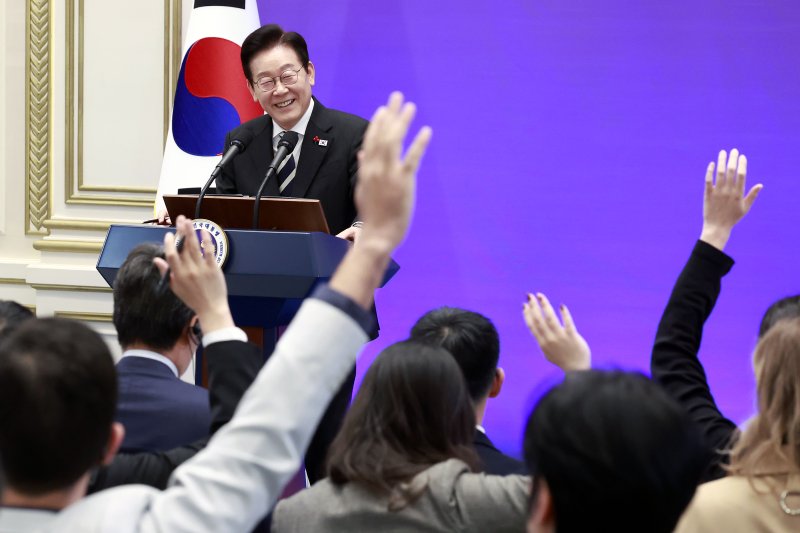
President Lee explained, "Despite President Trump’s proposal, some in the U.S. government seem to feel there is no need to rush." He added, "I suspect this is due to concerns about nuclear armament," but firmly stated, "There is neither a need nor an intention for nuclear armament."
President Lee made it clear that he opposes nuclear armament, stating that it would trigger a 'nuclear domino' effect in the region and that Korea’s economy could not withstand U.S. disapproval and international sanctions. On the other hand, he emphasized that uranium enrichment, Spent Nuclear Fuel reprocessing, and nuclear-powered submarines are "not directly related to nonproliferation" and stressed the need for peaceful use, as in the case of Japan.
President Lee stated, "If we could autonomously manage enrichment and reprocessing, the location would not be a significant issue." However, since there are no overseas facilities willing to accept Spent Nuclear Fuel reprocessing, he explained that it should preferably be done domestically. Regarding nuclear-powered submarine construction, President Lee noted that President Trump proposed building them at the Philadelphia Naval Shipyard, but described this as highly impractical. He asserted that constructing them domestically, where Korea boasts world-class shipbuilding efficiency, is more realistic. President Lee cited the approval for nuclear-powered submarine construction as the greatest achievement of his summit with President Trump.
President Lee also stated that he had proposed a visit to China within the year to President Xi Jinping, but that the visit has been delayed due to circumstances on the Chinese side. He added, "President Xi Jinping is surprisingly good at making jokes," and expressed hope for an early visit to China.
When asked about his stance on China-Japan tensions, President Lee responded, "Taking sides only exacerbates conflict," and quoted a Korean proverb: "Stop fights, but encourage negotiations." He emphasized that coexistence, mutual respect, and cooperation are the most desirable approaches.
In response to a question from Japanese media about joint efforts to address the Cambodia scam (fraud and human trafficking) crisis, President Lee expressed his hope that South Korea and Japan would cooperate. It has been reported that many Japanese victims are being detained in the Kingdom of Cambodia. President Lee also clarified that issues such as the Dokdo sovereignty dispute and historical conflicts over the Sado Gold Mine would not lead to a breakdown in dialogue with Prime Minister Sanae Takaichi of Japan. He stated his intention to continue shuttle diplomacy by visiting Prime Minister Takaichi’s hometown.
Regarding North Korea policy, President Lee said that, if necessary to facilitate North Korea–United States dialogue between President Donald Trump and Chairman Kim Jong Un, he would consider discussing adjustments to the ROK-US Combined Military Exercise. However, when asked whether the government would apologize for leaflet campaigns to the DPRK to ease tensions, he replied that it would be difficult. President Lee explained, "While I sometimes think an apology may be necessary, I hesitate to say so, fearing it could become a source of political controversy or accusations of being pro-North."
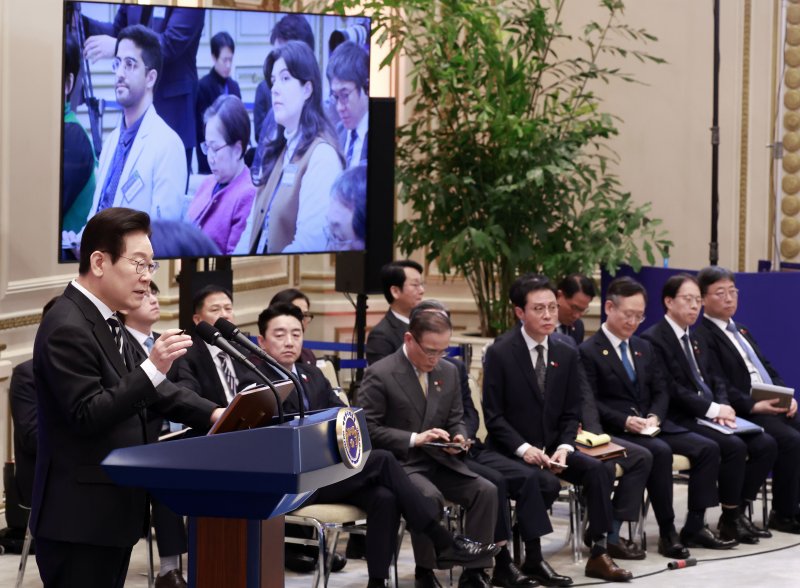
In response to a foreign reporter’s question about measures for South Koreans detained in the DPRK for over ten years, President Lee said he would look into the circumstances. Expressing surprise, he stated, "This is the first I’ve heard of South Korean nationals being held in the DPRK," and instructed Wi Sung-lac, Director of the Office of National Security (ONS), to investigate. It is reported that three male missionaries, arrested in the DPRK while conducting missionary work, have been detained for over ten years on charges of subversion and espionage, and sentenced to indefinite hard labor.
[email protected] Kim Kyung-soo, Sung Seok-woo Reporter