'Non-Judge' to Chair Judicial Administration Council... Ruling Party Unveils Judicial Administration Reform Plan
- Input
- 2025-12-02 15:08:32
- Updated
- 2025-12-02 15:08:32
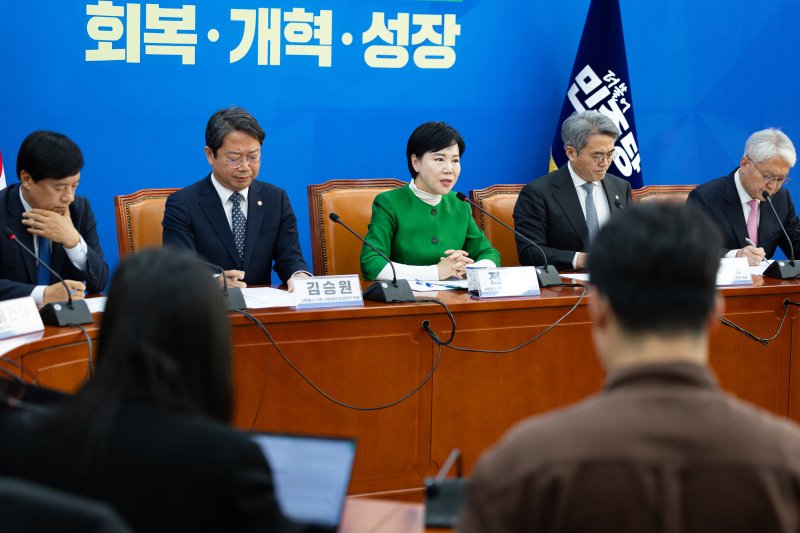
[Financial News] On the 2nd, the Democratic Party of Korea (DPK) unveiled its final judicial administration reform plan. The DPK emphasized that, through this reform, appointing a non-judge as chair of the Judicial Administration Council would decentralize the 'imperial authority' of the Chief Justice of the Supreme Court of Korea. Addressing concerns raised by some regarding the constitutionality of the reform, the DPK dismissed them as 'unfounded.'
The Judicial Administration Normalization Task Force of the DPK presented the reform plan at the National Assembly of the Republic of Korea. Jeon Hyun-hee, the head of the Task Force and a DPK lawmaker, stated, "The core of the reform is to disperse the imperial authority concentrated in the Chief Justice of the Supreme Court of Korea and to strengthen democratic procedures in judicial administration." She added, "By separating trials from administration, the reform aims to prevent the Chief Justice from intervening in trials and to guarantee judicial independence." She further explained, "While respecting the judicial authority guaranteed by the Constitution, the reform ensures the independence of trials from within the judiciary itself." Jeon also announced that the 'Judicial Administration Normalization Act' would be submitted on the 3rd.
Lee Geon-tae, a DPK lawmaker and member of the Task Force, asserted, "This reform plan does not seek to intervene in judicial work, but rather to strengthen its independence." He criticized claims that the reform infringes on judicial independence as 'nonsense.' Lee also noted, "The plan does not strip the courts of any existing authority." He argued, "If the Chief Justice of the Supreme Court of Korea opposes even this, it would only be to protect vested interests."
The Task Force announced plans to amend the Court Organization Act to abolish the current National Court Administration and establish the Judicial Administration Council, a collegial body. Functions such as personnel management, currently handled by the National Court Administration, will be transferred to the Judicial Administration Council. The new Council will consist of 13 members, including a non-judge chair at the ministerial level and three standing members.
A key aspect of the reform is the appointment of judges. The Judicial Administration Council will prepare and deliberate on personnel proposals, report them to the Chief Justice of the Supreme Court of Korea, who will then decide whether to accept them. This represents a significant reduction in the Chief Justice's authority. However, the Chief Justice retains the final decision-making power in judicial appointments, in accordance with Article 104(3) of the Constitution, in an apparent effort to avoid constitutional challenges.
Additionally, the Task Force addressed the issue of preferential treatment for former Justices of the Supreme Court of Korea. Under the reform, lawyers who previously served as Justices will be barred from representing cases before the Supreme Court for five years after retirement.
The reform plan also includes changing the title of the Inspector General for Judicial Ethics within the Supreme Court to Inspector General, and operating it as a separate entity. Jeon Hyun-hee explained that excluding former court officials from this role would enhance the effectiveness and independence of oversight within the Supreme Court.
The Task Force also stressed the need to strengthen the Judges' Council. The reform plan calls for the establishment of a Judges' Council as an advisory body on judicial administration at every level of the court, with all judges participating. Major matters prescribed by law, such as the selection of candidates for President of the Court, must be reviewed and decided by the Judges' Council. According to the DPK, this measure is intended to empower judges who preside over trials to take a more active role in court administration.
Jeon Hyun-hee also addressed concerns about the constitutionality of the reform plan, aside from the Chief Justice's appointment authority, stating, "Most of these claims are not based on fact and do not align with current law." She pledged, "We will do our utmost to ensure the passage of this bill within the year."
Meanwhile, the DPK continues to intensify its push for judicial reform, not only with the reform plan unveiled by the Task Force but also through proposals from the Special Committee on Judicial Reform, including increasing the number of Justices of the Supreme Court of Korea. The DPK has also advanced measures such as the Special Panel for Insurrection Cases and the Crime of Legal Distortion through the Legislation and Judiciary Committee. The party has repeatedly cited allegations of election interference by Chief Justice Cho Hee-dae and delays in trials by Judge Ji Gui-yeon, signaling an escalation in legislative efforts targeting the judiciary.
[email protected] Kim Hyeong-gu Reporter