"DPRK Reinforces DMZ Barbed Wire, a Move to Encourage Russia to Bypass South Korea" [FN People]
- Input
- 2025-12-02 14:30:13
- Updated
- 2025-12-02 14:30:13
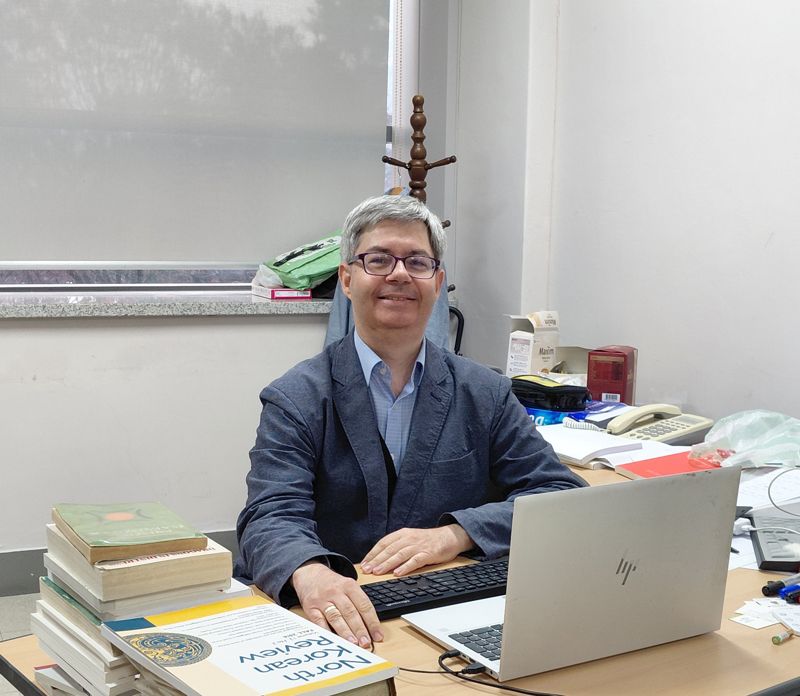
[Financial News] "I do not believe the current risk from the DPRK is greater than during the 2015 DMZ Landmine Incident. Historically, the worst incidents caused by the DPRK have been surprise attacks, whereas the current measures are highly public and thus fundamentally different."
Balazs Szalontai, a North Korea researcher from Hungary and professor at Korea University, offered this assessment on the recent tension-raising actions by the Democratic People's Republic of Korea (DPRK) in the Korean Demilitarized Zone (DMZ) and along the Military Demarcation Line (MDL). He noted that even with the reinforcement of fences and guard posts, the installation of triple barbed wire, and additional landmines in some areas, the military threat should not be exaggerated.
Professor Szalontai explained, "This is a symbolic move intended to reinforce the message that the two Koreas must remain as isolated as possible, much like when the DPRK previously severed all rail and road links between North and South."
He added, "It is not solely aimed at South Korea." According to him, "The purpose is to thwart plans to open a Korea-Russia Transport Corridor passing through DPRK territory." Furthermore, he noted, "Russia is being maneuvered into dealing exclusively with the DPRK, rather than cooperating with both Koreas." This suggests that by blocking logistics and transportation routes through the DPRK, Russia's options are being limited to the DPRK alone.
Professor Szalontai stated, "In 2024, the DPRK's role in the Russia-Ukraine war enabled it to secure a security treaty with Russia, which is far more advantageous than the 2000 Treaty on Friendship, Good-Neighborly Relations and Cooperation between the Democratic People's Republic of Korea and the Russian Federation." He explained that the recently signed Treaty on Comprehensive Strategic Partnership provides the DPRK with a much more favorable framework, and that "the DPRK can gain far greater benefits at a lower cost through cooperation with Russia than through a nuclear agreement with the USA." He analyzed that the fortification of the DMZ and the closure of inter-Korean land routes can also be seen as a means to solidify this partnership.
Regarding President Lee Jae Myung's remark that "we must create even the smallest opening to dialogue with the DPRK," Professor Szalontai evaluated this conciliatory gesture as a positive signal to neighboring countries. He noted that humanitarian projects such as the excavation and repatriation of remains in the DMZ are difficult to criticize from a security or economic perspective, and even if the DPRK does not respond, China can observe which side is more open to dialogue. He interpreted South Korea's actions as sending a message to China that "we are not the party seeking to escalate tensions."
On the issue of nuclear-powered submarines, he pointed out, "Since China also opposes this issue, the DPRK can present it as a move by the USA targeting both Pyongyang and Beijing, while still drawing support from China." He also warned that if gestures for dialogue and messages of military buildup are sent simultaneously, China may perceive conflicting signals.
Professor Szalontai has analyzed the DPRK's behavior from 1949 to 1989 based on Hungarian diplomatic documents. He assessed, "Although Hungary's communist regime was officially a friend, the DPRK was in fact an extremely self-serving partner." Unlike other allies such as Vietnam and the Republic of Cuba, which provided relatively detailed and reliable information, the DPRK tended to withhold information even from its official allies.
He concluded, "If the DPRK showed such an attitude even toward official allies, then in inter-Korean relations, rational calculation of interests must take precedence over emotion or rhetoric." He added, "The reinforcement of barbed wire and landmines in the DMZ should be seen as calculated actions aimed at deepening inter-Korean isolation, restructuring Russia's options, and considering Chinese public opinion."
[email protected] Seong Seok-woo
[email protected] Seong Seok-woo Reporter