Constitutional Court Upholds Constitutionality of Former Road Traffic Act Provision Mandating Harsher Penalties for Three or More DUI Offenses
- Input
- 2025-12-01 15:08:27
- Updated
- 2025-12-01 15:08:27
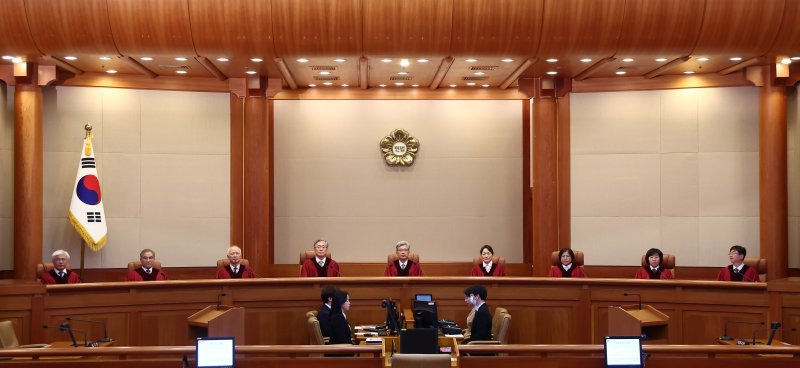
[Financial News] The Constitutional Court of Korea has ruled that a previous provision of the Road Traffic Act, which imposed harsher penalties such as imprisonment or fines for individuals convicted of driving under the influence (DUI) three or more times within a short period, is constitutional.
According to the legal community on the 1st, the Constitutional Court of Korea unanimously upheld the constitutionality of Article 148-2, Paragraph 1 of the former Road Traffic Act, which was amended on June 8, 2011, and remained in effect until March 27, 2018. The decision was delivered on the 27th of last month by all nine justices.
In August 2018, Mr. A was indicted for driving without a license with a blood alcohol concentration of 0.153%. Previously, Mr. A had received suspended prison sentences for DUI offenses in 2015 and 2017, making him subject to aggravated punishment. During his trial, Mr. A requested a constitutional review of the Road Traffic Act provision that imposes harsher penalties on individuals who violate DUI regulations more than twice and are caught driving under the influence again.
The Constitutional Court of Korea stated, "The provision in question aims to ensure the effectiveness of penalties in response to the illegality and culpability of repeated DUI offenses," adding, "There is a rational basis for imposing harsher penalties on those with three or more DUI convictions." The Court determined that the aggravated punishment clause does not violate the principle of proportionality between responsibility and punishment.
However, in November 2022, the Constitutional Court of Korea found the aggravated punishment clause of the so-called Yoon Chang-ho Act, which targeted individuals with two or more DUI offenses, to be unconstitutional. Although the circumstances were similar, the distinction between constitutionality and unconstitutionality was based on the time interval between repeated DUI offenses. The Court explained, "There is a temporal limitation between past violations and the subsequent repeat offense subject to punishment," highlighting the difference from the previous unconstitutional ruling.
At the time of the Yoon Chang-ho Act ruling, the Court held that if more than ten years had passed since the initial DUI offense, even if a person was caught again, it would be difficult to regard the conduct as repeatedly endangering the lives and physical safety of society.
As a result, on January 3, 2023, the Road Traffic Act was amended again. The revised provision now states that a person who is sentenced to a fine or greater penalty for violating DUI regulations and commits another violation within ten years from the date the sentence becomes final will be punished according to specific criteria.
In contrast, Mr. A received suspended prison sentences for DUI offenses in January 2015 and November 2017. Less than a year later, in August 2018, he was caught driving under the influence again, which distinguishes his case from those under the Yoon Chang-ho Act.
[email protected] Lee Hwan-joo Reporter