"I Just Hugged and Kissed Her Because She Was Cute"... Two-Year-Old Girl Collapses and Loses Consciousness [Health Talk]
- Input
- 2025-11-28 07:20:09
- Updated
- 2025-11-28 07:20:09
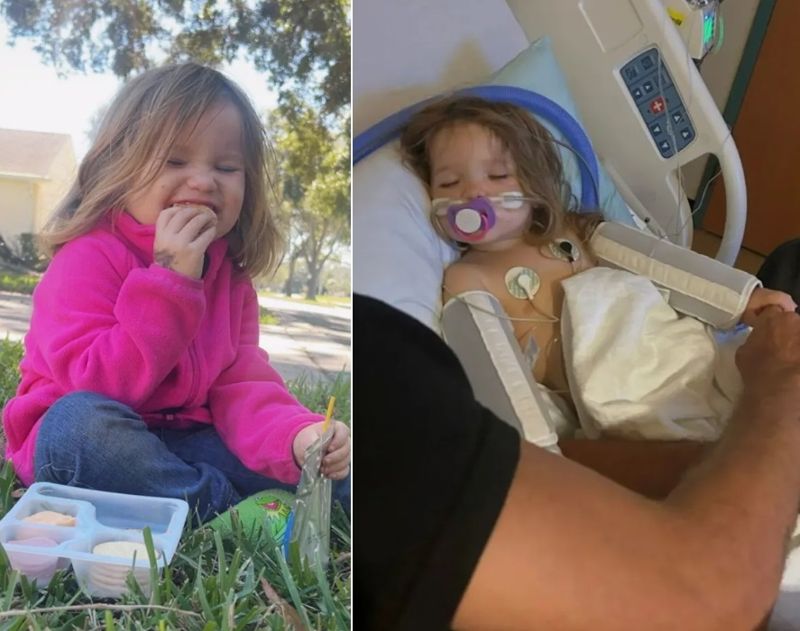
[Financial News] The story has emerged of a previously healthy two-year-old girl who developed cold symptoms, lost consciousness, and was rushed to the emergency room. The child's parents claim, "It was because someone kissed our daughter."
According to The Sun and other foreign media on the 28th, Destiny Smith, a 30-year-old from Florida, noticed last November that her two-year-old daughter was showing symptoms of a cold.
Destiny initially thought it was just a common cold, but soon noticed abnormal signs such as shortness of breath and labored breathing, prompting her to rush her daughter to the hospital.
Medical staff diagnosed the child with respiratory syncytial virus (RSV). Her condition deteriorated rapidly within hours, and she was airlifted by helicopter to the pediatric intensive care unit.
Despite respiratory treatments every two hours, her oxygen saturation continued to fall. The girl lost consciousness and hovered between life and death, receiving intensive care in the pediatric ICU for five days before gradually recovering. After discharge, she continued using an inhaler every four hours for three weeks while being closely monitored.
Regarding the route of infection, Destiny said, "During the Thanksgiving holiday, several relatives hugged and kissed my daughter," adding, "I can't be sure if everyone maintained perfect hygiene, such as washing their hands."
She continued, "I never realized that a kiss could put a child's life at risk," and warned, "People who are not immediate family should be careful about hugging or kissing a child."
Dr. Primrose Freestone, a clinical microbiologist at the University of Leicester, pointed out, "Kissing a baby is a sign of affection, but it can have serious health consequences."
She added, "Parents of young babies should not hesitate to ask others not to kiss or touch their child," emphasizing, "It is important to always remember that infants are extremely vulnerable to infectious diseases."
She further advised, "If you really want to kiss a baby, it's better to do so on the feet or the back of the head rather than on the mouth or face."
It may start as a simple cold, but in infants and young children, the condition can deteriorate rapidly.
RSV is the most common cause of respiratory infections in infants and young children worldwide. It is a leading virus that causes severe respiratory failure, especially in those aged six months to two years.
Although it often begins like a common cold, the condition can worsen dramatically within hours in a young child's airway. Due to this unpredictable rate of deterioration, if a child exhibits unusual breathing patterns, such as grunting or the abdomen being drawn in under the ribs, immediate medical attention is necessary.
For adults, RSV usually results in mild upper respiratory symptoms similar to a cold. However, for infants with weak immune systems, the elderly, and those with chronic illnesses, it can lead to pneumonia, bronchiolitis, or hypoxemia, making it a leading cause of hospital admissions every winter.
RSV spreads through saliva and direct contact, and can survive for several hours on surfaces such as toys and doorknobs, allowing for indirect transmission. The incubation period is typically four to six days, and early symptoms—runny nose, cough, and mild fever—are almost indistinguishable from those of a common cold.
Beware of 'Herpesvirus,' which can also be transmitted through physical contact such as kissing.
Infants under two years old have underdeveloped immune systems, making them more susceptible to serious infections than adults. Therefore, infections that cause only mild symptoms in adults or older children can be life-threatening for infants.
Herpesvirus infection is a representative example. If herpesvirus affects only the baby's eyes, mouth, or skin, most cases recover with antiviral treatment. However, if the virus spreads throughout the body and affects internal organs, it can be fatal in the worst-case scenario.
There was also a case in the UK last March where a two-year-old boy lost vision in one eye after being kissed on the face and contracting the virus. At the time, medical staff suspected that someone infected with herpesvirus had kissed the child's eye or the area around it, leading to the infection.
moon@fnnews.com Moon Young-jin Reporter