'First Night Flight' for Nuri rocket (Flight 4)... The Reason Behind the Midnight Launch
- Input
- 2025-11-27 02:07:53
- Updated
- 2025-11-27 02:07:53
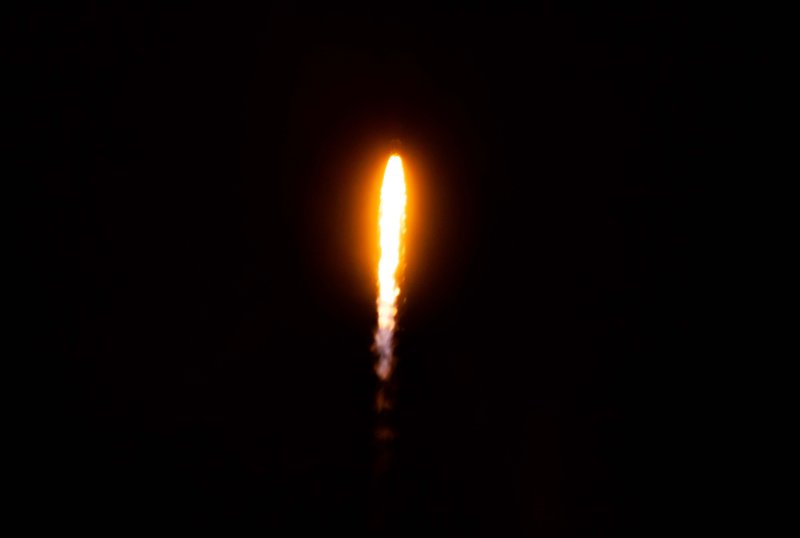
[Financial News] At 1:13 a.m. on the 27th, a one-ton launch vehicle soared into the sky in sync with the countdown, emitting a dazzlingly bright light that pierced the night. The glow from the turbine exhaust made it appear like a radiant cross in the sky.
On this day, Nuri (KSLV-II) ascended into the night sky, marking its first-ever night launch. Nuri rocket (Flight 4) carried a total of thirteen satellites, including the main payload, CAS500-3, and twelve CubeSats as secondary payloads.
The reason for scheduling the launch at night was directly related to the mission requirements of the main payload satellite.
CAS500-3, developed by Korea Aerospace Industries (KAI), is a 516 kg satellite tasked with scientific missions such as observing faint phenomena like auroras, airglow, the space magnetic field, and plasma.
Auroras and airglow are extremely faint, making them difficult to observe during periods of strong sunlight. Therefore, the launch timing had to be adjusted to ensure the satellite would encounter optimal sunlight conditions for aurora observation. This is similar to how ground-based observatories are located on mountaintops to avoid artificial light from vehicles and buildings.
Calculations showed that when the satellite crosses the equator from south to north, the local time of ascending node (LTAN) should be 12:40 p.m. to best align with sunlight for aurora observation.
The research team at the Korea Aerospace Research Institute (KARI) worked backward from the required LTAN, factoring in the time it would take for the satellite to reach orbit after liftoff and the time it would cross the ascending node. After considering all these conditions, they determined that the optimal launch window was between 12:54 a.m. and 1:14 a.m. Korea time on the 27th.
If this window was missed, the next opportunity would be at the same time, 24 hours later.
Nuri rocket (Flight 4), launched at 1:13 a.m., successfully separated CAS500-3 thirteen minutes later at 1:26 a.m. The twelve CubeSats were then released in pairs at twenty-second intervals.
About fifteen minutes after launch, the separation of CubeSats 11 and 12 was confirmed, verifying the successful deployment of all thirteen onboard satellites.
y27k@fnnews.com Seo Yoon-kyung Reporter