"I Am the Successor to the Lee Administration"... First Meeting Between Chung Cheong-rae and Cho Kuk Ends in Tension
- Input
- 2025-11-26 15:55:10
- Updated
- 2025-11-26 15:55:10
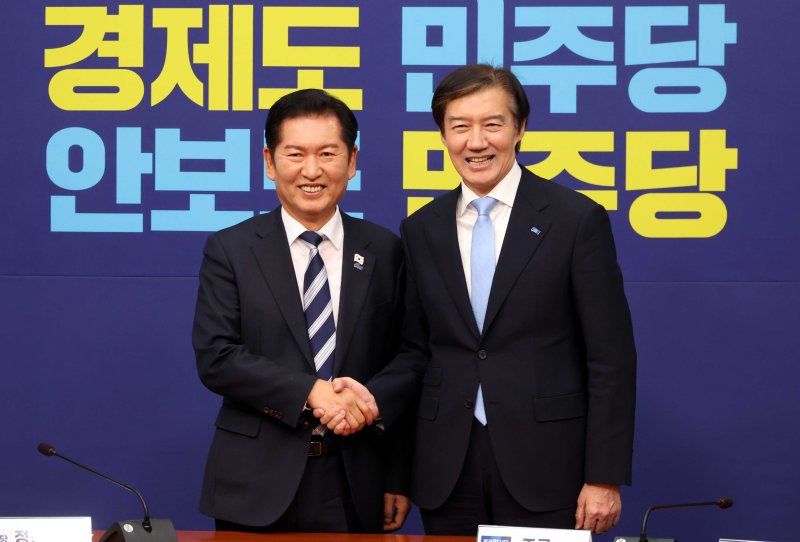
During his first courtesy visit to Chung Cheong-rae after taking office, Cho Kuk maintained a humble attitude throughout the meeting. He began by saying, "Thank you for welcoming the leader of a small party." Referring to the joint statement signed in April by the Rebuilding Korea Party, Progressive Party, Social Democratic Party, and Basic Income Party during the interim leadership of Park Chan-dae in the DPK, Cho Kuk pointed out, "It has been half a year, yet there has been no progress."
The so-called political reform bill jointly agreed upon at the Opposition Five-Party Roundtable at the time included reducing the current Negotiation Group requirement from 20 seats to 10–15 seats and introducing a runoff voting system for local elections. These have been long-standing demands of the four opposition parties, excluding the DPK.
Cho Kuk stated, "Even in the extraordinary circumstances following the last presidential election, the gap in vote share between the pan-democratic and anti-democratic candidates was a mere 0.9%. Political reform is necessary to prevent such outcomes," emphasizing, "This is not about who gains or loses. Based on this, we can defeat the forces of insurrection and the far right."
Additionally, Cho Kuk highlighted that during his meeting with Woo Sang-ho, Chief Political Affairs Secretary at the Office of the President of South Korea, the previous day, the president expressed support for discussions on political reform. He appealed, "I hope you, Leader Chung, will personally take the wheel in driving political reform."
In response, Chung Cheong-rae drew a line, emphasizing the principle of 'together yet separate.'
Chung Cheong-rae first addressed the jointly agreed political reform bill by the five opposition parties, stating, "I have asked that efforts be made to ensure the special committee on political reform is activated within the National Assembly." Regarding the so-called 2024 South Korean martial law crisis, he added, "This is still an ongoing issue," and stressed, "We must eradicate the remnants of martial law and complete the three major reforms to restore democracy and constitutional order in this country. I believe the Rebuilding Korea Party will be by our side in this endeavor."
Nevertheless, Chung Cheong-rae reiterated, "As a member of the DPK, I have no choice but to do my utmost for the party’s victory. I believe I will do the same in next year’s local elections," and added, "For the DPK’s victory and the success of the Lee Jae Myung administration, I will do my best as party leader without hesitation."
Chung Cheong-rae’s sharp response is seen as being mindful of Cho Kuk, who is considered a strong presidential contender and has publicly declared his intention to expand his influence in his political base of the Busan-Gyeongnam region and the DPK stronghold of Honam since his special pardon on Liberation Day. If the runoff voting system for local elections, one of the key points of the political reform bill, is introduced, Cho Kuk may run for mayor of Busan in the next election. Should Chung Cheong-rae lose support in the Busan-Gyeongnam region, where he has worked to win votes through efforts such as relocating the Ministry of Oceans and Fisheries (MOF) and developing the Northern Sea Route (NSR), responsibility could fall on him.
Furthermore, since taking office as party leader, Chung Cheong-rae has not yet shaken off rumors of discord between the party and the government. He is also facing internal strife for insisting on the one-member-one-vote system for party members. In this context, the president’s message of support for the political reform bill is widely seen as a significant threat to Chung Cheong-rae, who is seeking re-election as party leader.
[email protected] Song Ji-won Reporter