‘Separation of Traditional Finance and Virtual Asset Businesses’ Eased by Naver Corporation and Dunamu Inc.: Is It Becoming a Reality? [Crypto Briefing]
- Input
- 2025-11-26 17:32:43
- Updated
- 2025-11-26 17:32:43
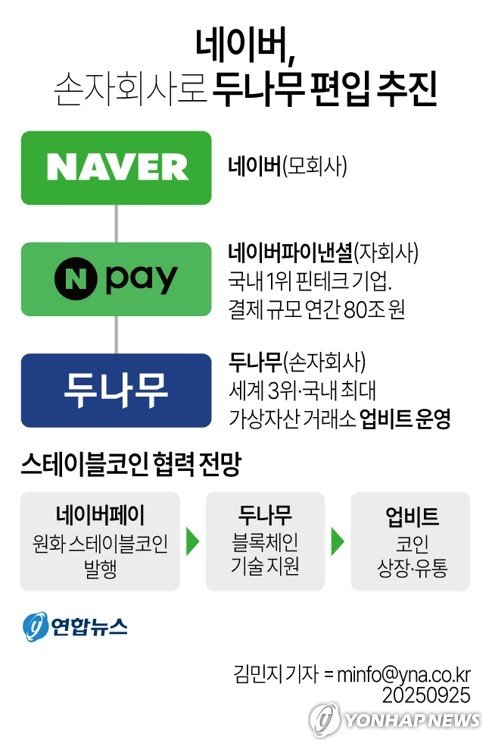
[Financial News] The merger attempt between Naver Corporation and Dunamu Inc., operator of Upbit, has ignited discussions about easing the ‘Separation of Traditional Finance and Virtual Asset Businesses’ in Korea. The biggest variables for the merger’s success are the business combination review and the separation principle itself. In the United States, the Bank Holding Company Act maintains the separation principle, but allows financial companies to invest in virtual asset firms on a case-by-case basis. In contrast, Korea has effectively blocked such investments since 2017.
According to industry sources on the 26th, Lee Hae-jin, founder and chairman of the board of Naver Corporation, and Song Chi-hyung, chairman of Dunamu Inc., are scheduled to announce the merger plan between NAVER Financial Corporation and Dunamu Inc. at a press conference on the 27th. The presence of both companies’ top executives in public is seen as an indication that some risks, such as the separation principle, have been mitigated. It is also noted that fintech companies like NAVER Financial Corporation cannot be classified as traditional financial institutions, supporting this outlook. Currently, NAVER Financial Corporation is not a licensed financial company but an electronic financial business registered under the Electronic Financial Transactions Act.
Min-seung Kim, head of research at Korbit, pointed out, “Electronic financial businesses are governed by different laws than financial companies. The term ‘Separation of Traditional Finance and Virtual Asset Businesses’ is not legally defined, but rather expresses the government’s stance or direction, so there can be various interpretations regarding the differences between electronic financial businesses and financial companies.”
The separation principle is a ‘shadow regulation’ that restricts financial companies such as banks and securities firms from investing in or collaborating with virtual asset companies. It serves as an implicit rule to prevent the high volatility and risks of virtual assets from spilling over into the traditional financial system. Examples include financial authorities blocking the brokerage and listing of Bitcoin (BTC) spot Exchange-Traded Funds (ETF) by financial investment firms, and the one-to-one matching between won-based virtual asset exchanges and real-name account banks, both of which are cited as part of this separation.
With the merger between Naver Corporation and Dunamu Inc. gaining momentum, industry attention has shifted to the potential easing of the separation principle. Some argue that easing the separation is necessary to vitalize the stablecoin industry, which is a core element of the government’s policy and the Naver-Dunamu big deal. Recent moves by the government and National Assembly to incorporate virtual assets, including stablecoins, into the institutional framework are also seen as positive. Ho Yoon Jung, a researcher at Korea Investment & Securities Co., Ltd., stated, “As there are calls within the political sphere for a more flexible interpretation of the separation principle, a positive atmosphere is forming around NAVER Financial Corporation’s acquisition of Dunamu Inc. Stablecoins could create significant synergy with Naver’s existing businesses in advertising, commerce, and fintech.”
Financial authorities are also placing importance on international regulatory trends and global consistency when considering the institutionalization of virtual assets. In the United States, while the separation principle is maintained through laws such as the Bank Holding Company Act, a flexible approach is taken toward fintech and virtual asset companies. Notable examples include investments or collaborations by BNY Mellon, The Goldman Sachs Group, Inc., and J.P. Morgan with Coinbase, Circle, and Fireblocks.
Min-seung Kim explained, “In the United States, the separation principle has often taken the form of shadow regulation. However, after Donald Trump took office, the Federal Deposit Insurance Corporation (FDIC) and the Federal Reserve Board (FRB) exempted banks from the requirement to obtain prior regulatory approval for virtual asset-related activities.” He added, “How far the authorities allow the business plans of the merged entity between Naver Corporation and Dunamu Inc. will be a crucial turning point in the regulatory landscape for the separation principle.”

Meanwhile, Dunamu Inc. announced that the equity value ratio with NAVER Financial Corporation has been set at approximately 3 to 1. This means Dunamu Inc.’s total corporate value is about three times larger than that of NAVER Financial Corporation. The equity value of Dunamu Inc. is estimated at 15.13 trillion KRW, while NAVER Financial Corporation’s equity value is estimated at 4.94 trillion KRW.
The per-share price of unlisted shares of Dunamu Inc. and NAVER Financial Corporation has been calculated at 439,252 KRW and 172,780 KRW, respectively. Based on the difference in the number of shares issued by each company, the share exchange ratio has been set at 1 to 2.54. This means that a shareholder holding one share of Dunamu Inc. will receive 2.54 shares of NAVER Financial Corporation.
A Dunamu Inc. representative stated, “The shareholders’ meeting to approve the comprehensive share exchange is expected to be held in the second quarter of next year after obtaining regulatory approval in accordance with relevant laws. Once approval is granted, a separate briefing session will be held for shareholders, and their opinions will be fully gathered before convening the shareholders’ meeting.”
elikim@fnnews.com Kim Mi-hee Reporter