‘Exchange Rate Nears 1,500 KRW’ — Korean Won Hits Lowest Value in 16 Years Since Financial Crisis
- Input
- 2025-11-24 07:17:26
- Updated
- 2025-11-24 07:17:26
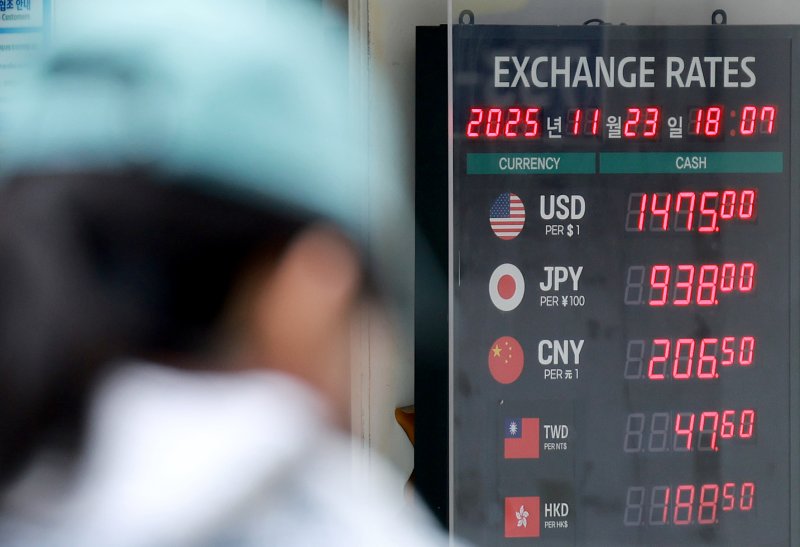
[Financial News] Last month, the real value of the Korean won plunged to its lowest level in 16 years since the global financial crisis.
REER at 89.08... Third lowest after Japan and China
According to the BOK and BIS, Korea’s REER index was 89.09 (2020=100) at the end of October.
This is 1.44 points lower than at the end of the previous month, and marks the lowest level in 16 years and two months since August 2009 (88.88) during the financial crisis.
Even compared to March this year, when political uncertainty was heightened by the declaration of martial law (89.29), the index is 0.2 points lower. It remains slightly above the 86.63 recorded at the end of November 1998, during the IMF Crisis when Korea received a bailout from the International Monetary Fund (IMF).
The Real Effective Exchange Rate (REER) measures the purchasing power of a country’s currency relative to other currencies. Generally, a value below 100 indicates that the currency is undervalued compared to the base year.
In Korea’s case, the REER index fell as low as 68.1 during the IMF Crisis. During the financial crisis, it dropped to a minimum of 78.7. More recently, it remained above 100 from October 2020 to July of the following year, then hovered in the mid-90s.
Among the 64 countries tracked by the BIS, Korea ranked third lowest after Japan (70.41) and China (87.94). Notably, the won’s decline in October was the second largest after New Zealand (-1.54), indicating that the Korean currency weakened rapidly compared to other major currencies.
Surge in Overseas Stock Purchases Cited as Cause of Won’s Weakness
Authorities pointed to a surge in overseas stock purchases by domestic investors as a key reason for the won’s depreciation. According to the BOK’s balance of payments data, Koreans invested $71.8 billion in overseas stocks (securities investment, stocks) from January to September this year. This exceeds last year’s $42.1 billion and 2023’s $29.8 billion. Compared to $16.3 billion in 2015, the figure has more than quadrupled in a decade.
Experts also cited risk aversion and inflation as contributing factors. Park Jihoon, head of the capital markets division at Hana Bank, explained, “The dollar has strengthened due to risk aversion, and increased investments by Koreans in U.S. stocks have fueled demand for the dollar, resulting in a particularly sharp decline in the won. The relatively stable inflation rate in Korea has also contributed to the drop in the REER.”
Meanwhile, there are growing expectations in and outside the foreign exchange market that the KRW/USD exchange rate could break the 1,500 won mark. On the 21st, the rate soared to 1,476.0 won during weekly trading, the highest since April 9, when concerns over U.S. tariff hikes and U.S.-China trade tensions peaked at 1,487.6 won.
[email protected] Kim Hee-sun Reporter