"Instead of 500 yen, it was 500 won—You’ve been tricked": Japanese Small Business Owners Report Losses from '500 Won Coin' Scam
- Input
- 2025-11-21 14:53:26
- Updated
- 2025-11-21 14:53:26
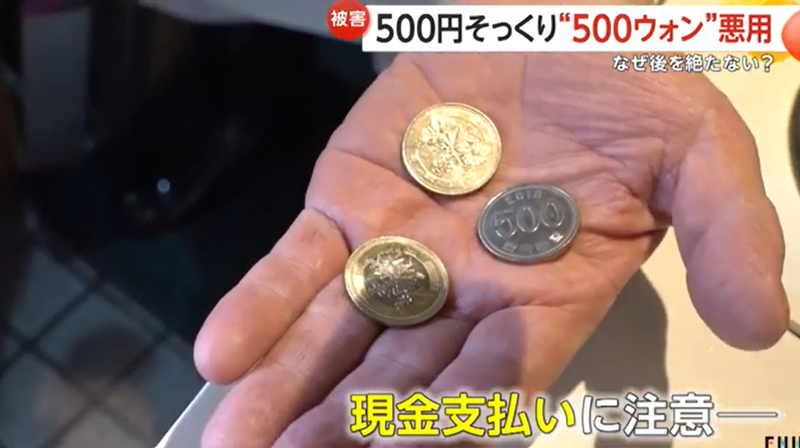
Recently in Japan, small business owners have reported losses after customers used a mix of the Japanese 500 yen coin and the Republic of Korea (ROK) 500 won coin in their stores. The two coins are nearly identical in weight and appearance, which has led to confusion.
On the 20th, Fuji News Network (FNN) reported on this issue with the headline, "A string of incidents involving 500 won coins—worth one-tenth of the 500 yen coin—being mistaken for 500 yen." The report highlighted that restaurant and gas station owners have been affected.
In stores where cash payments are common, there have been cases where customers pay with a 500 won coin instead of the 500 yen coin, which is worth about 4,700 won in ROK currency.
Takashi Ito, who runs a udon shop in Shinjuku, Tokyo, told FNN, "The size and weight are almost the same, making it very difficult to distinguish between the two." He added, "Over the past 10 years, I have experienced nearly 15 similar incidents."
At this shop, where many customers pay in cash, it is not uncommon for someone to leave the payment for their udon on the table and leave.
Ito stated, "It’s not easy to keep track of every customer’s movements from the kitchen. It can take time to realize that a 500 won coin was left behind." He emphasized, "If someone leaves a coin and quickly exits during the busy lunch hour, there’s no way for me to catch up."
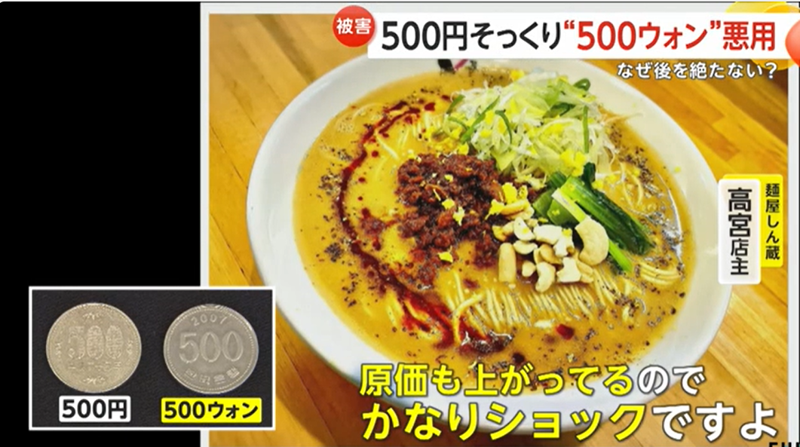
A similar incident occurred on the 4th of this month at the Shinjo ramen shop in Nihonmatsu City, Fukushima Prefecture.
The owner of the Takamiya Branch said, "After closing, an employee told me there was a coin they had never seen before. It turned out to be a 500 won coin." The owner added, "With prices rising, this was a real shock."
A comparable case was reported at a gas station in Miyagi Prefecture in May, and in December last year, a bathhouse in Katsushika City, Tokyo, discovered a 500 won coin among a pile of 500 yen coins while tallying sales.
The history of this 'crime' of substituting the 500 won coin for the 500 yen coin goes back further than many realize. According to FNN, in 1999, there were incidents where 500 won coins were shaved down to match the weight of the 500 yen coin and then used in vending machines to receive change. In response, the Japanese government introduced a new 500 yen coin and upgraded vending machines.
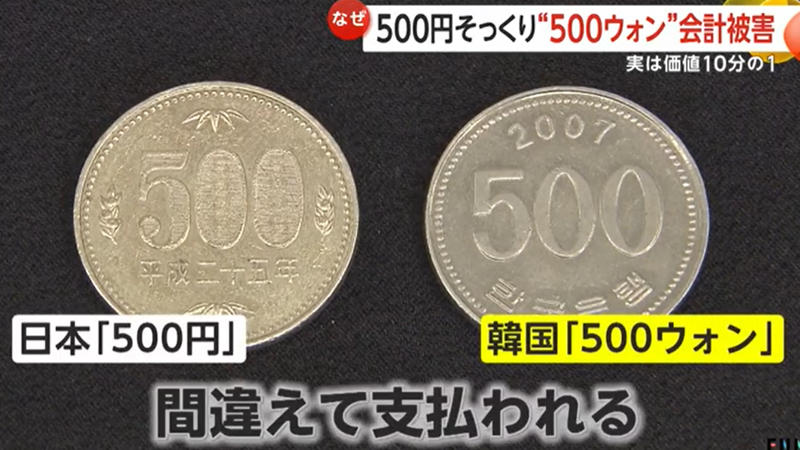
Local Japanese people also say it is difficult to distinguish between the two coins. In fact, both coins have a diameter of 26.5 mm, and their weights are similar: the 500 won coin weighs 7.7g, while the old 500 yen coin weighs 7g and the new one 7.1g.
When FNN showed both coins to people on the street, many commented, "They look extremely similar," "I wouldn’t suspect it was a 500 won coin," and "If you look closely you can tell, but since the sizes are so alike, it’s easy to miss."
[email protected] Seo Yoon-kyung Reporter