"It Shouldn't Be a One-Person Burden"... Working Mom Employment Rate Hits Another All-Time High
- Input
- 2025-11-20 12:00:00
- Updated
- 2025-11-20 12:00:00
[Financial News] For Ms. A (36), who has a five-year-old child, browsing job search websites has become a daily routine as she seeks to re-enter the workforce. She left her job after getting married and becoming pregnant, but as her child started attending daycare, it became difficult to manage household expenses on a single income. Her desire for self-fulfillment and to find her role in society also grew stronger.
The employment rate for working moms with underage children has once again reached a record high. Analysts attribute this increase to a combination of women's desire for self-actualization, rising living costs, and the expansion of government support policies.
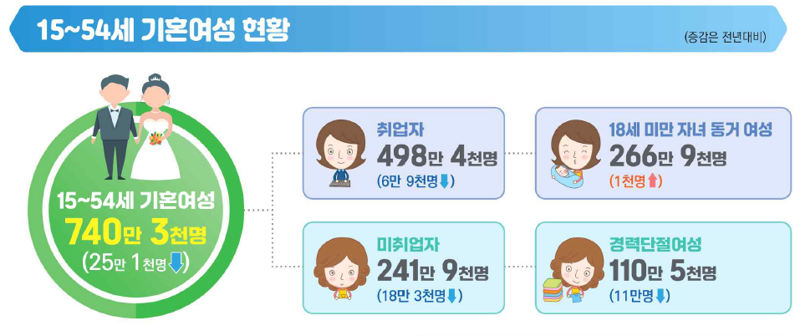
According to the 'First Half of 2025 Regional Employment Survey on the Employment Status of Married Women' released by the Ministry of Data and Statistics on the 20th, out of 7,403,000 married women aged 15 to 54, 4,984,000 were employed. Their employment rate stood at 67.3%, up 1.3 percentage points from the previous year.
For married women aged 15 to 54 living with underage children, the employment rate was 64.3%, a 1.9 percentage point increase from the previous year. This figure surpasses last year's record, which had been the highest since statistics began in 2016.
By age group, the employment rates for working moms were as follows: 67.9% for ages 45–49, 66.5% for ages 50–54, 64.7% for ages 35–39, 64.5% for ages 40–44, and 57.8% for ages 30–34. The data shows that employment rates tend to be higher among older women.
Looking at the number of children, working moms with one child accounted for 1.36 million (50.8%), those with two children made up 1.14 million (42.8%), and those with three or more children totaled 170,000 (6.5%). This highlights the challenges of participating in the labor market as the number of children increases. Employment rates by children's age were 57.7% for those with children aged six or younger, 66.1% for those with children aged 7–12, and 70.4% for those with children aged 13–17, indicating that mothers with younger children have lower employment rates.
In contrast, the proportion of career-interrupted women—those who left their jobs—has decreased. Among married women aged 15 to 54, there were 1,105,000 career-interrupted women, a decrease of 110,000 from the previous year. Their share of the total married female population also dropped by 1.0 percentage point to 14.9%, the lowest since the survey began in 2014.
The main reasons for career interruption were childcare (490,000, 44.3%), marriage (268,000, 24.2%), and pregnancy or childbirth (244,000, 22.1%). All categories showed a decline compared to the previous year.
Byoung-hoon Lee, a professor of sociology at Chung-Ang University (CAU), explained, "In the past, it was common for women to leave the workforce after marriage, but recently, dual-income households have become the new norm due to the expansion of women's social roles and an increase in paternity leave among men. As the cost of living rises, the perception that 'both partners must work to maintain the household' is spreading, leading to greater economic participation among married women."
hippo@fnnews.com Kim Chan-mi Reporter