A Love Fulfilled in Death, Illuminated by a Delicate Duet
- Input
- 2025-11-13 22:30:00
- Updated
- 2025-11-13 22:30:00
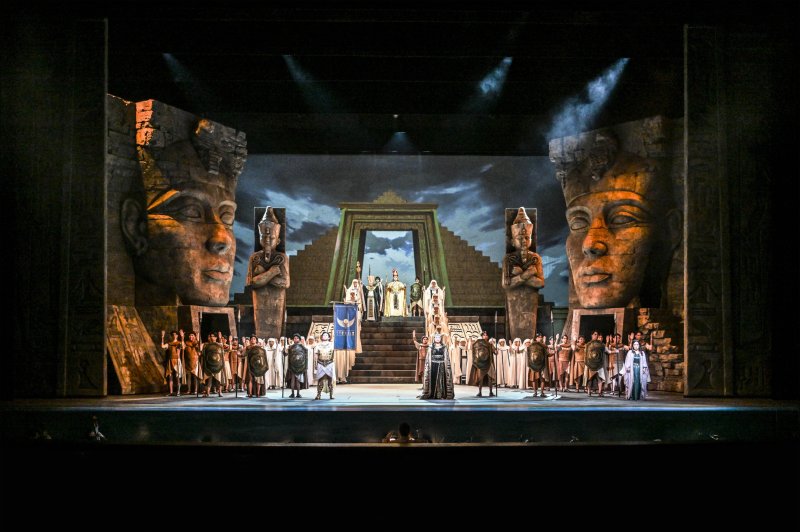
This production, co-hosted by The Financial News and the Seoul Metropolitan Opera for its 40th anniversary, brought an Eastern interpretation to the authenticity of the original work, revived the music’s inherent nobility through masterful conducting, and wove the characters’ inner worlds with meticulous vocal artistry. The result was a stage worthy of the title 'grand opera.' In particular, the delicate duet 'O, Farewell to the World,' where two lovers fulfill their love through death, left a lingering impression in the Sejong Center for the Performing Arts during late autumn.
Premiered in 1871 at the Cairo Royal Opera House, 'Aida' tells the tragic fate of Aida, a princess of the Federal Democratic Republic of Ethiopia who falls in love with the general of an enemy nation amid the conflict between a powerful empire and a weaker state; Radames, the Egyptian general who dreams of heroic ideals and pure love; and Amneris, the Egyptian princess torn between love, jealousy, and power.
This performance featured world-renowned vocalists, including soprano SaeKyung Rim, who has played Aida over 100 times, as well as the Seoul Metropolitan Chorus and Winner Opera Choir, reviving the grandeur of the original. In Act II’s 'Triumphal March,' a highlight of 'Aida,' the overwhelming energy of over 200 performers erupted on stage. Principal and supporting vocalists, a large chorus, and the orchestra combined to deliver a majestic sound, while brass instruments on stage resonated throughout the entire Sejong Center for the Performing Arts, crossing both the audience and the pit. Dynamic group dances, immersive video projections, and a revolving stage created a visually stunning spectacle.
The true allure of 'Aida' lies in its human drama, delicately unfolding within a grand scale. This production especially shone with the 'aesthetics of duality.' Director Lee Hoesu symbolized the east, where the sun rises, as 'life and glory,' and the west, where the sun sets, as 'death and eternity,' using space, lighting, and color to contrast these two worlds.
The essence of 'Aida' is also revealed in the emotional dialogues crafted by Giuseppe Verdi, particularly in the duets. The scene in Act II, where Amneris probes Aida’s feelings, was filled with palpable tension. In Act III, the duet between Aida and her father Amonasro by the Nile River left a strong impression.
On this night, SaeKyung Rim, as Aida, portrayed a soul torn between love and country with her signature dignity and strength. Sanggeun Shin, as Radames, skillfully revealed the face of a strong yet lonely man, both splendid and heroic. Songmi Yang, as Amneris, traversed emotions of love, jealousy, regret, and redemption, bringing the tragic climax of the work to completion.
In the final scene, Aida and Radames meet their end in an underground tomb, but this space is depicted not as darkness, but as 'the far side of the river bathed in light.'
Director Lee Hoesu stated, "I reinterpreted 'Aida' with the metaphors of the Nile River and Samdocheon, which symbolize the boundary between life and death," adding, "Samdocheon is not merely a path to death, but the starting point of reincarnation that can only be reached by passing through death. This aligns with the ancient Egyptians’ belief that life is but a brief moment preparing for the world beyond." Performances run at the Sejong Center for the Performing Arts from the 13th to the 16th.
jashin@fnnews.com Shin Jin-a Reporter