"Semi-Public Bus Operating System: 6 Trillion Won in Support, Yet Public Interest Has Declined"
- Input
- 2025-11-11 15:18:53
- Updated
- 2025-11-11 15:18:53
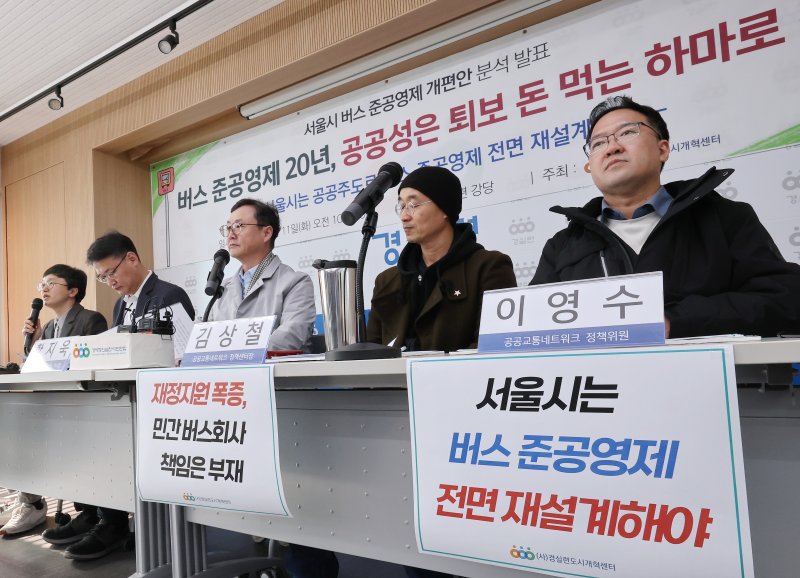
On the 11th, the Citizen's Coalition for Economic Justice (CCEJ) held a press conference at its auditorium in Jongno District, Seoul, to present the results of its analysis of the '20-Year Seoul Semi-Public Bus Operating System Reform Plan.'
The Semi-Public Bus Operating System was introduced in 2004 by the Seoul Metropolitan Government (SMG) as the first of its kind nationwide, aiming to enhance the public nature of city buses. Under this system, private bus companies provide services, but revenues from bus operations are jointly managed by the companies and local governments. Local governments cover deficits for bus companies in exchange for maintaining routes in transportation-vulnerable areas, thereby ensuring public service.
According to CCEJ, the total amount of financial subsidies has reached 6.3 trillion won and continues to surge. While annual subsidies ranged from 200 to 300 billion won after the system's introduction, they jumped to 456.1 billion won in 2021, 811.4 billion won in 2022, and 891.5 billion won in 2023. CCEJ pointed out, "The cumulative subsidy of 6.3 trillion won is enough to provide a compact car to 420,000 Seoul citizens," adding, "It is difficult to predict how much more this amount will increase in the future."
Criticism has also arisen that the Semi-Public Bus Operating System has disrupted the proper functioning of supply and demand for buses. Because the system fully compensates operating expenses based on standard transportation costs, regardless of actual revenue, the public sector assumes the management risks of private bus companies. CCEJ explained, "Since financial support is automatically adjusted according to changes in transportation revenue, there is little real incentive to reduce costs," and analyzed, "This creates an asymmetric settlement structure where cost risks are transferred to the public sector while profits accrue to the private sector."
CCEJ also highlighted that this profit structure has enabled private bus companies to record high levels of profits and dividends. Net profits from the Semi-Public Bus Operating System in Seoul were 69.4 billion won in 2018, 67.3 billion won in 2019, 74.7 billion won in 2020, 77.2 billion won in 2021, 71.6 billion won in 2022, and 89.4 billion won in 2023, showing an upward trend. Dividend payouts also steadily increased, reaching 28.3 billion won in 2018, 56.5 billion won in 2019, 35.4 billion won in 2020, 44.1 billion won in 2021, 50.6 billion won in 2022, and 58.1 billion won in 2023. CCEJ stated, "Because standard transportation costs are guaranteed regardless of demand, Seoul bus companies have consistently posted net profits of 60 to 70 billion won annually, with a record high of 89.4 billion won in 2023," and added, "During the COVID-19 period from 2020 to 2022, when SMG's bus subsidies surged, net profits actually increased compared to previous years."
CCEJ stressed that a complete redesign of the Semi-Public Bus Operating System is inevitable and urged for countermeasures. CCEJ stated, "Standard transportation costs should be verified through external evaluations and audits, and options such as route adjustment authority and partial public operation of vehicles should be considered."
[email protected] Seo Ji-yoon Reporter