Ruling Party Calls for Expanded Livelihood Budget, Opposition Criticizes 'Cash Handouts' as Populism... Clash Intensifies
- Input
- 2025-11-10 15:45:20
- Updated
- 2025-11-10 15:45:20
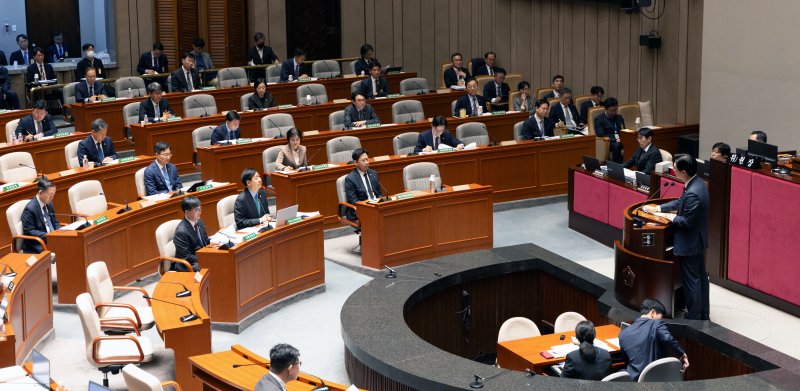
[Financial News] On the 10th, the ruling and opposition parties reaffirmed their sharp differences over next year's budget bill. The Democratic Party of Korea (DPK) consistently argued for an increase in the livelihood budget. The People Power Party maintained its stance that cash-based support measures, such as Rural Basic Income, amount to mere populism.
The Special Committee on Budget and Accounts of the National Assembly of the Republic of Korea began its full-scale review of the 2026 budget and other economic ministries' budgets on this day.
The DPK's Euljiro Committee for Livelihood Action held a press conference at the National Assembly of the Republic of Korea before the review, once again emphasizing the need to expand the livelihood budget.
The Euljiro Committee stated, "Even a budget of 728 trillion won is still insufficient to restore the livelihoods of households, self-employed individuals, small business owners, and SMEs that have been damaged over the three years of the Yoon Suk Yeol administration." The committee added, "We will scrutinize and reinforce the budget more thoroughly and strategically."
The committee particularly welcomed the government's plan to increase the standard median income by 6.51%, which would expand livelihood benefits for low-income groups, and the allocation of a 700 billion won budget for this purpose. Additionally, it welcomed the 600 billion won budget for small business management stability vouchers and the 700 billion won budget for the Youth Future Savings program.
The committee further criticized, "The People Power Party is already calling for cuts to these livelihood recovery budgets, labeling them as 'cash handouts.' The Euljiro Committee will make every effort to defend the livelihood budget."
Han Ki-ho of the People Power Party described the Rural Basic Income project as 'populism' during the budget review process. Han pointed out, "In the Rural Basic Income project, local governments bear 60% of the cost, while the central government covers about 40%. Each local government is expected to contribute an average of 30 billion won, which is a significant burden."
In response, Kang Hyung-seok, Vice Minister of Agriculture, Food and Rural Affairs (MAFRA), explained, "While it is indeed a burden, there are also plans for internal expenditure efficiency and revenue source development, so I do not consider it an excessive burden."
Cho Jung-hun criticized the government's Debt Service Ratio (DSR) 40% regulation included in the October 15 Real Estate Policy and the government's expansionary fiscal stance as 'contradictory.' He argued that while the government is promoting future industry investment through 516 trillion won in loans as per its mid-term fiscal plan, it does not guarantee the public's right to borrow.
In response, Koo Yun-cheol, Deputy Prime Minister for Economic Affairs and Minister of Economy and Finance, emphasized the need for an expansionary fiscal policy, stating, "We are in a period of great transformation with Artificial Intelligence (AI), and unless the nation invests fiscally during this era of super-innovation, Korea risks falling behind in this race."
[email protected] Kim Hyung-gu Reporter