Play 'Yakiniku Dragon' - Chong Wishing: "I Might Be the Only Playwright Whose Childhood Home Is a World Heritage Site"
- Input
- 2025-11-10 11:25:20
- Updated
- 2025-11-10 11:25:20
[Financial News] The term 'Zainichi' originally refers to 'foreigners residing in Japan.' However, it also embodies the fate of ethnic Koreans in Japan, who have been labeled as outsiders for their entire lives. Min Jin Lee, a 1.5-generation Korean American novelist, re-examined the lives of Koreans in Japan through her novel 'Pachinko,' describing them as 'not merely victims, but people who have fought to create their own lives.'
Chong Wishing, a second-and-a-half generation Korean-Japanese director, has also brought the history and identity of Koreans in Japan to the stage. He is a prominent playwright and director, having written scripts for films by the late director Yoichi Sai, such as 'All Under the Moon' and 'Blood and Bones.' 'Yakiniku Dragon,' his signature work, premiered in 2008 to mark the 20th anniversary of Seoul Arts Center and the 10th anniversary of Japan's New National Theatre. This play is a quintessential example of realism, delicately capturing the lives and identities of Koreans in Japan.
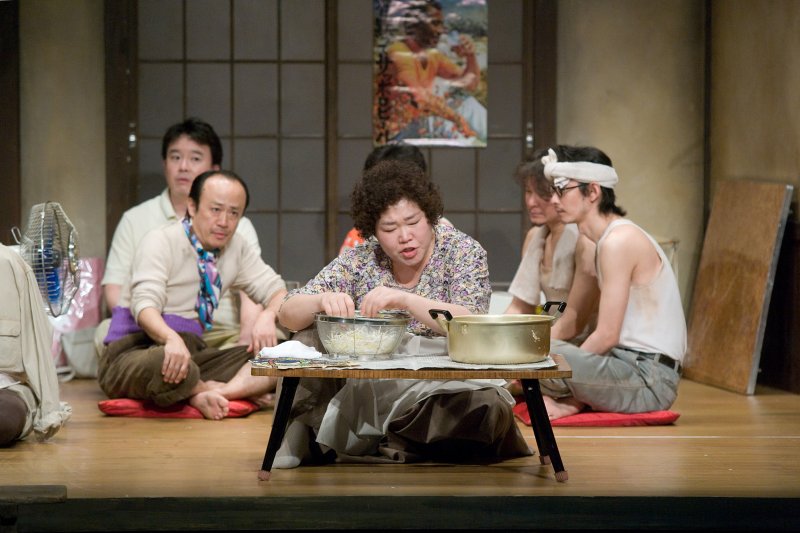
'Yakiniku Dragon' depicts the lives of Koreans in Japan in the 1970s, set in a grilled offal restaurant.
'Yakiniku Dragon' is set in a grilled offal restaurant in the Kansai region of Japan during the 1970s. It tells the story of Yong-gil, a father who lost an arm and his wife in the war, and his family, who never lose hope despite poverty and discrimination. The restaurant is named 'Yakiniku Dragon' after the word 'dragon' (Yong).
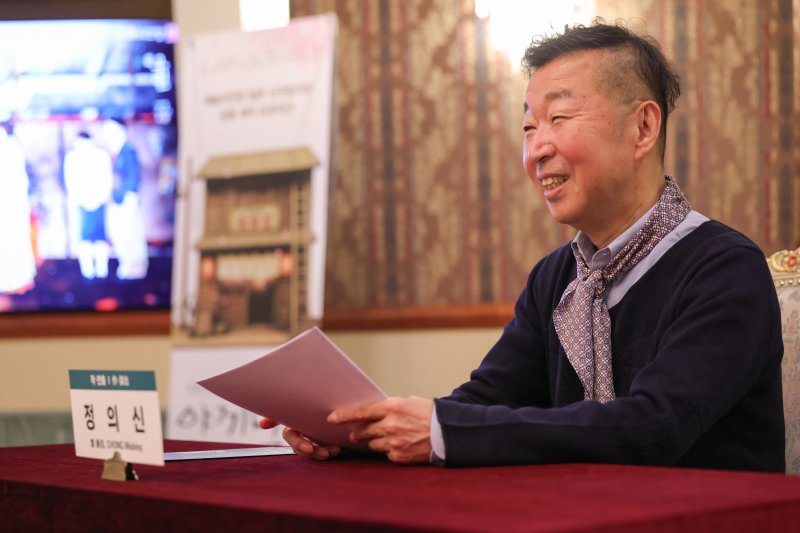
In an interview at Seoul Arts Center in Seocho-gu, Seoul, on the 6th, Chong Wishing shared, "The scenes of a community of poor people building their own homes on government land after the war are based on my father's real-life experiences." He added, "The plot point where the village is destroyed and turned into a park is also drawn from true events."
Born and raised in a slum in Himeji, Hyōgo Prefecture, home to the World Heritage Site Himeji Castle, he laughed and said, "I might be the only playwright whose childhood home is a World Heritage Site."
The reason the play is set in a grilled offal restaurant is similar to 'Pachinko.' Chong Wishing explained, "If 'Pachinko' is a symbolic space intertwined with the history of survival, identity, and discrimination for Koreans in Japan, then in the 1970s, grilled offal or yakiniku represented food for poor laborers and Koreans in Japan." He noted that while Japanese people enjoy it now, back then, it was a humble space selling inexpensive offal.
The play was co-produced by Seoul Arts Center and Japan's New National Theatre in 2008, and its 2011 revival sold out every performance in both countries. This year’s production commemorates the 60th anniversary of Korea-Japan diplomatic relations, bringing the show back to Korean audiences after 14 years—a period long enough for the world to change.
Chong Wishing remarked, "Although interest in Korean culture and K-pop is high in Japan, there is still indifference toward the history and lives of Koreans in Japan."
This year, the film 'Kokuho' by Korean-Japanese director Lee Sang-il surpassed 10 million viewers, ranking second in Japanese box office history. However, Chong Wishing commented, "Director Lee has become a symbol of hope for the younger generation," but added, "I don't feel that perspectives on Koreans in Japan have fundamentally changed."
He also pointed out that the number of Koreans in Japan is decreasing every year, and even Osaka, once a hub for the community, is not the same as before. "The numbers are dwindling, and more people are acquiring Japanese citizenship, leading to fewer points of contact," he said. "There are even attempts to blur history, as seen in the controversy over the Kanto Massacre Memorial Monument in Tokyo."
"The world is at war... There is a sense of empathy regarding migration and refugee issues."
Recently, diaspora narratives such as the drama 'Pachinko' and the film 'Minari' have gained global attention. Chong Wishing attributed this trend to ongoing wars and conflicts. He added, "Stories of migration and life in a foreign land can become anyone's reality at any moment, which creates a sense of unease." He shared that when 'Yakiniku Dragon' was recently performed as a reading in Australia and the United States, audiences interpreted the work within this context.
Chong Wishing’s creative drive has always centered on 'minorities.' He said, "I wanted to document the lives of those who have supported the shadows of modern society before they disappear." He continued, "Even among poor playwrights, few have walked the same path as I have. That's why I feel compelled to continue writing about the lives of Koreans in Japan and other minorities."
Along with 'Yakiniku Dragon,' his works 'Pamaya Sumire' and 'For Example, Like a Flower Blooming in the Field' are known as the Korean-Japanese trilogy. These plays depict the hidden side of Japanese modern history from the 1950s to the 1970s, and the stories of poor laborers and Koreans in Japan who supported the transformation of abandoned mines into airport construction sites. For him, creating theater is an act of proving the existence of Koreans in Japan.
Laughter Deepens Tears
'Yakiniku Dragon' features a bustling household: Yong-gil's two daughters from his previous marriage, his second wife Young-soon, her daughter, and their youngest son together—six family members in total.
In this production, actors and musicians greet the audience on stage and in the seats 20 minutes before the curtain rises. Through a pre-show filled with the aroma of grilling meat and lively music, the audience is invited to become guests at the grilled offal restaurant. Laughter, after all, deepens the tears. This work is no exception. Chong Wishing emphasized that, while the play addresses discrimination and pain, it also contains elements of entertainment.
It is also special that both Korean and Japanese actors share the stage. Chong Wishing stated, "This is not just a Korea-Japan co-production; the participation of Japanese, Korean, and Korean-Japanese actors is essential. I hope audiences will enjoy the performance beyond the barriers of language and nationality."
He also highlighted the importance of the youngest son in the play, expressing his hope that each audience member would find their own interpretation. "The youngest son is like an observer of the family. I am curious to see how audiences perceive Tokio and what meaning they find in the family," he said.
The play runs from November 14 to 23 at CJ Towol Theater, Seoul Arts Center.
jashin@fnnews.com Shin Jin-a Reporter