Kim Byung-kee: 'Focus on Livelihood Bills in November Assembly... Judicial Reform Set for December'
- Input
- 2025-11-09 15:15:04
- Updated
- 2025-11-09 15:15:04
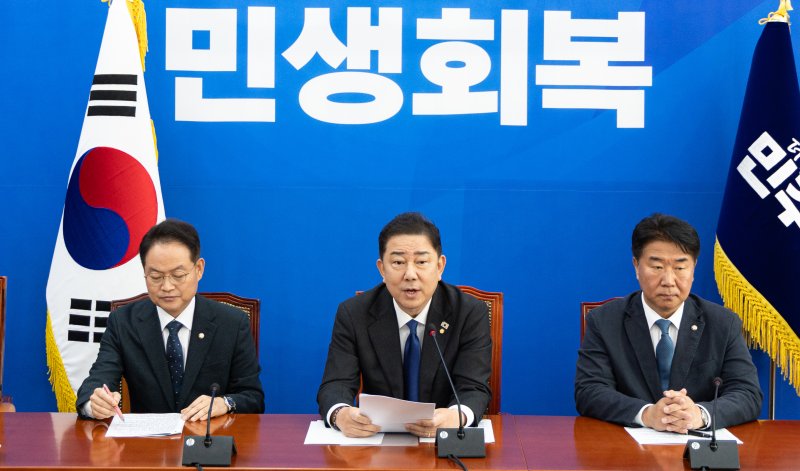
[Financial News] The Democratic Party of Korea (DPK) has decided to prioritize the passage of livelihood-related bills at this month's plenary session. With strong clashes expected between the ruling and opposition parties over reform bills, including the Judicial Reform Bill promoted by the DPK, and next year's budget, the party plans to postpone contentious bills until the end of the year and first pass urgent livelihood bills. In particular, the DPK aims to process fast-track items such as the Semiconductor Special Act within this month through consultations with the People Power Party and other opposition parties.
At a press conference held at the National Assembly of the Republic of Korea on the 9th, Kim Byung-kee, floor leader of the DPK, stated, 'We expect the National Assembly to hold one or two plenary sessions in November,' adding, 'If things proceed as scheduled, we will focus on processing livelihood bills first.' Heo Young, DPK's chief policy secretary, also remarked, 'Within the People’s Livelihood Economic Council with the People Power Party, we hope to reach agreements on various common pledges and livelihood bills, including the K-Steel Act.'
Kim Byung-kee specifically addressed the follow-up to the United States–Korea Tariff Negotiations, stating, 'This tariff negotiation is an agreement, not a treaty or convention subject to ratification by the National Assembly of the Republic of Korea.' He announced plans to process the Special Act on Investment in the United States, which will support the implementation of the United States–Korea Tariff Negotiations, within this month.
He commented, 'The Lee Jae-myung administration has achieved results that exceeded expectations, from the tariff negotiations to the Asia-Pacific Economic Cooperation (APEC) summit and the United States–Korea security dialogue.' He continued, 'It is the National Assembly’s responsibility to enact follow-up legislation to translate these achievements into growth.' He further emphasized, 'Legislation to establish an investment fund for the United States, reduce tariffs between the two countries, and foster strategic industries must be enacted without missing the golden time.'
The DPK also plans to process the Semiconductor Special Act within this month through bipartisan negotiations. Kim Byung-kee stated, 'If consensus is reached on fast-tracked bills such as the Semiconductor Special Act, we hope to process them in November,' adding, 'Our goal is to fully discuss and process these bills with the People Power Party and others.'
The DPK will focus on passing livelihood bills this month and plans to address reform legislation, including the Judicial Reform Bill, in December. Kim Byung-kee said, 'I expect the Judicial Reform Bill will be processed in December,' explaining, 'Even if we want to proceed quickly, if we combine the Judicial Reform Bill with livelihood bills, the People Power Party will likely filibuster, causing significant delays in passing livelihood bills. It is not because the Judicial Reform Bill is incomplete.'
He also reiterated his position on abolishing the breach of trust offense. Kim Byung-kee stated, 'My stance on abolishing the breach of trust offense remains firm,' but added, 'About 30 laws need to be amended, and all related cases must be reviewed, so it appears the Ministry of Justice (MOJ) lacks sufficient time.' He continued, 'It would be ideal to complete this by December, but even if it takes longer, it is better to do it thoroughly. Therefore, the timeline may be extended.'
Additionally, Kim Byung-kee said, 'I do not agree, even as a personal opinion, with the idea of abolishing the breach of trust offense under the Commercial Act first and then later under the Criminal Act in a phased approach. If we are to abolish the breach of trust offense, both the Commercial Act and Criminal Act should be revised at once and, if possible, processed swiftly.'
[email protected] Choi Jong-geun Reporter