"The Key to RISE's Success Lies in Integrating Employment and Job Data"
- Input
- 2025-11-09 09:39:25
- Updated
- 2025-11-09 09:39:25
For the Regional Innovation System & Education (RISE) initiative to succeed, it has been pointed out that both local governments and universities need to build data systems that connect education, employment, and job information, rather than relying solely on simple employment rates. This is recognized as the most crucial yet insufficient aspect within university settings.
On the 9th, Seungjoo Baek, Research Fellow at the Korean Educational Development Institute (KEDI), emphasized the need to establish a national data platform that collects, discloses, and shares information to track and analyze students’ pathways from education to early career stages. He also noted the necessity of creating legal and institutional frameworks that allow not only universities but also local governments and regional industries to jointly utilize the data they generate.
In his report, "Diagnosing and Policy Tasks for Building a Data-Based Ecosystem in the RISE Era," Seungjoo Baek assessed the current state of local-university data integration from a data perspective and proposed concrete policy tasks for the successful implementation of RISE.
According to the report, despite policy directions emphasizing local collaboration, the use of local-university integrated data still largely remains within the boundaries of universities.
An analysis of 120 academic studies on local-university cooperation revealed that over 60% employed qualitative research methods such as case studies and interviews. Even among the 51 quantitative studies, most only reprocessed publicly available data, highlighting limitations in deeply analyzing the actual effects of local integration.
Furthermore, an analysis of the project proposals from nine universities selected for the 2024 30 Glocal Institutions Initiative showed that 73.4% of the 'local integration performance indicators' proposed by universities relied on internal university data for measurement. Seungjoo Baek pointed out, "Although the true goal of glocal universities is to create educational models that enable both the region and the university to grow together, a significant number of performance indicators still focus primarily on internal changes within the university."
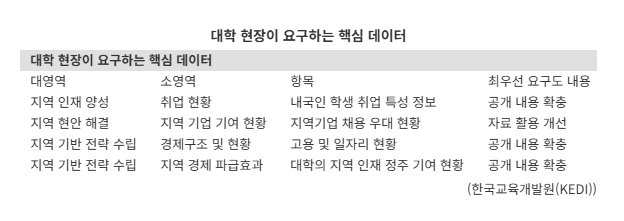
University campuses are clearly articulating the types of data most needed to drive new changes. A survey of key administrators and staff at universities nationwide found that data related to student employment and regional jobs and employment was considered both the most important and the most insufficient.
In particular, a needs analysis comparing importance and sufficiency revealed that the most urgent improvements were required for data directly linked to jobs. The top priorities for improvement in each area included information on employment characteristics of domestic students, preferential hiring status at local companies, and the current status of employment and jobs.
In other words, the data universities seek are not simply outcome indicators like employment rates, but rather detailed data that can capture the processes and connections between education and employment. For instance, there is a need for data that can analyze local job retention rates among graduates, local settlement rates, and the relevance between completed educational programs and actual job placements.
Seungjoo Baek emphasized, "To ensure that university education can make a tangible contribution to addressing local challenges, it is essential to secure concrete and granular data that can connect education and employment."
monarch@fnnews.com Kim Man-gi Reporter