[fn Editorial] Abandoning Nuclear Power Makes It Difficult to Achieve Greenhouse Gas Reduction Goals
- Input
- 2025-11-06 18:24:48
- Updated
- 2025-11-06 18:24:48
Reducing GHG emissions is a responsibility that every country must pursue as global warming accelerates. Under the Paris Agreement adopted in 2015, each nation is required to set its own NDC and submit it to the United Nations. The Paris Agreement established a goal of achieving net-zero GHG emissions by 2050. South Korea is no exception.
China ranks first in GHG emissions, followed by the United States, with South Korea in eleventh place. At the end of last year, the Biden administration announced a 2035 target of reducing emissions by 61–66% compared to 2005 levels. In September, China set a specific goal for the first time to cut emissions by 7–10% from its peak by 2035.
The real issue is whether these targets are achievable. Despite recognizing the importance of GHG reduction, major countries are facing internal conflicts. Former U.S. President Donald Trump declared, 'Climate change is a hoax,' and announced his intention to withdraw from the Paris Agreement. The European Union (EU) recently set an ambitious climate goal of a 90% reduction compared to 1990, but member states are strongly opposed.
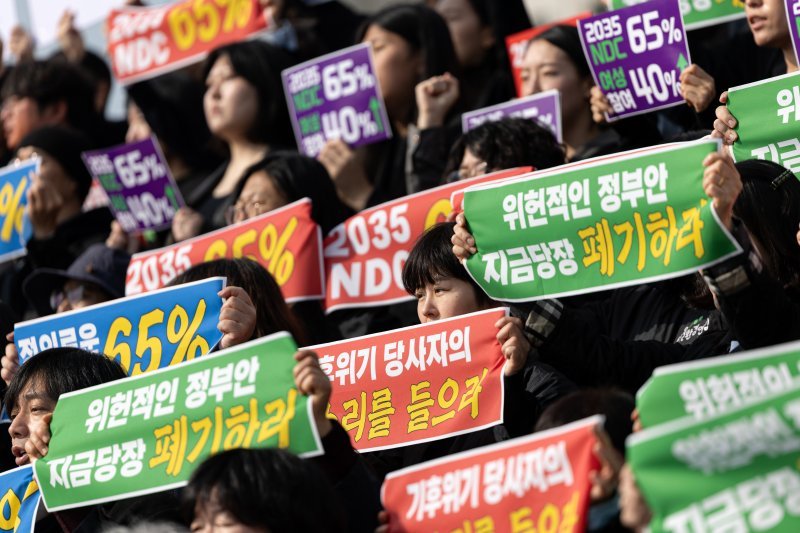
In South Korea, environmental groups insist that a maximum reduction of 65% must be achieved, while businesses argue that even a 50% reduction is difficult to attain. Ultimately, the final target will likely be set somewhere between the two government proposals, but it will be a goal that satisfies neither civil society nor the business sector.
Already struggling with a prolonged economic downturn, companies are voicing concerns about the costs of reducing GHG emissions. To achieve the 50–60% reduction target, the power sector must cut emissions by 68.8–75.3%, transportation by 50.5–62.8%, and industry by 24.3–28.0%. Although the burden on industry is relatively lower, the costs of installing carbon reduction facilities are still significant.
It is expected that the power sector will need to reduce emissions by more than 70%, which remains a challenging goal even with ten years left. The government has announced plans to rapidly increase the share of renewable energy and shut down thermal and coal-fired power plants, but these measures are not without issues.
Renewable energy sources such as solar and wind are less efficient and not well-suited to South Korea’s geographical environment. Previous solar expansion policies ended up harming the environment rather than protecting it. Therefore, the best policy is to increase the share of nuclear power, which is recognized as an eco-friendly, low-carbon energy source, for electricity generation. It is regrettable that the Moon Jae-in government pursued a nuclear phase-out policy and the Lee Jae-myung administration has also shown reluctance to utilize nuclear energy.
If the goal is to achieve carbon neutrality, abandoning nuclear power should not be an option. After shutting down Kori Nuclear Power Plant Unit 1 at the end of its 40-year design life, a decision has yet to be made on extending the operation of Kori Unit 2. In the United States, nuclear plants have had their lifespans extended to 80 years after safety checks. A total of 90 reactors are set to operate for 60–80 years. Giving up nuclear power would make achieving carbon neutrality impossible.