"Is Youth Unemployment Really Low?" The Reason Behind Low Unemployment Rates: 20-Somethings Giving Up on Job Searching
- Input
- 2025-11-06 12:00:00
- Updated
- 2025-11-06 12:00:00
According to an analysis by the Korea Development Institute (KDI), a government-funded research institute, the recent low unemployment rate of around 2% is partly due to young people who have given up looking for work. The unemployment rate is calculated as the number of unemployed people divided by the economically active population. However, those in their 20s classified as 'taking a break' are not counted as unemployed in the statistics. Although many in their 20s may intend to seek jobs in the future and could be considered potential unemployed, they are not included in the official figures. The development of job-matching technologies on online recruitment platforms has also contributed to lowering the unemployment rate.
On the 6th, at Government Complex Sejong, the Korea Development Institute (KDI) released a report titled 'Causes and Implications of the Recent Low Unemployment Rate.' The report attributed the persistently low unemployment rate, despite sluggish economic growth, to two main factors: an increase in 20-somethings classified as 'taking a break,' which indicates giving up on job searching, and improved job-matching efficiency through online platforms. In fact, after remaining stable at the mid-to-high 3% range before the Coronavirus Disease 2019 (COVID-19) crisis, the unemployment rate dropped rapidly in 2021 and has since stayed in the mid-to-high 2% range. The continued low unemployment rate, even as economic growth slows, suggests that there may be structural changes occurring in the labor market.
The unemployed are defined as economically active individuals who have sought work within the past four weeks. In contrast, those who have given up job searching, such as those classified as 'taking a break,' are counted as economically inactive. The economically inactive population includes people engaged in studies, housework, childcare, health issues, or those without a specific reason, who are then classified as 'taking a break.' As the number of people 'taking a break' increases, the number of unemployed decreases and the economically inactive population grows. This dynamic can result in a lower unemployment rate in the statistics, even when the economy is not performing well, because the unemployment rate is the proportion of unemployed among the economically active population.
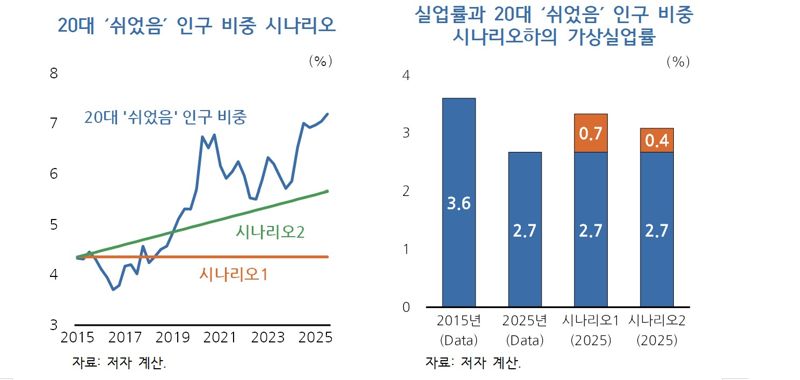
Recently, the number of people classified as 'taking a break' has been rising. In 2005, this group accounted for 3.2% (1.23 million) of the working-age population, but this year it has expanded to 5.6% (2.54 million). Among those in their 20s, the proportion classified as 'taking a break' increased from 3.6% of the working-age population in 2005 to 7.2% this year. While the working-age population in their 20s declined by 17% from 2005 to this year, the number of 20-somethings 'taking a break' grew by 64% during the same period. This indicates a weakening willingness among young people to participate in the labor market.
KDI estimated that if the proportion of 20-somethings 'taking a break' and matching efficiency remained at 2015 levels, the current unemployment rate of 2.7% would be 1.1 percentage points higher, reaching 3.8%. If the share of 20-somethings 'taking a break' stayed at the 2015 level of 4.4%, the unemployment rate would rise by 0.7 percentage points to 3.4%. If matching efficiency had not improved since 2015, the rate would be 0.4 percentage points higher, at 3.1%. These estimates assume that the factors suppressing the unemployment rate—such as the increase in the 'taking a break' population and improved matching efficiency—would be less pronounced if their growth slowed.
Kim Ji-yeon, a research fellow at KDI, stated, "Despite the recent economic slowdown, the continued low unemployment rate reflects both positive aspects, such as improved matching efficiency, and negative aspects, such as a decline in job-seeking intentions among the working-age population. Both factors have consistently exerted downward pressure on the unemployment rate since before the COVID-19 crisis. As the labor market recovered from the COVID-19 crisis, increased labor demand led to a sharp drop in the unemployment rate."
She added, "A low unemployment rate does not necessarily indicate improved employment conditions. The fact that much of the decline in the unemployment rate stems from young people leaving the labor market suggests that more young people are giving up on job searching due to skepticism about the possibility of securing stable jobs. It would be desirable to gradually shift the education system to foster human resources that meet industrial demand, while alleviating the dual labor market structure and securing the capacity to create quality jobs through enhanced corporate productivity."
junjun@fnnews.com Choi Yong-jun Reporter